
Allama Iqbal: the message of selfhood
At the start of the 20th century, Urdu poetry found a voice that left the ghazal gathering to speak to nations and history: Muhammad Iqbal of Sialkot.
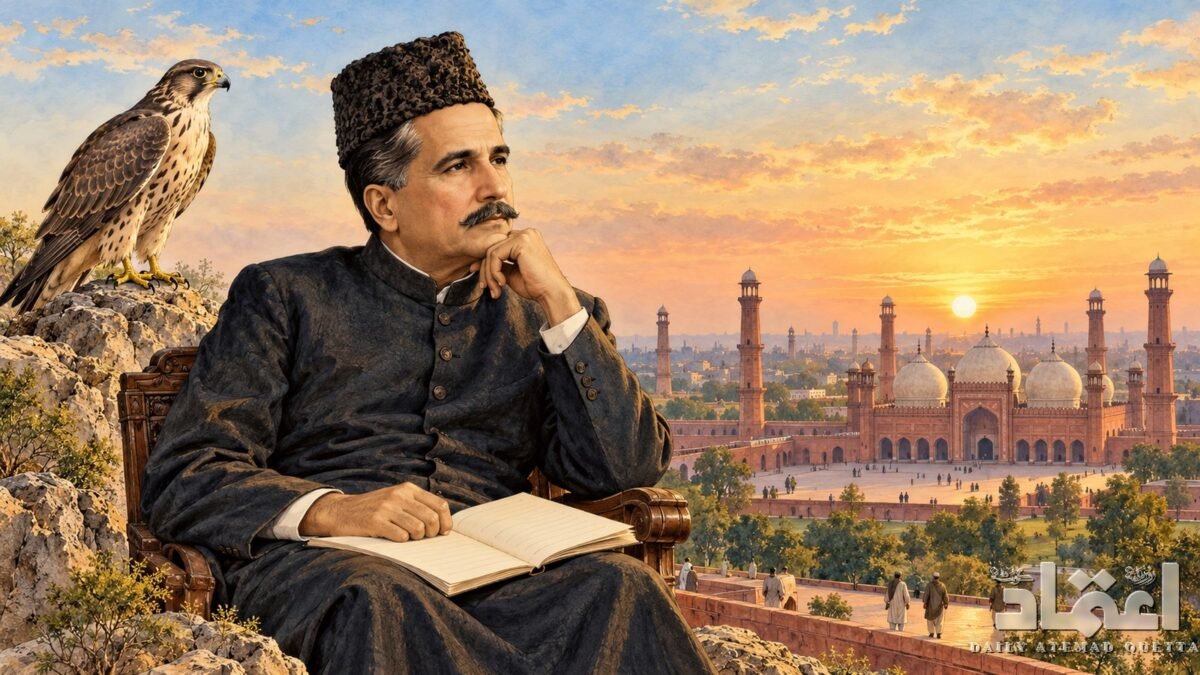
At the start of the 20th century, Urdu poetry found a voice that left the gathering of the ghazal to speak to nations and to history. It was the voice of Muhammad Iqbal, the son of a Kashmiri family of Sialkot. He was a teacher of philosophy and a lawyer, and then became a poet whom the Muslims of the subcontinent call “Shair-e-Mashriq” (Poet of the East) and “Hakeem-ul-Ummat” (Sage of the Ummah). But Iqbal should be understood through his verse, not through slogans:
Beyond the stars there are other worlds stillOther tests of love are yet to come
Life and times
Muhammad Iqbal was born in Sialkot on 9 November 1877. His father, Sheikh Noor Muhammad, was a religious merchant of an ascetic temperament. At the Scotch Mission School and College in Sialkot he found teachers such as Maulvi Syed Mir Hasan, who instilled in him a taste for Arabic and Persian literature. In 1895 he came to Lahore and joined Government College. There, as a student of the orientalist Professor Thomas Arnold, he was drawn towards philosophy. In 1899 he took an MA in philosophy and began teaching at Oriental College and Government College.
In this early Lahore period his poems began to be recited at the meetings of Anjuman-e-Himayat-e-Islam, and his fame spread. “Tarana-e-Hindi” (Saare jahan se achha), written in 1904, dates from this time. In 1905 he went to Europe. He studied philosophy at Cambridge, earned a doctorate from the University of Munich in 1907 on the development of metaphysics in Persia, and in 1908 passed the bar examination at Lincoln’s Inn before returning to Lahore.
After 1908 he took up law as his livelihood and poetry as his message. “Shikwa” (1909) and “Jawab-e-Shikwa” (1913) made him the poet of the Muslims of all India. In 1915 came the Persian masnavi “Asrar-e-Khudi”, which Nicholson translated into English, and his name reached Europe. His first Urdu collection, “Bang-e-Dra”, was published in 1924. In 1922 the government conferred the title of “Sir” on him. From 1926 to 1930 he was a member of the Punjab Legislative Council. In December 1930 he presided over the Muslim League session at Allahabad, whose address is regarded as an important turning point in the political history of the subcontinent.
His last years were spent in illness and constant writing. “Bal-e-Jibreel” (1935) and “Zarb-e-Kaleem” (1936) belong to this period, and “Armaghan-e-Hijaz” was published after his death. He died in Lahore on 21 April 1938 and was buried in the shadow of the Badshahi Mosque.
Style
The central idea of Iqbal’s poetry is “khudi” (selfhood). Man should recognise the power hidden within him, strengthen his self, and work in the world as God’s deputy. The idea recurs again and again in both his Persian and Urdu verse:
Raise your selfhood so high that before every decree of fateGod Himself asks His servant: tell me, what is your wish?
His language has many Persian compounds, but his best couplets are simple and flowing, and that is why they are on every tongue. He has a whole system of symbols: the shaheen (falcon), the tulip, the stars, the desert, the caravan. They carry meaning from one couplet to the next. For him the falcon is a symbol of the young man who flies high, lives alone and does not eat another’s kill:
Your nest is not on the dome of a royal palaceYou are a falcon: make your home among the rocks of the mountains
Iqbal is also a poet of the ghazal, but thought prevails even in his ghazal. He blended Western philosophy, Islamic mysticism and the study of the Quran in his poetry in such a way that his verse seems to be the work not of a poet but of a thinker.
Selected verse
For thousands of years the narcissus weeps over its sightlessnessWith great difficulty one man of vision is born in the garden
Better than the whole world is our HindustanWe are its nightingales, and it is our garden
My longing comes to my lips as a prayerO God, let my life be like a candle
A word that comes from the heart has effectIt has no wings, yet it has the power of flight
Dive into your own heart and find the trace of lifeIf you will not be mine, do not; but at least be your own
Firm faith, ceaseless action, love that conquers the worldThese are the swords of men in the struggle of life
Those warm with faith built the mosque in a single nightMy heart, an old sinner, could not become a worshipper in years
I love those young menWho cast their lasso at the stars
It is good for the guardian of reason to stay with the heartBut sometimes leave it alone as well
By action life becomes heaven and hell alikeThis creature of clay is by nature neither of light nor of fire
One clarification is necessary. The couplet “Do not be afraid of the fury of the opposing wind, O eagleIt blows only to make you fly higher” is very commonly recited as Iqbal’s, but it is not in any of his collections, and it is not correct to call it his. Iqbal’s verse is to be judged by his Kulliyat, not by social media.
Explanation of the couplets
“For thousands of years the narcissus weeps over its sightlessness…” The narcissus flower is shaped like an eye but cannot see. It weeps for thousands of years over its blindness, and only then is one with sight born in the garden. That is, a man of vision is born once in centuries. The couplet is in “Bang-e-Dra”.
“Better than the whole world is our Hindustan…” The first couplet of “Tarana-e-Hindi” (1904), which is still sung on both sides of the border. It dates from the early period when the homeland was Iqbal’s major theme.
“My longing comes to my lips as a prayer…” From “Bachche ki Dua” (A Child’s Prayer), which is recited at morning assembly in millions of schools across the subcontinent. My wish comes to my lips as a prayer that my life may be like a candle, that is, that it may give light to others.
“A word that comes from the heart has effect…” A word that comes from the heart has effect. It has no wings, but it has the power to fly. From a ghazal in “Bang-e-Dra”.
“Dive into your own heart and find the trace of life…” Go within yourself and find the secret of life. If you will not be mine, do not be, but at least be your own. The message of selfhood in the simplest words. From “Bal-e-Jibreel”.
“Firm faith, ceaseless action, love that conquers the world…” Firm faith, constant action and a love that conquers the world: in the struggle of life these three things are man’s swords. From the poem “Tulu-e-Islam” in “Bang-e-Dra”.
“Those warm with faith built the mosque in a single night…” Those with fervent faith built a mosque in one night, but my heart is an old sinner and could not become a worshipper in years. Here Iqbal mocks himself and outward piety at the same time. From “Bang-e-Dra”.
“I love those young men…” I love the young men who cast their lasso at the stars, that is, who have the courage to make the impossible possible. From “Bal-e-Jibreel”.
“It is good for the guardian of reason to stay with the heart…” It is good that reason watches over the heart, but sometimes the heart should be left alone. This balance Iqbal strikes between reason and love is in a ghazal in “Bang-e-Dra”.
“By action life becomes heaven and hell alike…” By his action, a man’s life can become heaven or hell. This creature of clay is by nature neither an angel nor a devil. From “Bang-e-Dra”.
Influence and legacy
Iqbal’s influence went beyond Urdu poetry to the politics and thought of the subcontinent. In Pakistan he has been given the status of national poet. Iqbal Academy was founded in his name and publishes scholarly editions of his work and research on him. His mausoleum, in front of the courtyard of the Badshahi Mosque in Lahore, is a national monument. His Persian poetry is read in Iran, Turkey and Central Asia, and his verse has been translated into several European languages.
In literary terms, Iqbal gave Urdu poetry the weight of thought that Hali had begun, and made even the ghazal a vehicle of philosophy. After him, the whole tradition of national and intellectual poetry in Urdu grew in his shadow.
To readers: Which couplet of Iqbal came back to you at a turning point in your life? Write to us. Selected couplets will be published with your name.
Next Friday: Hasrat Mohani, poet of the ghazal and soldier of freedom.
Sources
- Rekhta, Allama Iqbal: poetry and introduction. https://www.rekhta.org/poets/allama-iqbal?lang=ur
- Iqbal Academy Pakistan, Lahore: chronology of Iqbal’s life and Kulliyat-e-Iqbal (Urdu). https://www.allamaiqbal.com/
- Allama Iqbal Urdu Cyber Library (text of the Kulliyat, cited by book and poem). https://www.iqbalcyberlibrary.net/
- Annemarie Schimmel, Gabriel's Wing: A Study into the Religious Ideas of Sir Muhammad Iqbal, E. J. Brill, Leiden, 1963 (reprinted Iqbal Academy Pakistan, Lahore).
- Iqbal Singh Sevea, The Political Philosophy of Muhammad Iqbal: Islam and Nationalism in Late Colonial India, Cambridge University Press, 2012.
- Javid Iqbal, Zinda Rood (biography of Iqbal, three volumes), Sheikh Ghulam Ali and Sons, Lahore, 1979–1984.
- Muhammad Sadiq, A History of Urdu Literature, 2nd edition, Oxford University Press, Delhi, 1984 (chapter on Iqbal).
 More from E-Magazine
More → Aamer Sohail: the aggressive left-handed opener
 Abd al-Malik ibn Marwan: Arabic offices, new coins and the octagonal domed shrine
 Abd al-Rahman I: the emir who founded Cordoba's Great Mosque
 Abdul Hafeez Kardar: Pakistan cricket's first captain
 Abdul Razzaq: the all-rounder who either blocked or hit
 Abel Tasman: the Dutch voyage that found Tasmania and New Zealand
 Afanasy Nikitin: the Russian merchant who travelled to India
 Ahmad ibn Majid: master navigator of the Indian Ocean