
Abdul Hafeez Kardar: Pakistan cricket’s first captain
Kardar led Pakistan in their first Test in 1952 and captained the side in its first 23 Tests, winning six of them.
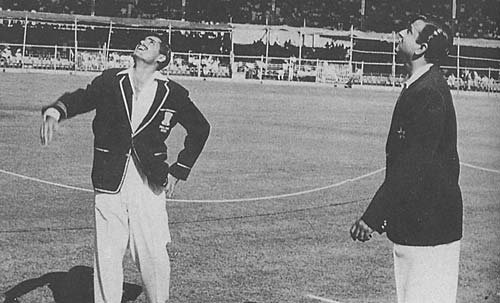
When Pakistan entered Test cricket in 1952, the new side was led by Abdul Hafeez Kardar. He captained Pakistan in their first 23 Tests and won six of them. According to Wisden, he can be regarded as the “patriarch” of Pakistani cricket, and under his leadership the new team earned respect rather than sympathy2. Kardar is one of the few players to have played Test cricket for two countries: first India and then Pakistan1.
Early life and start in cricket
Abdul Hafeez Kardar was born in Lahore on 17 January 1925. Until 1947 he played as Abdul Hafeez only. He later added the family name Kardar to his name. His first-class career began in the 1943-44 season. He represented several sides, including Northern India, Oxford University and the English county Warwickshire2.
His Test career began on 22 June 1946 at Lord’s, when he played for India against England. Batting at number eight in his first Test innings, he scored 43 runs. On that tour he played three Tests for India and scored 80 runs1.
After the tour he stayed on in England and studied at Oxford. According to Wisden, during his years at Oxford and Warwickshire he learnt the skills of leadership from captains such as Martin Donnelly and Tom Dollery. His two seasons with Warwickshire were quite successful2. This experience later helped him as captain of Pakistan.
Style of play
Kardar batted left-handed and bowled left-handed. Wisden described his batting as fearless and unique. His usual response was to advance down the wicket to the very first ball and send it straight back over the bowler’s head. On his bowling, Wisden writes that on a good wicket he was economical, and on a poor wicket he was extremely dangerous2.
The figures bear this out. His economy rate in Test cricket was 2.11, and in nine Tests played on Pakistani pitches it was only 1.25. In 1955, in three Tests against New Zealand, he took 10 wickets at an average of 15.1. In the same series his best match bowling was five wickets for 73 runs1.
Captaincy of Pakistan
Kardar was captain in Pakistan’s first Test match, against India in 19522. On the same tour, on 28 November 1952 in Chennai (Madras), he scored 79. When India toured Pakistan in 1955, he scored 93 in the second innings of the Test that began in Karachi on 26 February. It is the highest score of his Test career1.
In October 1956, in the one-off Test against Australia in Karachi, he played an innings of 69, and Pakistan won the match. On the 1958 tour of the West Indies he scored 253 runs in five Tests at an average of 31.62. These included innings of 57 in Kingston and 56 in Georgetown. His last Test was against the West Indies in Port of Spain on 26 March 1958, in which he scored 441.
According to Wisden, during his captaincy of 23 matches Pakistan beat every Test side of the time except South Africa, whom Pakistan did not play2. For a new team that had begun Test cricket only a few years earlier, this was a major achievement. As captain he scored 847 runs at an average of 24.91 and took 21 wickets1.
Statistics
| Tests | |
|---|---|
| Matches | 26 |
| Runs | 927 |
| Best score | 93 |
| Average (batting) | 23.76 |
| Hundreds / fifties | 0 / 5 |
| Wickets | 21 |
| Best bowling | 3/35 |
| Average (bowling) | 45.42 |
| Five wickets in an innings | 0 |
| Matches as captain | 23 |
Source: ESPNcricinfo Statsguru1. The figures are for his international career. They include the three Tests he played for India.
Influence and legacy
Even after leaving the game, Kardar stayed connected with Pakistan cricket. He was chief selector and, from 1972 to 1977, president of the Pakistan Cricket Board of Control. According to Wisden, he put the administration of Pakistani cricket on modern lines. He spoke of doing away with unwieldy committees and of the spread of cricket in Asia, and he was among the early supporters of neutral umpires. Wisden also writes that he was quick to take offence at criticism. At the same time it describes him as a far-sighted administrator, many of whose suggestions were later generally accepted2.
Abdul Hafeez Kardar died in Islamabad on 21 April 19962. The confidence seen in the early years of Pakistan’s Test cricket was laid largely by his leadership. His greatest achievement was shaping the first generation of Pakistan’s Test players into a team. The first chapter in the history of Pakistan cricket begins with his name.
Sources
- ESPNcricinfo Statsguru, Abdul Hafeez Kardar, Test batting and bowling career summaries and innings lists: https://stats.espncricinfo.com/ci/engine/player/41030.html?class=1;template=results;type=batting , https://stats.espncricinfo.com/ci/engine/player/41030.html?class=1;template=results;type=batting;view=innings , https://stats.espncricinfo.com/ci/engine/player/41030.html?class=1;template=results;type=bowling , https://stats.espncricinfo.com/ci/engine/player/41030.html?class=1;template=results;type=bowling;view=innings
- ESPNcricinfo player profile, Abdul Hafeez Kardar (archived copy; profile essay from Wisden Cricketers' Almanack obituary): https://web.archive.org/web/2016/http://www.espncricinfo.com/ci/content/player/41030.html
 More from E-Magazine
More → Abdul Razzaq: the all-rounder who either blocked or hit
 Abel Tasman: the Dutch voyage that found Tasmania and New Zealand
 Afanasy Nikitin: the Russian merchant who travelled to India
 Ahmad ibn Majid: master navigator of the Indian Ocean
 Ahmad ibn Tulun: the administrator who built Cairo's red-brick mosque
 Al-Mansur, the Abbasid caliph who built Baghdad's Round City
 Al-Razi and how he told smallpox from measles
 Al-Walid I: the caliph who built Damascus's Great Mosque and the city of Anjar