
Akbar Allahabadi: the poet who made India laugh and think
Akbar Allahabadi, Urdu's greatest satirical poet, mocked the new culture of colonial India while serving as a judge under British rule.
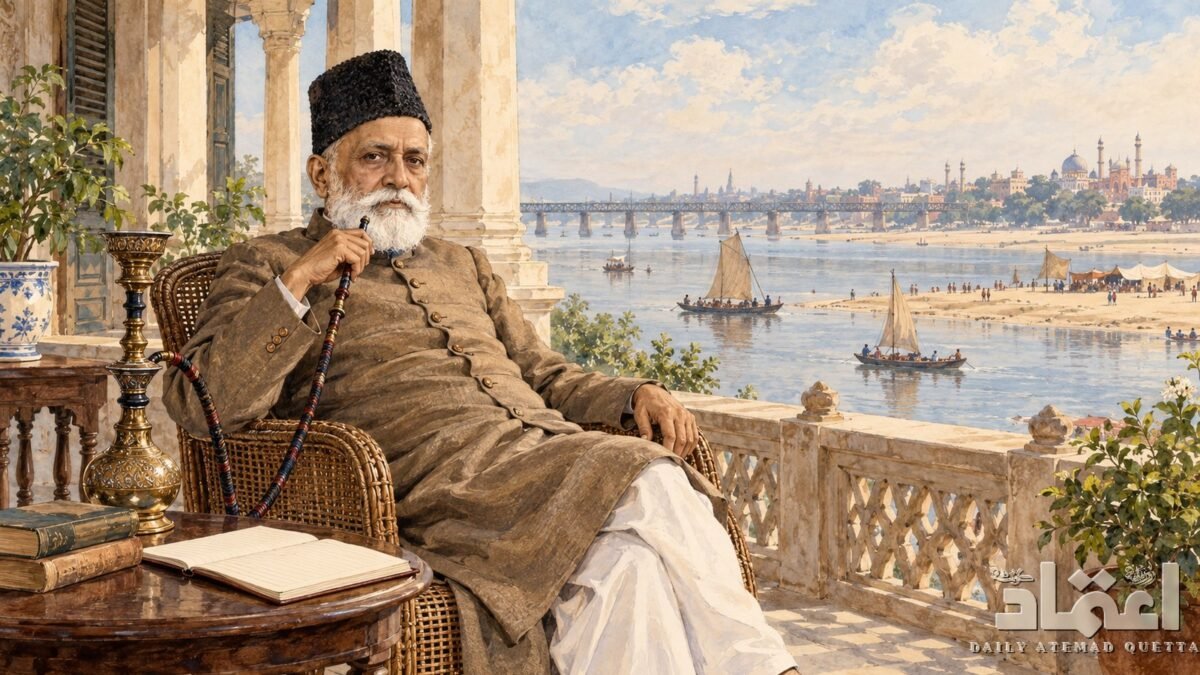
India was changing in the late nineteenth century. Railways, the telegraph, colleges, coats and trousers, the English language and new politics were all arriving together. Educated Muslims were divided on them. Sir Syed and Hali thought the new education necessary. But in Allahabad sat a judge who was himself an officer of the British government and a product of its college and courts. Yet he mocked the new culture so sharply that people laughed and then fell to thinking. This was Akbar Allahabadi, the greatest humorous poet of Urdu, whose verses are still quoted freely in speeches and columns:
We are slandered even when we sighThey commit murder and there is no outcry
Life and times
Syed Akbar Hussain was born on 16 November 1846 in Bara, a town near Allahabad. His father, Syed Tafazzul Hussain, held a minor post and the family was poor. He was taught Arabic and Persian at home. He then learned English on his own and, while still young, took a job in the railway department. The job did not end his studies. He passed the law examination, practised as a lawyer and was appointed a munsif in 1880.
Akbar’s official career was a success. He became a sessions judge in 1894 and received the title of Khan Bahadur in 1898. In 1903 he retired on a pension and settled quietly in Allahabad. This was when his poetry reached its peak. As a judge he could not take part openly in politics, and perhaps that constraint sharpened his satire. He knew how British rule worked, and that knowledge is the base of his humour.
In his years after retirement he watched India’s new politics closely. In his last years, when Gandhi’s Non-Cooperation Movement began, he wrote poems under the title “Gandhi Nama”, which show both the old poet’s interest in the movement and his comment on it. His eyesight had weakened and his health was failing. He died in Allahabad on 9 September 1921. His Kulliyat was published in three volumes during and after his lifetime, and writers such as Abdul Majid Daryabadi wrote about his personality and thought in detail.
Style
Akbar’s poetry is usually called “zarafat” (wit), but his wit is not mere joking. He freely brings English and everyday words into his verse, such as “college”, “leader”, “Mister”, “pension” and “hotel”. He then makes these words do what serious poetry cannot:
We think all such books deserve to be bannedWhich make sons read them and think their fathers mad
His other weapon is his informal tone. He speaks in verse as if chatting over tea, but the remark carries a thorn that pricks the reader later. He was not against the new culture. He was against imitating it. And he laughed as much at those who held religion on contract as at the new gentlemen of the college:
I never argued about religionI never had any spare wit to waste
A part of his work is serious ghazal with a Sufi colour, in which the weariness of an elder and his detachment from the world show through. This vein is read less often, but it is necessary for understanding Akbar the man.
Selected verses
Why this uproar over a little drink?I have not robbed anyone, nor have I stolen
I am in the world but not a seeker of the worldI have passed through the market but am no buyer
Yesterday several ladies appeared unveiledAkbar sank into the earth with national shameI asked them what had become of their veilThey said it has fallen on the men’s wits
Rivals have gone to the police station to file a reportThat Akbar takes God’s name in these times
So civilised we became that we never saw homeA life in hotels, and death in a hospital
Friends, what great feat can we claim?Took a BA, got a job, drew a pension, and died
He would not have been disgraced by killing the childrenAlas, Pharaoh never thought of a college
Let the sheikh go to the Kaaba, we shall see EnglandHe will see God’s house, we will see God’s glory
Ask God for whatever you wish to ask, AkbarThis is the one door where asking brings no disgrace
Explanation of the verses
“Why this uproar over a little drink…” Why such noise over a little drink? I have not committed robbery or theft. The satire is that society raises a clamour over a small vice and shuts its eyes to a big one.
“I am in the world but not a seeker of the world…” I live in the world but do not seek it. I pass through the market but am not a buyer. An example of Akbar’s serious, Sufi vein.
“Yesterday several ladies appeared unveiled…” When several women appeared unveiled, Akbar sank into the ground with shame. Asked what had become of their veil, they said it had fallen on the men’s wits. The last line turns the whole satire on the poet himself and men who think like him.
“Rivals have gone to the police station to file a report…” His enemies have reported to the police that Akbar still takes God’s name in these times. That is, in the new age, taking God’s name is an offence that can be reported.
“So civilised we became that we never saw home…” We became so “civilised” that we never saw our homes. Life was spent in hotels and death came in hospital. Akbar’s best-known comment on the new culture.
“Friends, what great feat can we claim…” What did our friends achieve? They took a BA, worked, drew a pension and died. The whole picture of life produced by the new education, in one verse.
“He would not have been disgraced by killing the children…” Had Pharaoh opened a college instead of killing children, he would not have been disgraced and his aim would have been met. For Akbar, the new education changes minds so that a nation is cut off from itself. This is his harshest verse and so it drew the most debate.
“Let the sheikh go to the Kaaba, we shall see England…” Let the sheikh go to the Kaaba, we will go to England. He will see God’s house, we will see God’s glory, meaning the progress of the English. The satire is in the voice of the new gentlemen.
“Ask God for whatever you wish to ask, Akbar…” Akbar, ask God for whatever you want to ask. This is the one door where there is no disgrace after asking. Akbar’s serious, prayerful vein.
Influence and legacy
Akbar showed Urdu poetry a path that a whole generation of humorous poets later followed, but none reached his height. His verses became proverbs. “Took a BA, got a job, drew a pension, and died” is still repeated wherever education and jobs are discussed. The targets of his satire are recognised even today, because imitation and show are a disease of every age.
He was also criticised as an enemy of progress, and his differences with Sir Syed’s circle kept that debate alive. But Abdul Majid Daryabadi and later critics showed that Akbar’s problem was not progress but thoughtless imitation and aversion to one’s own culture. His letters and serious verse show a man who stood between the new and old worlds and saw both clearly.
To readers: Which of Akbar’s verses makes you laugh most, or makes you think most? Write to us. Selected verses will be published with your name.
Next Friday: Allama Iqbal, who made poetry a message of selfhood and awakening.
Sources
- Rekhta, Akbar Allahabadi: poetry and introduction. https://www.rekhta.org/poets/akbar-allahabadi?lang=ur
- Kulliyat-e-Akbar Allahabadi (three volumes), Allahabad; new edition: Maktaba Jamia, New Delhi.
- Abdul Majid Daryabadi, Payam-e-Akbar (essay), available on Rekhta. https://www.rekhta.org/articles/payam-e-akbar-abdul-majid-daryabadi-articles?lang=ur
- Ram Babu Saksena, A History of Urdu Literature, Ram Narain Lal, Allahabad, 1927 (section on Akbar).
- Muhammad Sadiq, A History of Urdu Literature, 2nd edition, Oxford University Press, Delhi, 1984 (chapter on Akbar Allahabadi).
- Shamsur Rahman Faruqi, "Akbar Ilahabadi", in Encyclopaedia Iranica (online edition). https://www.iranicaonline.org/articles/akbar-elahabadi
 More from E-Magazine
More → Aamer Sohail: the aggressive left-handed opener
 Abd al-Malik ibn Marwan: Arabic offices, new coins and the octagonal domed shrine
 Abd al-Rahman I: the emir who founded Cordoba's Great Mosque
 Abdul Hafeez Kardar: Pakistan cricket's first captain
 Abdul Razzaq: the all-rounder who either blocked or hit
 Abel Tasman: the Dutch voyage that found Tasmania and New Zealand
 Afanasy Nikitin: the Russian merchant who travelled to India
 Ahmad ibn Majid: master navigator of the Indian Ocean