
Sindh signs MoU with Huawei to build Pakistan’s first AI-based digital province
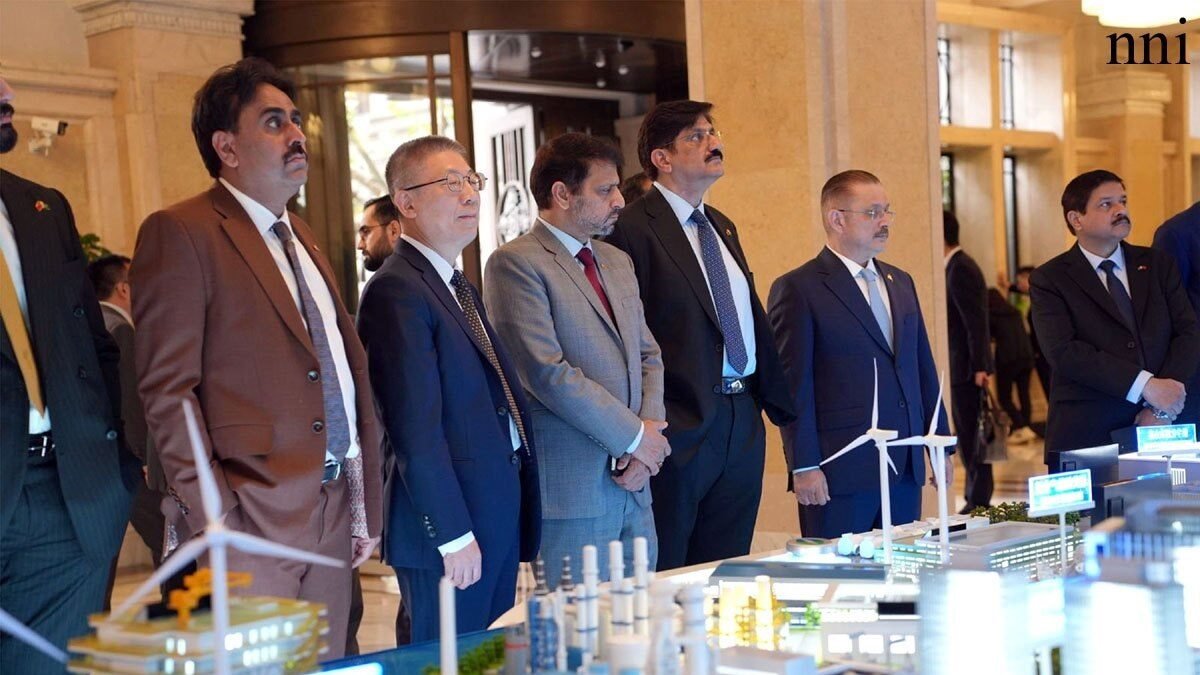
SHANGHAI: The Sindh government has signed an important memorandum of understanding with the global technology company Huawei. It aims to set up Pakistan’s first digital province based on artificial intelligence.
The agreement was finalised during a high-level visit by Sindh Chief Minister Syed Murad Ali Shah to Huawei’s Lianqiu Lake Research and Development Centre in Shanghai. Under it, the Sindh government’s strategy will move beyond the mere purchase of technology towards a deeper, joint partnership.
The agreement covers the complete digitalisation of e-governance, provincial cloud and data centre infrastructure, smart city solutions and large-scale information and communication technology training for the youth of Sindh. A framework for broad cooperation has also been agreed in the fields of artificial intelligence, cloud computing, smart cities, digital government and AI-based smart parks.
The MoU was signed by the Chief Minister’s Special Assistant for Investment, Syed Qasim Naveed Qamar. Murad Ali Shah and Huawei Pakistan Chairman Ethan Sun were also present on the occasion.
Chief Minister’s address
Addressing the signing ceremony, Murad Ali Shah said this was an important shift from buying technology to developing it together through joint projects, local capabilities and the skills of the province’s youth. He said the Sindh government would provide cooperation at the highest level to ensure tangible results for citizens.
Praising Huawei’s research capabilities, he said the company spends more than a fifth of its revenue on continuous research and development, which has earned it a place among the world’s leading technology companies.
Huawei began operations in Shenzhen in 1987 as a private company wholly owned by its employees. In 2025, the company reported revenue of 880.9 billion Chinese yuan and a net profit of 68 billion Chinese yuan.
In 2025 alone, the company spent 192.3 billion Chinese yuan on research and development, which is 21.8 per cent of its revenue. Over the past decade, it has spent more than 1.38 trillion Chinese yuan on research in total.
Huawei in Pakistan is led by Chief Executive Officer Ethan Sun, and the company is playing an important role in promoting information and communication technology capabilities in the country. This includes a major initiative with the Special Investment Facilitation Council, under which 300,000 Pakistani youths will be trained. In September 2026, Pakistan’s first national-level telecom equipment repair centre was also inaugurated in Islamabad.
Murad Ali Shah also thanked Huawei for arranging an earlier visit to its global model site in Wuhan, and said the visit had left a deep impression on the provincial leadership.
Lianqiu Lake centre
The signing ceremony was held at the Lianqiu Lake Research and Development Centre, which was formally inaugurated in 2024 in Jinze Town, Qingpu District, in western Shanghai. The campus spreads over about 2,400 mu, or roughly 160 hectares, and has a total built-up area of 2.06 million square metres.
More than 10 billion Chinese yuan, or about $1.4 billion, has been invested in the project. The centre is designed for 30,000 to 35,000 researchers and engineers. Its eight zones are connected by an internal light rail system known as the Red Train.
The centre focuses on new developments in semiconductor design, 5G and 6G wireless technology, intelligent automotive solutions and digital energy.
Citing Wuhan, where modern technology helps city administrators quickly identify urban problems and prevent crises before they worsen, Murad Ali Shah stressed that Karachi, a city of more than 20 million people, also urgently needs such capabilities. He said the Sindh government was committed to making Sindh Pakistan’s leading digital province, with smart, data-driven governance in Karachi and other cities and a youth workforce fully prepared for the digital economy.
Four priorities for the first year
The Chief Minister presented four concrete priorities for the first year of the partnership.
The first is to set up a pilot digital platform in Karachi for urban management and flood early warning, drawing on the experience of Wuhan’s smart city model.
The second is to prepare a roadmap for setting up a Sindh government cloud and data centre, including effective disaster recovery, cyber security and AI computing infrastructure.
The third is to establish an innovation and training centre in Karachi Education City, with a research and development facility and an AI-based smart park.
The fourth was to arrange information and communication technology training and certification for students in Sindh, in close cooperation with the province’s universities.
The Chief Minister also proposed setting up a joint working group of focal persons nominated by both sides, so that progress under the mutually agreed first-year plan could be ensured on time.
For Sindh, the main aim of the agreement is to move beyond the mere purchase of technology and build an active technical partnership, including joint pilot projects, capacity building and knowledge transfer. This also includes securing Huawei’s support for setting up an innovation centre and an AI-based smart park in Karachi Education City, putting technical cooperation on government cloud systems, data centres and cyber security into practice, and equipping local youth with certified information and communication technology skills that meet industry standards.
Concluding the ceremony with a clear measure of success, Murad Ali Shah said: “Let us judge the success of this agreement not by the signatures on this document but by the services provided to our citizens and the opportunities created for our youth.”
Thanking Huawei for its hospitality and its trust in Sindh, he formally invited the company’s team to visit Karachi, so that a lasting partnership could be strengthened further.
More from Technology

OpenAI plans humanoid robots; building robot’s brain biggest challenge, says Sam Altman

SECP sets up Security Operations Centre for cyber security, inaugurated by NADRA chairman

China-funded $12.9m geodetic survey system: duty exemption on ninth batch of equipment under consideration

Foodpanda introduces telematics-based safety system for delivery riders

China claims first satellite internet link across Arctic, Antarctica and Qinghai-Tibet Plateau

Elon Musk says he will give every US child a share of SpaceX

Scientists find green star that changes colour, Warwick University study says

Moon shrinking, over 10,000 new cracks found on surface, study warns of moonquakes

Japan set to launch mission to bring back samples from Mars moon Phobos

Elon Musk predicts Tesla Roadster could fly over Grand Canyon or Snake River

TikTok permanently suspends advertising account for Elon Musk documentary
