
Mir Taqi Mir: the Khuda-e-Sukhan of Urdu ghazal
Mir Taqi Mir's life in Agra, Delhi and Lucknow, his style, selected couplets and their meaning, and his place in Urdu ghazal.
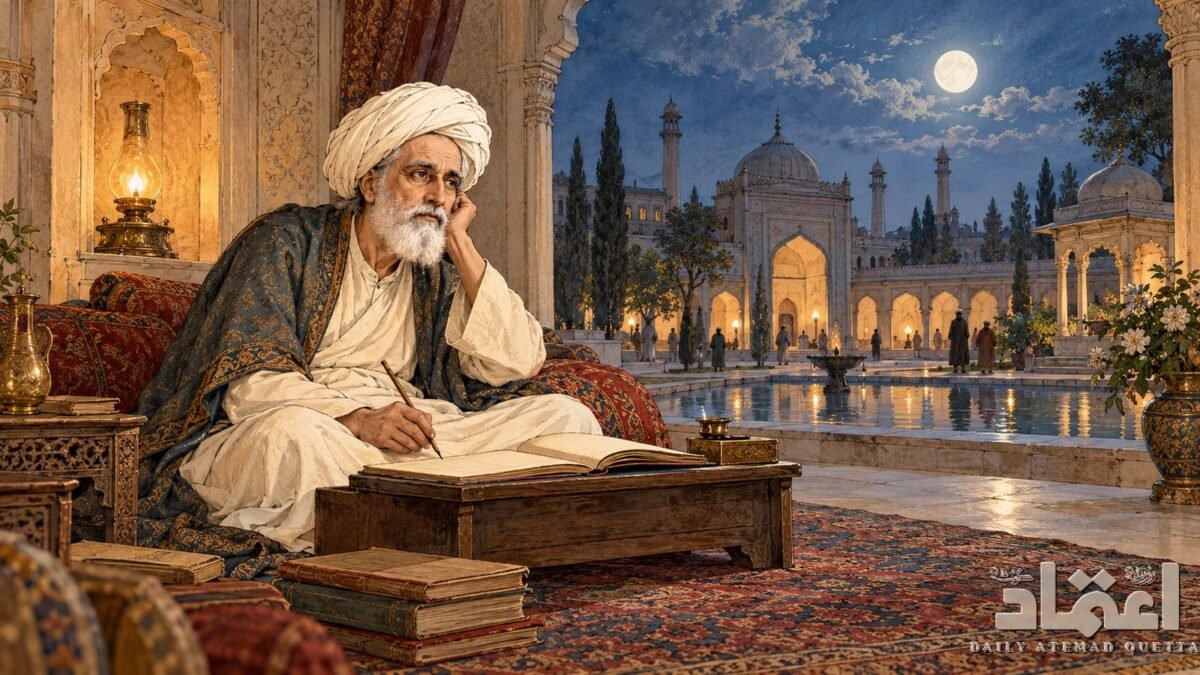
Delhi in the eighteenth century was a strange city. The Mughal emperors sat on the throne, but power had slipped from their hands. The armies of Nadir Shah and Ahmad Shah Abdali came, the city was plundered and neighbourhoods were burnt. A few years later, people would return and try to resettle the same streets. In this city, which was repeatedly ruined and resettled, Urdu ghazal found a voice that no one has been able to forget since. It was the voice of Mir Taqi Mir, whom his contemporaries and later poets called "Khuda-e-Sukhan" (the god of poetry). Even Ghalib, who did not easily accept anyone as a master, said of Mir:
You are not the only master of Rekhta, GhalibThey say that in the past there was also someone called Mir
Life and times
Mir Muhammad Taqi, pen name Mir, was born around 1723 in Akbarabad, that is Agra. His father, Mir Muhammad Ali, was a man of a dervish temperament. Mir speaks warmly of his teachings in his Persian autobiography, "Zikr-e-Mir". After his father’s death, nothing was left for the young Mir in Agra and he came to Delhi, where he found the patronage of the noble Samsam-ud-Daula. In 1739, Samsam-ud-Daula was killed in Nadir Shah’s invasion, and Mir lost this support too.
In Delhi, Mir was associated with the household of Siraj-ud-Din Ali Khan Arzu, a leading scholar and poet of the time. He received his scholarly training there, but bitterness in family relations left a deep mark on his temperament. In "Zikr-e-Mir", he himself describes a period of mental illness and madness that he went through in his youth. He saw Delhi plundered again and again. He saw his home and neighbourhood ruined in the invasions of 1748, 1757 and the 1760s. This experience remains in his verses as a lasting pain.
In 1782, when it was no longer possible to live in Delhi, Mir went to Lucknow at the invitation of Nawab Asaf-ud-Daula of Awadh. A stipend was fixed for him there, and he spent the rest of his life, about 28 years, in Lucknow. But the colourful gatherings of Lucknow, with their new wealth, never felt like his own. He remained a man of Delhi even there. Several anecdotes of his barbs at the speech and manners of the people of Lucknow are preserved in the biographical anthologies. Mir died in Lucknow on 20 September 1810.
Mir’s poetry comprises six divans, which have been published as "Kulliyat-e-Mir". Besides ghazals, he wrote masnavis, of which "Muamlat-e-Ishq" and "Khwab-o-Khayal" are prominent. He wrote in Persian the first biographical anthology of Urdu poets, "Nikat-ush-Shuara", from which we learn much about the early history of Urdu poetry. "Zikr-e-Mir" is an account of his own life and times and is counted among the earliest autobiographies in Urdu literature.
Style
Mir’s poetry is known for its simplicity, but this simplicity is not superficial. In short metres and in words close to everyday speech, he says things that sink into the reader’s heart and stay there for a long time:
Look, does this rise from the heart or from the soulThis smoke, where is it rising from
In his poetry, pain is not a personal complaint but the name of a reality of life. Love, mortality, loneliness and the ruin of the city are his major themes. But Mir is not only a poet of grief. He also has playfulness and biting satire, and such a depiction of beauty that a single petal becomes a whole face:
What can one say of the delicacy of her lipsThey are like a petal of a rose
In his four-volume book "Sher-e-Shor Angez", Shamsur Rahman Faruqi has shown that Mir’s apparently simple verses hold several layers of meaning. He has also shown that Mir was not only a poet of "ah" (the sigh) but a great craftsman of language.
Selected verse
Every leaf and every plant knows my conditionWhether or not the flower knows, the whole garden knows
Our existence is like a bubbleThis display is like a mirage
When do tears not come to my eyesBlood comes when they do not
Since evening I remain somewhat dimmedMy heart has become the lamp of a pauper
Mir, in those half-open eyesAll the intoxication is like that of wine
Death is a pause for wearinessThat is, we will go on further after catching our breath
Breathe gently, for the work is very delicateIn this glassmaker’s workshop of the world
Why do you weep on the long road of loveWait and see what happens further on
Delhi, which was a city chosen from among the world’sWhere the chosen ones of the age livedThe heavens plundered it and laid it wasteWe are the people of that same ruined land
Speak softly at Mir’s bedsideHe has only just fallen asleep, weeping
Whether it was we, you or MirAll became captives of her tresses
Explanation of the couplets
«Every leaf and every plant knows my condition…» Every leaf and every plant in the garden knows the state of my love. Only that one flower, the beloved, pretends not to know, or perhaps truly does not know.
«Our existence is like a bubble…» Our life is like a bubble of water that ends in a moment. The glitter of the world is like the illusion of water in a desert.
«When do tears not come to my eyes…» Tears are in the eyes at all times. When tears do not come, blood is coming from the eyes. That is, there is no break in sorrow.
«Since evening I remain somewhat dimmed…» As soon as evening comes, I become sad, like a poor man’s lamp with little oil that begins to flicker from the evening.
«Mir, in those half-open eyes…» In the beloved’s half-open eyes there is the same intoxication that wine has. This description of eyes is among the most famous lines in Urdu ghazal.
«Death is a pause for weariness…» Death is a pause for tiredness, not the end of the journey. We will catch our breath and go on. Looking at death with such simplicity is Mir’s work alone.
«Breathe gently, for the work is very delicate…» This world is as fragile as a glass factory. Breathe carefully here, lest something break.
«Why do you weep on the long road of love…» The road of love is long. Why are you weeping already? Wait and see what happens further on. This couplet is commonly recited in the form "Ibtida-e-ishq hai rota hai kya".
«Delhi, which was a city chosen from among the world’s…» It is said that Mir composed these verses at a gathering in Lucknow when people asked him where he came from. This lament for the ruin of Delhi is repeated to this day.
«Speak softly at Mir’s bedside…» Speak in a low voice at Mir’s bedside. He has only just fallen asleep, weeping. The poet sees himself as a third person, and that is the brilliance of this couplet.
«Whether it was we, you or Mir…» Whether it is I, you or Mir, all are prisoners of her tresses. Later poets widely adopted this way of saying something in a short metre.
Influence and legacy
In the history of Urdu ghazal, Mir is a milestone after whom every poet had to settle his own relationship with him. Ghalib, as mentioned above, accepted him as a master of an earlier age. Twentieth-century poets such as Nasir Kazmi took the tradition of the short metre and plain tone from Mir himself. In Urdu criticism, "Mir’s simplicity" is a chapter of its own.
Today Mir’s work is available in fluent translations and several scholarly editions. His complete Kulliyat is on the Rekhta website. Two hundred years later, this poet, who witnessed the destruction of his age, is the dearest poet to readers of Urdu.
To readers: Which of Mir’s couplets is closest to your heart? Write and send it to us. Selected couplets will be published with your name on next Friday’s page.
Next Friday: Mirza Ghalib, who after Mir gave Urdu ghazal a new height of thought.
Sources
- Rekhta, Mir Taqi Mir: poetry and introduction. https://www.rekhta.org/poets/meer-taqi-meer?lang=ur
- Mir Taqi Mir, Zikr-i Mir: The Autobiography of the Eighteenth Century Mughal Poet, translated and annotated by C. M. Naim, Oxford University Press, Delhi, 1999.
- Shamsur Rahman Faruqi, Sher-e-Shor Angez (four volumes), National Council for Promotion of Urdu Language, New Delhi, 1990–1994.
- Muhammad Husain Azad, Ab-e-Hayat, Lahore, 1880 (new edition: Āb-e Ḥayāt: Shaping the Canon of Urdu Poetry, trans. Frances Pritchett and S. R. Faruqi, Oxford University Press, 2001). https://www.columbia.edu/itc/mealac/pritchett/00fwp/published/txt_ab_e_hayat/index.html
- Frances W. Pritchett, A Garden of Kashmir: The Ghazals of Mir Taqi Mir, Columbia University (online commentary on selected ghazals). https://www.columbia.edu/itc/mealac/pritchett/00garden/
- Ram Babu Saksena, A History of Urdu Literature, Ram Narain Lal, Allahabad, 1927 (chapter on Mir).
- Muhammad Sadiq, A History of Urdu Literature, 2nd edition, Oxford University Press, Delhi, 1984.
 More from E-Magazine
More → Aamer Sohail: the aggressive left-handed opener
 Abd al-Malik ibn Marwan: Arabic offices, new coins and the octagonal domed shrine
 Abd al-Rahman I: the emir who founded Cordoba's Great Mosque
 Abdul Hafeez Kardar: Pakistan cricket's first captain
 Abdul Razzaq: the all-rounder who either blocked or hit
 Abel Tasman: the Dutch voyage that found Tasmania and New Zealand
 Afanasy Nikitin: the Russian merchant who travelled to India
 Ahmad ibn Majid: master navigator of the Indian Ocean