
Wali Dakni: the first great name of the Urdu ghazal
The story of the Urdu ghazal begins in the Deccan, not in Delhi or Lucknow, and Wali Muhammad Wali carried it north.
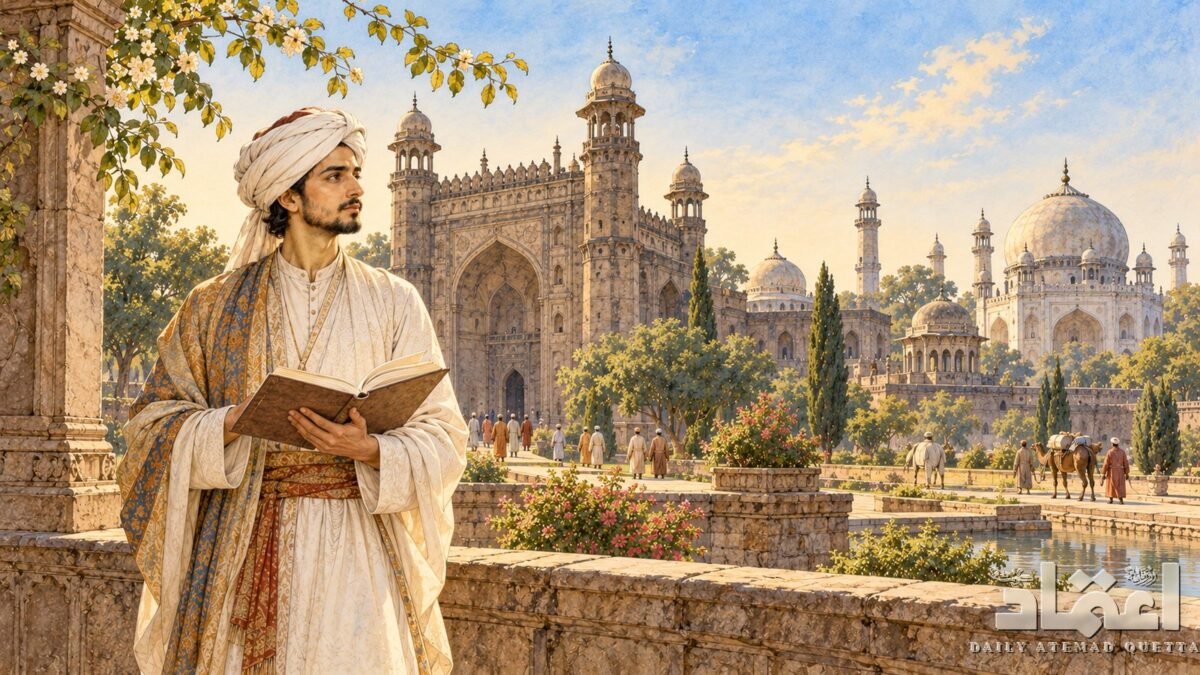
The story of the Urdu ghazal begins not in Delhi or Lucknow but in the Deccan. Until the late 17th century, poets in northern India wrote in Persian. Urdu, then called Rekhta or Hindi, was seen as a language for amusement. In the Deccan, things were different. The courts of Golconda and Bijapur had been listening to poetry in this language for years. The poet who refined this Deccani tradition, carried it to the north and gave the poets of Delhi the courage to write in their own language was Wali Muhammad Wali. He is also called Wali Dakni and Wali Aurangabadi. Of his own art he says:
The path of fresh themes is not closed;the door of poetry stands open until doomsday.
Life and times
Little is known for certain about Wali’s life. Rekhta gives his real name as Shamsuddin Muhammad Wali. According to common tradition, he was born in Aurangabad. Rekhta says he was born around 1667. It was the age of Aurangzeb, when Mughal armies were conquering the states of the Deccan. Soldiers, scholars and traders from the north and south were moving between each other’s cities.
Wali also travelled to Gujarat and stayed in the company of Sufis in Ahmedabad. His verse praises Gujarat and Ahmedabad, and according to Rekhta he died in Ahmedabad. The tazkiras (biographical anthologies) say that Wali came to Delhi around 1700 and met a Sufi elder there, Shah Saadullah Gulshan. Gulshan is said to have advised him to use the themes of Persian poetry in his own language. Scholars debate how accurate this account is. What is certain is that Wali’s verse has both the Deccani idiom and the delicacy of the Persian ghazal.
The real event came afterwards. According to Rekhta’s profile, when Wali’s diwan (collected poems) reached Delhi in 1720, people there were astonished. Copies were made at once. Delhi’s poets began writing ghazals in the same metres and rhymes as his. Giving up Persian to write in Rekhta became the fashion. Early Delhi poets such as Abru, Hatim and Naji were products of this wave. After them came the generation of Mir and Sauda.
The year of Wali’s death is also uncertain. Rekhta gives 1707, while several accounts place it later. We have given Rekhta’s date here and do not regard it as final.
Style
Wali is known for his freshness. His beloved is not an imaginary figure but a living person, whom he addresses directly. The word “you” appears in his verse more often than “he” or “she”. The poet complains less about the beloved’s absence and praises the beloved more, as if sitting in front of them:
I shall liken your lips to the ruby of Badakhshan;I shall tell the gazelles that your eyes are magic.
His language freely uses Deccani words such as “soon” (from), “koon” (to), “naeen” (not), “sajan” (beloved) and “nain” (eyes), along with Persian compounds. The mixture does not seem odd. It shows a new language being born. Wali is a master of simile. The simile of the tress has appeared a thousand times in Urdu and Persian, but Wali links it to the Indian scene:
Your tress is a wave of the Jamuna;the mole beside it is like an ascetic.
The beloved’s tress is a wave of the Jamuna, and the mole near it is like a sannyasi sitting on the bank. This picture comes not from Persian poetry but from the soil of India.
Selected verse
Love has slowly turned this cruel one to water,as fire slowly turns the rose to rosewater.
There is a strange pleasure in a night alone with a rose-faced beloved:speech softly, softly, and answer softly, softly.
With grace and coquetry the bright-browed one comes from home,as the sun rises slowly from the east.
Poverty robs life of all its springand robs a man of his credit.
One struck by the deadly arrow of lovewill surely find life a burden.
To remember that beloved every momentis the daily prayer of my sick heart.
The beloved’s lane is truly Kashi;my ascetic heart dwells there.
This black tress over your dimpled chinis like a thirsty she-serpent at a well.
The beautiful do wonderful things:with a single glance they make slaves.
Beloved, come to me a little, with coquetry, slowly, slowly,and tell me the hidden things of your heart, slowly, slowly.
Explanation of the couplets
“Love has slowly turned this cruel one to water…” Love has slowly melted my hard heart, as fire gradually turns a rose into rosewater. This simile from the distilling of rosewater is a hallmark of Wali.
“There is a strange pleasure in a night alone with a rose-faced beloved…” On a night of solitude, to speak softly to a beloved like a flower and to hear a soft reply has a pleasure of its own. Several poets later tried their hand at the refrain “slowly, slowly” of this very ghazal.
“With grace and coquetry the bright-browed one comes from home…” The beloved with the shining forehead leaves home with grace and coquetry, as the sun slowly rises from the east.
“Poverty robs life of all its spring…” Poverty takes away all the splendour of life and destroys a man’s standing. Three hundred years later, this couplet is still quoted like a proverb.
“One struck by the deadly arrow of love…” Why should life not feel heavy to one whose heart is deeply pierced by the arrow of love? It is a profound thought in plain words, and the language is no different from today’s Urdu.
“To remember that beloved every moment…” Remembering the beloved at every moment is the daily prayer of my sick heart, like a devotee reciting the same words day and night.
“The beloved’s lane is truly Kashi…” The beloved’s lane is my Kashi (Benares), and my ascetic heart lives there. This simile from a Hindu pilgrimage site shows how deeply Wali’s poetry was rooted in India’s shared culture.
“This black tress over your dimpled chin…” The black tress hanging over the dimple of your chin is like a thirsty she-serpent bending over a well. There was an old tradition of calling the dimple of the chin a “well of the chin”. Wali turned it into a living scene.
“The beautiful do wonderful things…” The beautiful work wonders: they cast one glance and make the onlooker a slave. This playfulness in a short metre later became the common colour of Delhi’s ghazal.
“Beloved, come to me a little, with coquetry, slowly, slowly…” Beloved, come to me a little, with coquetry, and tell me the hidden things of your heart gently. “Tuk” means a little and “apas” means one’s own. Both are soft Deccani words.
Influence and legacy
Later critics called Wali the “Chaucer” of Urdu, the poet who made a spoken tongue a language of literature. Before him, Quli Qutb Shah and other poets in the Deccan were also writing in Urdu. But Wali’s diwan proved to be the bridge by which the language reached Delhi and spread from there across the subcontinent. Mir Taqi Mir mentioned Wali in his Persian tazkira “Nikat-ush-Shuara”. A whole generation of 18th-century Delhi poets wrote ghazals in his metres and rhymes.
His Kulliyat (collected works) has now been printed in several editions, and dozens of his ghazals are available on Rekhta. His language may seem a little strange to read, but with a little attention one feels the same freshness that astonished Delhi 300 years ago.
To readers: Which of Wali’s couplets seemed closest to today’s language? Write to us. Selected couplets will be published with your name on next Friday’s page.
Next Friday: Mirza Muhammad Rafi Sauda, master of the qasida and satire, who also wrote of the decline of Delhi.
Sources
- Rekhta, Wali Muhammad Wali: profile. https://www.rekhta.org/poets/wali-dakni/profile?lang=ur
- Rekhta, ghazals of Wali Muhammad Wali (couplets in this instalment are from these pages): https://www.rekhta.org/ghazals/kiyaa-mujh-ishq-ne-zaalim-kuun-aab-aahista-aahista-wali-dakni-ghazals?lang=ur ; https://www.rekhta.org/ghazals/dil-huaa-hai-miraa-kharaab-e-sukhan-wali-mohammad-wali-ghazals?lang=ur ; https://www.rekhta.org/ghazals/tujh-lab-kii-sifat-laal-e-badakhshaan-suun-kahuungaa-wali-mohammad-wali-ghazals?lang=ur ; https://www.rekhta.org/ghazals/kuucha-e-yaar-ain-kaasii-hai-wali-mohammad-wali-ghazals?lang=ur ; https://www.rekhta.org/ghazals/muflisii-sab-bahaar-khotii-hai-wali-mohammad-wali-ghazals?lang=ur ; https://www.rekhta.org/ghazals/jise-ishq-kaa-tiir-kaarii-lage-wali-mohammad-wali-ghazals?lang=ur ; https://www.rekhta.org/ghazals/yaad-karnaa-har-ghadii-us-yaar-kaa-wali-mohammad-wali-ghazals?lang=ur ; https://www.rekhta.org/ghazals/khuub-ruu-khuub-kaam-karte-hain-wali-mohammad-wali-ghazals?lang=ur ; https://www.rekhta.org/ghazals/sajan-tuk-naaz-suun-mujh-paas-aa-aahista-aahista-wali-mohammad-wali-ghazals?lang=ur
- Wali Dakni, Kulliyat-e-Wali, edited by Noorul Hasan Hashmi, Anjuman Taraqqi Urdu (for comparison of the text).
- Mir Taqi Mir, Nikat-ush-Shuara (Persian tazkira, around 1752), mention of Wali.
- Muhammad Husain Azad, Ab-e-Hayat, Lahore, 1880, first period (account of Wali).
- Jamil Jalibi, Tareekh-e-Adab-e-Urdu, vol. 1, Majlis Taraqqi-e-Adab, Lahore, 1975 (chapter on Deccani literature and Wali).
- Ram Babu Saksena, A History of Urdu Literature, Ram Narain Lal, Allahabad, 1927 (chapter on Wali).
 More from E-Magazine
More → Aamer Sohail: the aggressive left-handed opener
 Abd al-Malik ibn Marwan: Arabic offices, new coins and the octagonal domed shrine
 Abd al-Rahman I: the emir who founded Cordoba's Great Mosque
 Abdul Hafeez Kardar: Pakistan cricket's first captain
 Abdul Razzaq: the all-rounder who either blocked or hit
 Abel Tasman: the Dutch voyage that found Tasmania and New Zealand
 Afanasy Nikitin: the Russian merchant who travelled to India
 Ahmad ibn Majid: master navigator of the Indian Ocean