
Orellana: the first voyage down the Amazon
In 1541, a party of hungry Spanish soldiers set out on a crude boat east of the Andes to find food. The river carried them to the Atlantic.
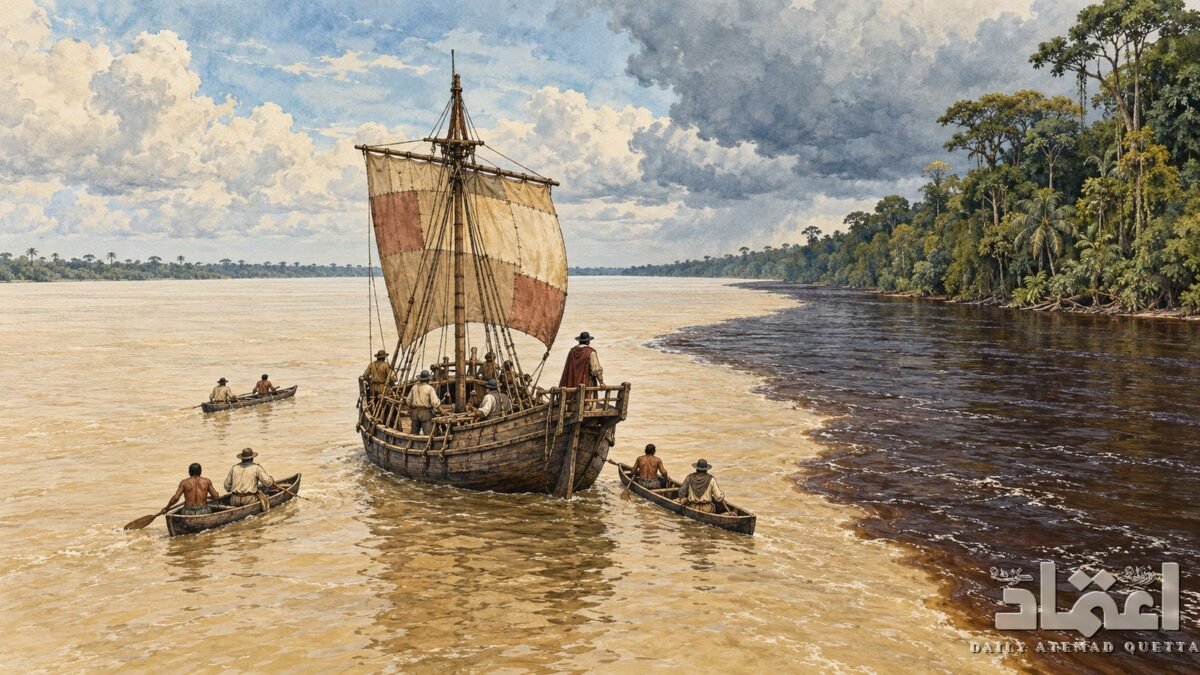
In 1541, a party of hungry Spanish soldiers set out in a crude boat east of the Andes to look for food. They meant to return within a few days. But the current carried them so far that, months later, they came out into the Atlantic Ocean. Francisco de Orellana and his companions thus became the first Europeans to travel down one of the world’s greatest rivers, the Amazon, all the way to the sea.
In search of cinnamon
According to the Encyclopaedia Britannica, Orellana was born in Trujillo, Spain, around 1490. He was in Peru with Francisco Pizarro in 1535 and became governor of Guayaquil in 1538. When Gonzalo Pizarro organised a large expedition to explore the lands east of Quito, Orellana was appointed his deputy. The expedition set out in search of the “Land of Cinnamon”.
The expedition was described by Garcilaso de la Vega, whose account Clements Markham translated into English for the Hakluyt Society in 1859. According to Garcilaso, the forest was so dense that in many places a path had to be cut with axes. The men lived on herbs and roots. Hunger, exhaustion and constant rain killed many of the Spaniards and their native companions. In the end they decided to build a small ship (brigantine) to cross the river. A forge was set up to make nails. Some of the nails were made from the shoes of horses that had been slaughtered to feed the sick. Tree resin was used in place of tar, and blankets and old shirts were handed over to fill the gaps.
Eighty leagues, three days
According to Garcilaso, after travelling along the river for more than two months, the men were told by local people that, ten days away at the meeting point with another large river, there was a settlement full of food. According to Markham’s note, this was the confluence of the Coca and Napo rivers. By then, two thousand of the expedition’s four thousand men had died. According to Britannica, Pizarro sent Orellana ahead in the same small ship, with fifty soldiers, to bring back food.
In Garcilaso’s words, Orellana covered eighty leagues in three days, without oars or sail, carried by the current alone. But he found no food there as promised, and going back against the strong current was almost impossible. The old historians do not agree on what happened next. Garcilaso calls it abandoning Pizarro. The historian Antonio de Herrera writes that, in some people’s view, they went on without permission and, in others’, with permission. According to Britannica, his companions persuaded him that return was impossible. Either way, they went on down the river.
Hunger, nails and a new ship
The main eyewitness account of Orellana’s voyage was written by a priest, Gaspar de Carvajal. Markham translated the story of the voyage from the Spanish historian Herrera’s “General History”, which quotes Carvajal’s accounts in many places. According to Herrera, on the second day the boat struck a floating tree and a plank broke. They landed on the bank and repaired it. With the help of the current they travelled twenty or twenty-five leagues a day, but for many days found no settlement. When the food ran out, they boiled leather belts and the leather of their shoes with herbs and ate them. According to Herrera, seven companions died of hunger.
At last they found a settlement where there was food, and Orellana decided to build a new, larger ship fit for a sea voyage. Herrera writes that the greatest difficulty was nails. Two men, who had never learnt the work, began to forge iron. Bellows were made from leather leggings, and in twenty days more than two thousand nails were ready. In the territory of a chief named Aparia, where the people were friendly, the ship was built in thirty-five days of labour and launched. Its seams were stuffed with cotton and coated with resin given by the local people.
The black river and the endless water
Herrera’s account contains several scenes of the river that can still be recognised today. At one point a river joined from the left whose water was “black as ink”. Its force was so great that its water flowed apart from the water of the main river for more than twenty leagues. According to Markham’s note, this was the Rio Negro. Further on, the river became so wide that one bank could not be seen from the other.
They passed several inhabited areas. In some places the people gave them food. In others there were clashes. In one clash Carvajal was wounded by an arrow, and later another arrow cost him an eye. According to Herrera, Carvajal claimed to have seen tall, strong women fighting at one place. Herrera repeats the claim and writes that he leaves it to the reader to judge whether it is true. According to Britannica, the river was probably named the Amazon because of this comparison with the “Amazon” women of Greek legend.
To the sea
Near the sea they began to feel the tide. Herrera writes that for about two hundred leagues they travelled among inhabited islands, as far as the tide rose strongly. At one place repairs took eighteen days because nails had to be made again. They twisted ropes from grass and made sails from the blankets they slept in. They had no pilot and no compass.
According to Herrera, on 26 August they left the mouth of the river and entered the sea between two islands four leagues apart. By their estimate the mouth was fifty leagues wide, and fresh water ran more than twenty leagues out to sea. According to Britannica, this was August 1542. While sailing north along the coast, the two boats were separated in the night. According to Herrera, the larger boat reached the island of Cubagua on 11 September, where the smaller one had arrived two days earlier. By Carvajal’s reckoning, they had travelled eighteen hundred leagues, counting the bends of the river. According to Garcilaso, Pizarro and his surviving companions returned to Quito with great difficulty in June 1542.
According to Britannica, Orellana went to Spain and sought the right to explore the region. On the second expedition, several ships and men were lost on the way. Around 1546, near the mouth of the river, his boat capsized and he drowned.
Next instalment: Sidi Ali Reis: the journey home through Gwadar, Sindh and Central Asia.
Sources
- Clements R. Markham (tr. and ed.), Expeditions into the Valley of the Amazons, 1539, 1540, 1639, Hakluyt Society, London, 1859 (Garcilaso de la Vega, "Expedition of Gonzalo Pizarro to the Land of Cinnamon", chapters II-III; Antonio de Herrera, "Voyage of Francisco de Orellana down the River of the Amazons", chapters I-V; Markham's notes). https://archive.org/details/expeditionsintov00markrich
- "Francisco de Orellana", Encyclopaedia Britannica. https://www.britannica.com/biography/Francisco-de-Orellana
 More from E-Magazine
More → Orhan: the Ottoman ruler who made Bursa his capital
 Pedro Álvares Cabral: Brazil
 Piri Reis map: the 1513 chart that may carry traces of Columbus
 Portuguese sailor Gil Eanes rounds Cape Bojador in 1434
 Qabus ibn Wushmgir: the scholar-ruler of Gorgan and his brick tower
 Qutb ud-Din Aibak: from slave to sultan and the start of the Qutb Minar
 Raymond Kopa: first Frenchman to win the Ballon d'Or
 Rivaldo: left-footed wizard and 2002 World Cup winner