
Pedro Álvares Cabral: Brazil
About six months after Vasco da Gama's return, Portugal sent a far larger fleet to India: 13 ships and, according to Cartwright, about 1,500 men.
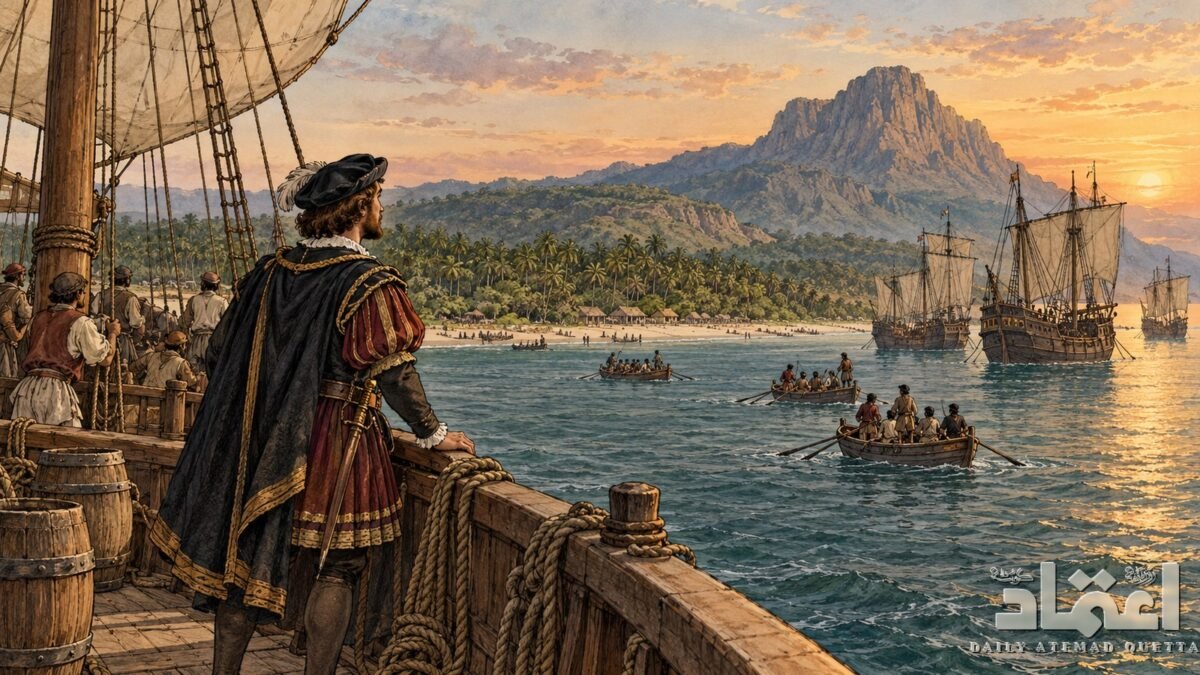
About six months after Vasco da Gama’s return, Portugal sent a far larger fleet to India: 13 ships and, according to Cartwright, about 1,500 men. Its commander was a young nobleman, Pedro Álvares Cabral. The fleet was to sail round Africa to India. But while making a long sweep across the Atlantic, it came upon the coast that is today called Brazil. The most important account of the discovery is the letter of the fleet’s scribe, Pêro Vaz de Caminha. The scholar William Brooks Greenlee published it in English in 1938 for the Hakluyt Society, together with other contemporary accounts.
Departure from Lisbon
According to Greenlee, the fleet assembled on 8 March 1500 at Restelo, near Lisbon. One ship belonged to Italian merchants and one to a Portuguese nobleman. The rest were fitted out at royal expense. The fleet carried the best sailors of the day, among them Bartolomeu Dias, who had been the first to round the southern tip of Africa. King Manuel II himself gave Cabral the banner bearing the royal emblem. According to Greenlee, all Lisbon came to see him off, because this was the first trading fleet to sail for India.
On 9 March the fleet left the mouth of the Tagus. It sighted the Canary Islands on 14 March and São Nicolau, in the Cape Verde Islands, on 22 March. The next morning the ship of Vasco de Ataíde was missing. It was not found despite two days of searching. Caminha writes that there had been neither a storm nor a contrary wind that night.
A long sweep to the west
After Cape Verde, the fleet steered south with some westing to avoid the calms near the equator, and ocean currents carried it further west. Why Cabral went so far west has been much debated, and claims have been made of an earlier discovery of Brazil. In Greenlee’s view, the evidence suggests that this coast had not been seen before and that the western route was taken mostly for ease of sailing.
Caminha writes that signs of land began to appear on 21 April. Long seaweed was floating on the water, which sailors also called "rabo de asno", or "donkey’s tail". The next day birds were seen, and towards evening land came into view: first a very high, round mountain, then lower land and thick forest. Cabral named the mountain "Monte Pascoal", or "Easter Mountain", because it was Easter week, and the land "Terra da Vera Cruz". By Greenlee’s reckoning, the date was 22 April 1500. The mountain still exists under the same name in the Brazilian state of Bahia.
Ten days at Porto Seguro
On 23 April small boats went to the shore and, according to Greenlee, the Portuguese probably set foot on the land for the first time. There they met people whose bodies were painted and who wore ornaments of bright feathers. Their appearance was unlike that of any people the Portuguese had seen. A storm came in the night. The next day the fleet sailed north and anchored in a safe harbour inside a reef. It was named "Porto Seguro", meaning "safe harbour".
The fleet stayed here until 2 May, trading with the local people and taking on water and wood. According to Greenlee, they could not even tell whether this was an island or a continent. Cabral sent a supply ship under Gaspar de Lemos back to Portugal with the news. Two letters carried on it have survived: one by Caminha and the other by "Master John", the fleet’s astronomer.
Caminha’s letter
Caminha’s letter was written "from this Porto Seguro, Friday, the first day of May, 1500". He tells the king that the visible coast would be some twenty or twenty-five leagues long. There are high banks of red and white earth along the shore, and the land above is flat and covered with great forests. "As far as the eye could reach, we saw only land and forest."
He states plainly that so far they had found no gold, silver or iron. But he writes that the climate is as mild as that of Entre Douro e Minho in northern Portugal, and that "its waters are endless", so that everything can grow in it. In his words, even if nothing else came of it, it would be enough as a stopping place for ships bound for Calicut. According to Greenlee, the country was later named "Brazil" after its red "brazilwood", which gave rise to a large trade in Europe for dyeing.
The storm off the Cape
From Brazil the fleet sailed straight for the southern tip of Africa, across a sea in which, according to Greenlee, no ship had sailed before. On 12 May a comet appeared and remained visible for ten days. The sailors took it as a bad omen. On 24 May a sudden storm sank four ships, among them that of Bartolomeu Dias. The sailor who had first sighted the Cape was lost at sea near it. The remaining seven ships were scattered with torn sails. One of them, that of Dias’s brother Diogo Dias, strayed far ahead and sighted the island of Madagascar, where, in Greenlee’s opinion, no European had been before.
India and the return
Cabral reached Mozambique on 20 July, Kilwa on 26 July and Malindi on 2 August. There he was given a friendly welcome and pilots for India. On 13 September 1500 six ships anchored off Calicut. The stay there ended in a fierce quarrel in which several Portuguese were killed or captured. According to Greenlee, they included Caminha, the writer of the letter. Cabral then went south to Cochin, which he reached on 24 December. He loaded spices there and at the nearby town of Cranganore. On the return he also obtained goods at Cannanore.
Near the African coast the ship of Sancho de Tovar ran aground on sand and had to be burned, though the crew were saved. At the port of Beseguiche near Cape Verde, two ships of Cabral’s fleet met three ships that had left Lisbon to explore the Brazilian coast further. Amerigo Vespucci was with them.
The fastest ship, the "Anunciada", reached Lisbon on 23 June 1501. According to Greenlee, Cabral himself arrived probably on 21 July 1501. Of the 13 ships, only five returned from India with cargo. Six were lost at sea and two came back empty. Greenlee writes that at the time the discovery of Brazil and Madagascar was regarded as a mere incident of the voyage, of no more importance than a place to take on wood and water.
Next instalment: Amerigo Vespucci: naming the New World.
Sources
- The Voyage of Pedro Álvares Cabral to Brazil and India, from Contemporary Documents and Narratives, translated with introduction and notes by William Brooks Greenlee, Hakluyt Society, Second Series, London, 1938 (Introduction, "The Voyage", pp. xviii–xxxi; Letter of Pedro Vaz de Caminha to King Manuel, Porto Seguro, 1 May 1500, with notes; introduction to the Vespucci letter from Beseguiche; biographical notes on Bartolomeu and Diogo Dias). Internet Archive copy. https://archive.org/details/in.ernet.dli.2015.57073
- Mark Cartwright, "Vasco da Gama", World History Encyclopedia, 3 June 2021 (Cabral's expedition of 13 ships and 1,500 men, March 1500). https://www.worldhistory.org/Vasco_da_Gama/
 More from E-Magazine
More → Piri Reis map: the 1513 chart that may carry traces of Columbus
 Portuguese sailor Gil Eanes rounds Cape Bojador in 1434
 Qabus ibn Wushmgir: the scholar-ruler of Gorgan and his brick tower
 Qutb ud-Din Aibak: from slave to sultan and the start of the Qutb Minar
 Raymond Kopa: first Frenchman to win the Ballon d'Or
 Rivaldo: left-footed wizard and 2002 World Cup winner
 Robert Lewandowski: the goal machine
 Roberto Baggio: Italy's artist who was more than one penalty