
Qutb ud-Din Aibak: from slave to sultan and the start of the Qutb Minar
A tall red sandstone tower stands in south Delhi; Britannica says Qutb ud-Din Aibak began building it in the early 13th century.
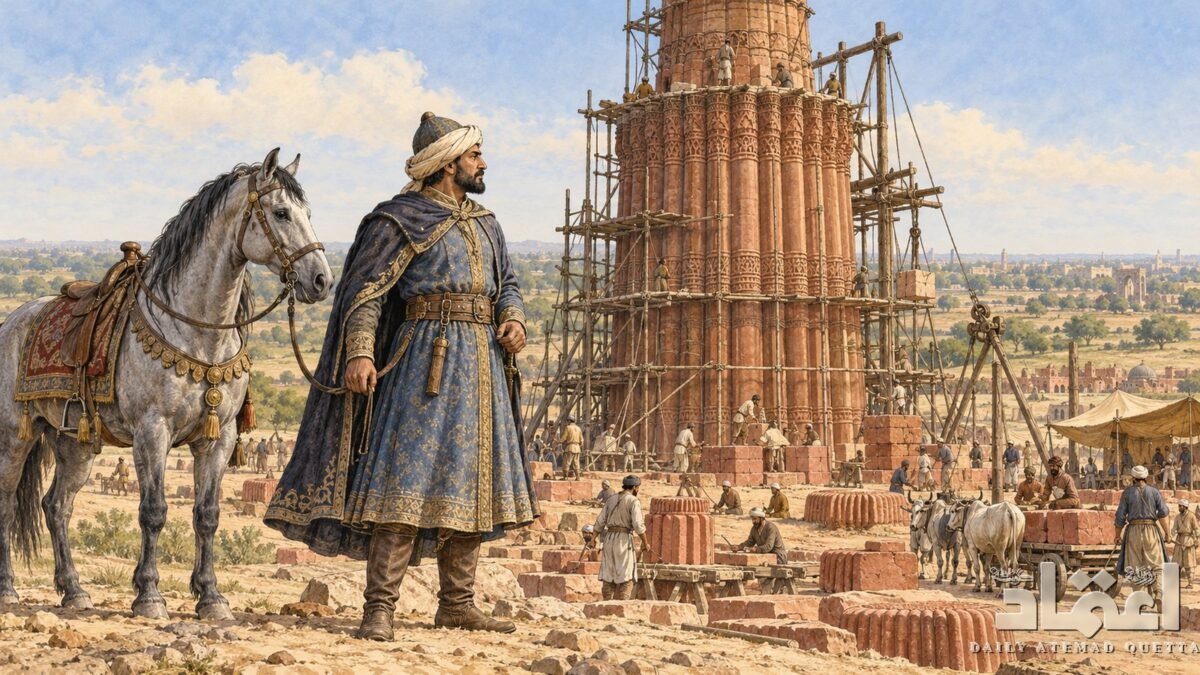
A tall tower of red stone stands in the south of Delhi. The world knows it as the Qutb Minar. According to Britannica, its construction was begun in the early thirteenth century by Qutb ud-Din Aibak. Aibak’s life story is extraordinary. A boy sold as a slave in childhood, he finally became the ruler of an empire in 1206 and remained in power until 1210. He is counted among the founders of the Delhi Sultanate.
Early life
According to Britannica, Aibak was born around 1150. He was of Turkic descent. He was sold as a slave in childhood and was raised in Nishapur, a city of Khorasan. “Aibak” is said to be the name of his tribe, formed from two Turkish words, “ai” (moon) and “beg” (chief).
Later he came into the possession of Muizzuddin Muhammad bin Sam of Ghor, known in history as Muhammad Ghori. According to Britannica, Muhammad Ghori made him master of the royal stables, and from there he rose step by step to military command.
Running the Ghorid territories in India
According to Britannica, after capturing Delhi in 1193, Muhammad Ghori returned to Khorasan and left Aibak in charge of consolidating the Ghorid territories in north-western India. Aibak made Delhi his base. According to Britannica, in the following years the region between the Ganges and the Yamuna came under his administration, while Bakhtiyar Khalji, a commander serving under him, brought Bihar and Bengal under Ghorid control.
Status as sultan
Muhammad Ghori was murdered in March 1206. According to Britannica, Aibak was his natural successor, but he was still legally a slave at that time. He therefore soon obtained a deed of manumission. It is commonly stated that he was enthroned in Lahore on 25 June 1206, and Lahore remained his capital.
Aibak strengthened his rule through carefully chosen family ties. According to Britannica, he married the daughter of Taj ud-Din Yildiz, the ruler of Ghazni, who was one of the claimants to Muhammad Ghori’s succession, and he secured his position through other marriage alliances as well. His son-in-law and ablest commander was Iltutmish, who later succeeded him. According to Britannica, inscriptions of the period describe Aibak as “Malik”, meaning king.
The Qutb Minar
Aibak’s most famous legacy is the Qutb Minar. According to Britannica, the tower, one of the tallest minarets in Asia, was begun by Aibak in Delhi in the early thirteenth century and completed by his successor, Iltutmish.
Today the tower is 72.5 metres high. According to Britannica and UNESCO, its diameter is about 14.3 metres at the base and 2.75 metres at the top, so it tapers gradually upwards. According to UNESCO, its walls have pointed and rounded flutes in alternation, which make it recognisable from afar.
According to Britannica, the tower has five storeys separated by projecting balconies, and each storey has fine bands of inscriptions. The lower three storeys are of red and yellowish sandstone, while the fourth and fifth use marble and sandstone. It was damaged by lightning and earthquakes in the fourteenth and fifteenth centuries, and local rulers had it repaired. In the early sixteenth century, Sikandar Lodi carried out major repairs to its upper two storeys.
UNESCO has declared the Qutb Minar and the monuments around it a World Heritage Site. The same complex includes the Alai Darwaza, built in 1311, which UNESCO calls a masterpiece of Indo-Islamic art.
Death
Aibak’s rule lasted only four years. According to Britannica, he died in 1210 of injuries sustained while playing chaugan (polo). It is commonly stated that this happened in Lahore in November 1210. His tomb is in the Anarkali area of Lahore.
Aram Shah ruled briefly after him, and then Iltutmish took the throne in 1211. According to Britannica, Iltutmish consolidated the independence of the Delhi Sultanate on the foundation laid by Aibak.
Legacy
Aibak’s reign was short, but according to Britannica, his successor strengthened the Delhi Sultanate on the foundation he had laid. It remained the major state of northern India for the next three centuries. His most prominent mark is the Qutb Minar, whose construction began in his time and which, eight centuries later, remains one of the most recognisable buildings in Delhi.
Sources
- Encyclopaedia Britannica, "Quṭb al-Dīn Aibak". https://www.britannica.com/biography/Qutb-al-Din-Aibak
- Encyclopaedia Britannica, "Quṭb Mīnār". https://www.britannica.com/topic/Qutb-Minar
- UNESCO World Heritage Centre, "Qutb Minar and its Monuments, Delhi". https://whc.unesco.org/en/list/233/
- Wikipedia, "Qutb ud-Din Aibak" (pointer only: coronation at Lahore on 25 June 1206, Lahore as capital, death in November 1210, tomb in Anarkali, Aram Shah, meaning of the name). https://en.wikipedia.org/wiki/Qutb_ud-Din_Aibak
 More from E-Magazine
More → Raymond Kopa: first Frenchman to win the Ballon d'Or
 Rivaldo: left-footed wizard and 2002 World Cup winner
 Robert Lewandowski: the goal machine
 Roberto Baggio: Italy's artist who was more than one penalty
 Roberto Carlos: the left-back behind the impossible free-kick
 Romário: the king of the penalty area
 Sadiq Mohammad: the left-handed opener of the Mohammad brothers
 Saeed Ahmed: the batsman of big centuries and glorious drives