
Qabus ibn Wushmgir: the scholar-ruler of Gorgan and his brick tower
A 53-metre brick tower in Gonbad-e Qabus, Iran, was built as the tomb of Qabus ibn Wushmgir, the Ziyarid ruler remembered for learning, poetry and calligraphy.
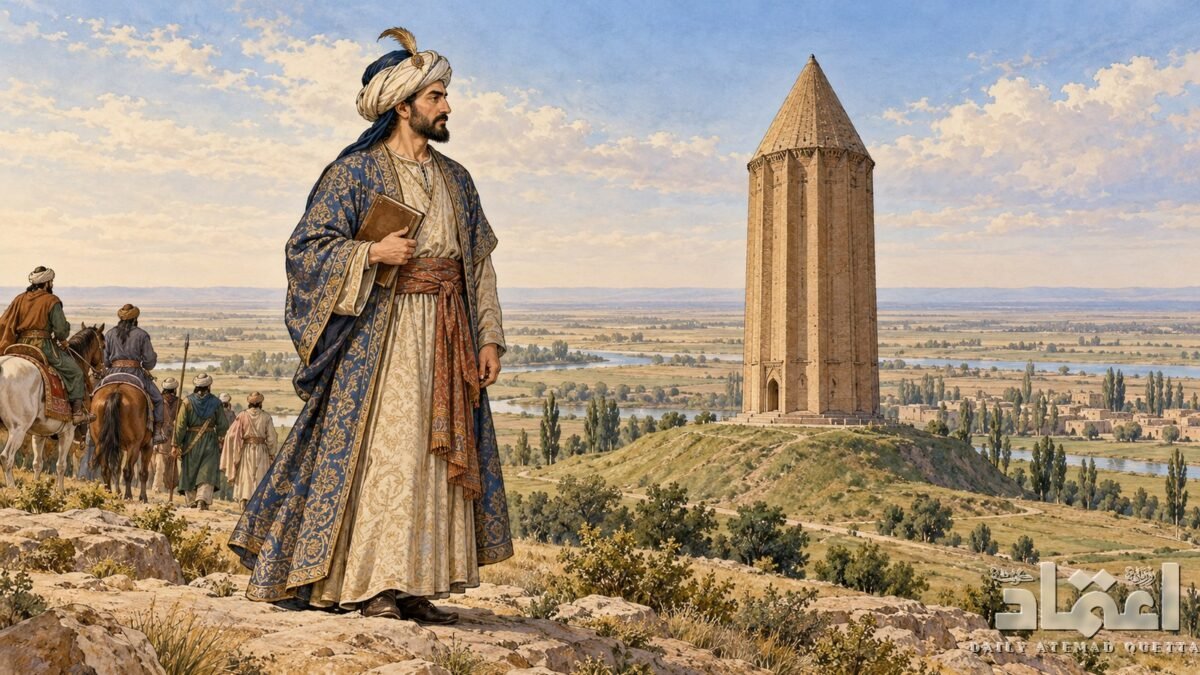
A tall tower of baked brick stands on a mound in the city of Gonbad-e Qabus in north-eastern Iran. It can be seen from miles away. More than a thousand years ago, Qabus ibn Wushmgir (Qabus ibn Wushmgir), a ruler of the Ziyarid dynasty, had it built as his tomb. Qabus ruled Gorgan and Tabaristan, on the southern coast of the Caspian Sea, in two periods: first from 977-978 to 981, and then from 997 to 1012. Historians remember him more for his learning, poetry and calligraphy than for his military successes.
The Ziyarid dynasty
According to Encyclopaedia Iranica, the Ziyarids were a small dynasty of the Caspian coastal region that lasted from 931 to about 1090. At first they ruled parts of northern Iran. Later their rule was limited to Tabaristan and Gorgan. Their capital was Gorgan (Jurjan in Arabic).
Qabus’s father, Zahir al-Dawla Wushmgir, ruled from 935 to 967. According to Iranica, “Wushmgir” literally means quail-catcher. In late 967 Wushmgir was killed in an attack by a wild boar.
First reign
After Wushmgir’s death, his elder son Bistun became ruler and governed until his death in 978. According to Iranica, after Bistun’s death Qabus set aside Bistun’s young son and took the throne. Between 978 and 979 the Abbasid caliph al-Ta’i’ gave him the honorific title “Shams al-Ma’ali”, which became part of his name.
This first reign was short. Relations with the neighbouring Buyid rulers soured, and in 980 and 981 Qabus lost first Tabaristan and then Gorgan.
Seventeen years in exile
According to Iranica, Qabus then took refuge with the Samanid governor in Nishapur and stayed away from his homeland for about seventeen years. This long exile proved important for his scholarly life. According to Iranica, his stay among the Samanids gave him the chance to meet noted scholars of Bukhara and Nishapur, and these ties strengthened his reputation.
In 997 circumstances changed, and Qabus returned at the invitation of the people of Gorgan.
Second reign
According to Iranica, the sources say little about events in Qabus’s second reign. During this period his relations with Sultan Mahmud of Ghazni were formal and cautious. Qabus kept his rule without accepting the overlordship of any outside ruler. His coins were issued from the Gorgan mint.
According to Iranica, his rule was harsh, and this harshness bred resentment. In the end his army rebelled, seized the capital and made his son Manuchihr ruler. Qabus gave up power at Bistam, and in the winter of 1012 he was killed by the rebels.
Writer, poet and calligrapher
According to Iranica, Qabus is the best known of the Ziyarid rulers, because of his scholarly and literary standing. He was a scholar of both Arabic and Persian and wrote poetry in both. He was famous for his skill in the ornate style of letter-writing, and a collection of his Arabic writings (letters) still survives. He was also regarded as an accomplished calligrapher and took an interest in astrology.
The 11th-century writer al-Tha’alibi describes him as an eminent writer, a scholar and a patron of learned men.
Al-Biruni and Ibn Sina
The names of two great scientists are linked with Qabus’s court. According to Iranica, the renowned scholar Abu Rayhan al-Biruni (al-Biruni) came to his court soon after Qabus retook the throne. Around 1000 he completed his book “al-Athar al-Baqiya” and dedicated it to Qabus. The book deals with the calendars, chronology and festivals of different peoples.
Ibn Sina (Avicenna) left Khwarazm in 1013 and reached Gorgan hoping for Qabus’s patronage, but according to Iranica Qabus had already died.
Gonbad-e Qabus
Qabus’s most striking memorial is his tomb, known as Gonbad-e Qabus (Gonbad-e Qabus). According to Iranica, Qabus himself supervised its construction between 1006 and 1007.
According to UNESCO, the tower is 53 metres high and built of unglazed baked brick. Hollow inside and cylindrical, it narrows slightly from bottom to top. Its diameter is 17 metres at the base and 15.5 metres at the top, and it is crowned by a conical brick roof. Its plan is a ten-pointed star, which creates ten projecting flanges on the outer wall. Two inscriptions in Kufic script run around the tower, naming Qabus as its founder and giving 1006 as the year of construction.
According to UNESCO, the tower is a masterpiece of early Islamic architecture because of its geometry and the height it reaches with brick walls alone. Its conical-roofed form became the model for tomb towers later built in Iran, Anatolia and Central Asia. UNESCO also says the ancient city of Jurjan, once a centre of learning and the arts, fell into ruin in later centuries and the tower is now its only surviving trace. The present city of Gonbad-e Qabus grew up around the tower in the early 20th century. It was added to the World Heritage List in 2012.
Qabus Nama
Qabus’s name is also linked with a famous work of Persian literature. According to Iranica, his grandson Unsur al-Ma’ali Kay Ka’us ibn Iskandar, one of the last known members of the Ziyarid dynasty, wrote a book of advice in the 11th century and named it “Qabus Nama” after his famous grandfather. In the book a father gives his son advice on manners, government, trade and various professions. Its English translation was published as “A Mirror for Princes”.
Legacy
Qabus’s rule was confined to a small region, but his name lives on today through three things: al-Biruni’s book dedicated to him, his grandson’s “Qabus Nama”, and the brick tower standing on the plain of Gorgan, which UNESCO calls a masterpiece of early Islamic architecture.
Sources
- C. E. Bosworth, "Ziyarids", Encyclopaedia Iranica, 2010. https://www.iranicaonline.org/articles/ziyarids/
- UNESCO World Heritage Centre, "Gonbad-e Qābus" (inscribed 2012). https://whc.unesco.org/en/list/1398/
- Kay Kāvus b. Eskandar, Qābus-nāma, trans. Reuben Levy as A Mirror for Princes, London, 1951 (title and authorship as given by Iranica). https://archive.org/details/qabus-nama-english-levy-1951
- Wikipedia, "Qabus" (pointer only: first reign from 977, return to Gorgan in 998, coin minted at Jurjan). https://en.wikipedia.org/wiki/Qabus
 More from E-Magazine
More → Qutb ud-Din Aibak: from slave to sultan and the start of the Qutb Minar
 Raymond Kopa: first Frenchman to win the Ballon d'Or
 Rivaldo: left-footed wizard and 2002 World Cup winner
 Robert Lewandowski: the goal machine
 Roberto Baggio: Italy's artist who was more than one penalty
 Roberto Carlos: the left-back behind the impossible free-kick
 Romário: the king of the penalty area
 Sadiq Mohammad: the left-handed opener of the Mohammad brothers