
Portuguese sailor Gil Eanes rounds Cape Bojador in 1434
In 1434 a small Portuguese ship passed a sandy cape on Africa's west coast and returned safely. For sailors of the time, it was the limit beyond which none had gone.
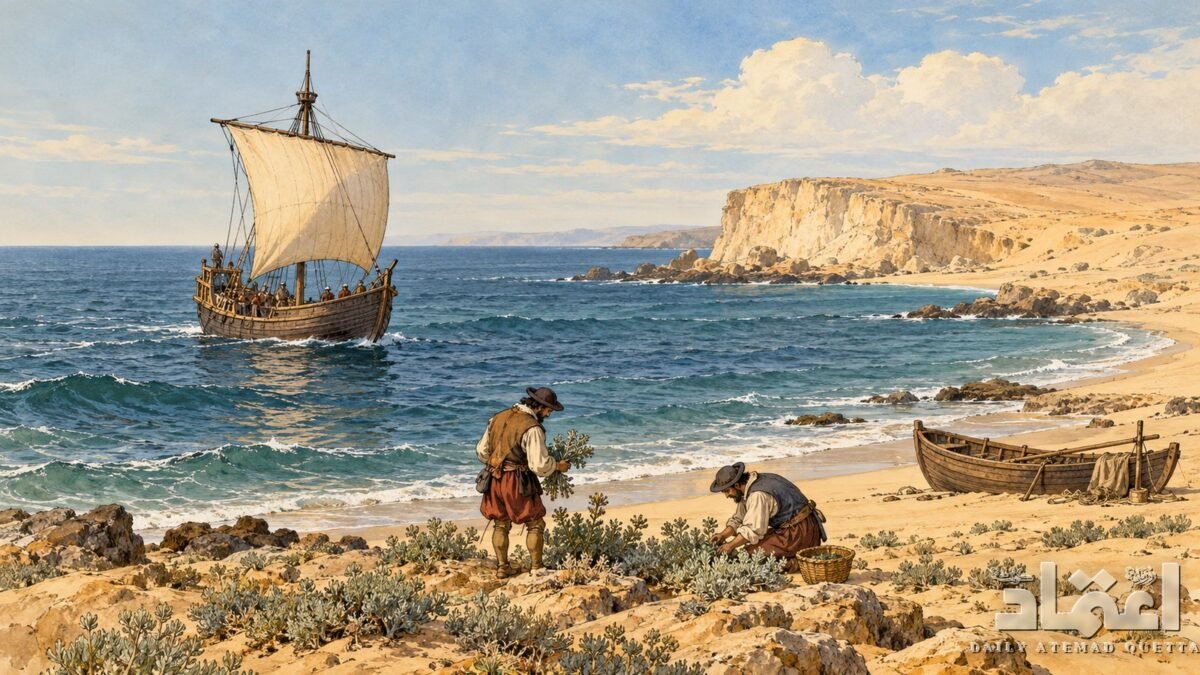
In 1434, a small Portuguese ship passed a sandy cape on the west coast of Africa and then returned home safely. For the sailors of that time, this cape was the last limit, beyond which their elders had never gone. It was called Cape Bojador, and the captain who crossed it was Gil Eanes. That voyage began the chain of events that later reached the Cape of Good Hope and the sea route to India.
Prince Henry and his chronicler
The central figure of the story is a prince who never went on these expeditions himself. According to Encyclopaedia Britannica, Henry the Navigator was born in Porto on 4 March 1394 and died on 13 November 1460. The English gave him the title “the Navigator”. Britannica says the title is not accurate, because he never set out on a voyage of discovery himself. He was only the patron of the voyages. Most of their cost came from the funds of the Order of Christ, which he had administered since 1420.
The most important account of these voyages is in the book “The Chronicle of the Discovery and Conquest of Guinea” by the Portuguese chronicler Gomes Eanes de Zurara. The Hakluyt Society published its English translation in two volumes in 1896 and 1899. It was made by Charles Raymond Beazley and Edgar Prestage. According to Prestage’s introduction, the king ordered Zurara in 1452 to write the book. He completed it in the royal library in Lisbon on 18 February 1453.
Zurara writes that Henry wanted to know what lay beyond the Canary Islands and Cape Bojador. Until then, no writing and no one’s memory gave any certain account of that region. One story said that two ships had gone beyond the cape and never returned.
Why sailors were afraid
The eighth chapter of Zurara’s book deals with this very question: why ships did not dare to go beyond the cape. In Zurara’s words, the reason was not cowardice but an old rumour that Spanish sailors had heard from generation to generation. The sailors said that beyond the cape there were no people and no settlement. The land was sandy like the deserts of Libya, with no water, no trees and no green grass. The sea was so shallow that even a league from the shore it was only one fathom (about six feet) deep. The currents were so terrible, they said, that a ship which once passed the cape could never come back.
According to Zurara, Henry sent ships every year for twelve years, and each time they turned back before reaching the cape. In the World History Encyclopedia, Mark Cartwright describes the real difficulty differently. Going beyond the cape was possible, but returning to Europe was hard against the steady winds from the north and the opposing currents.
The first attempt and the prince’s advice
The ninth chapter of Zurara’s book is titled: “How Gil Eannes, a native of Lagos, was the first to pass Cape Bojador”. According to it, after twelve years Henry finally had a “barcha” prepared and handed it to one of his squires, Gil Eanes. According to the World History Encyclopedia, the barca was the common European ship of the time. It had square sails and sailed well only with the wind behind it.
On the first voyage in 1433, Gil Eanes was seized by the same fear. According to Zurara, he went only as far as the Canary Islands and came back. The next year Henry had the same ship fitted out again. He called Eanes aside and told him: “You will not find any danger so great that the hope of reward is not greater.” He said that the men were merely repeating the opinion of four sailors who came from the Flanders trade or the usual routes and “know neither the needle (compass) nor the sea chart”.
1434: beyond the cape
Zurara writes that Gil Eanes resolved not to appear before the prince without firm news. On this voyage he went beyond the cape without regard for the danger. There he found the land to be the complete opposite of what he and others had believed. Zurara’s comment is interesting: the deed was small in itself, but it was reckoned great because of the daring involved.
On his return, Gil Eanes said that he had lowered a boat and gone ashore, but had found no man and no sign of habitation. As a token, he brought back some plants from there and presented them to the prince. In Portugal they were called “Saint Mary’s roses”. According to Zurara, he was given a very good reception and received honour and property. Henry later made him a knight as well.
In a note, Beazley writes that British Admiralty surveys have shown the old stories of dangerous rocks and currents at Bojador to be baseless.
Traces of men and camels
The following year Henry had a “barinel” prepared. According to a note in the translation, it was a ship driven by oars. He sent his cupbearer Afonso Gonçalves Baldaia on it. Gil Eanes went along in his own barca. According to Zurara, they went fifty leagues beyond the cape. The land there was also uninhabited, but there were footprints of men and camels in the sand. According to a note in the translation, the sailors named the place “Angra dos Ruivos”, meaning the bay of red fish, because of the many fish there.
From these traces Henry concluded that a settlement could not be far off. Zurara writes that he sent Baldaia again. Baldaia went seventy leagues further than the earlier place, a total of 120 leagues from the cape. He reached an estuary like a large river with good anchorages. The place came to be called “Rio do Ouro”. There he put two young men on horses and sent them inland to look for settlements.
Dates and disagreement
In the introduction to the second volume (1899) of the Hakluyt translation, Beazley writes that it is “almost certain” that no Portuguese ship had gone beyond Bojador before 1434. He also notes that the Portuguese chronicler Galvano gives the year of this voyage as 1432. On the other hand, according to Britannica, the account is an exaggeration. It says the cape Gil Eanes took to be Bojador was in fact Cape Juby, which earlier sailors had already passed. Scholars still do not agree on this.
What is clear is that after this voyage the fear of the Portuguese sailors was broken. Every few years their ships began to reach further along the African coast. About fifty-five years later the chain reached the southern tip of Africa.
Next instalment: Afanasy Nikitin: from Russia to India.
Sources
- Gomes Eannes de Azurara, The Chronicle of the Discovery and Conquest of Guinea, translated by Charles Raymond Beazley and Edgar Prestage, Hakluyt Society, First Series nos. XCV and C, London, 1896 and 1899; Vol. I, Introduction (Zurara's life; the 1452 commission and completion on 18 February 1453), chapters VII–X and notes 49–54 (including the note on Angra dos Ruivos); Vol. II, Introduction pp. ii–xi and notes 10–11 (Admiralty surveys; Galvano's 1432). Project Gutenberg eBooks #35738 and #35764. https://www.gutenberg.org/ebooks/35738 and https://www.gutenberg.org/ebooks/35764
- Charles E. Nowell and the Editors, "Henry the Navigator", Encyclopaedia Britannica (dates, parentage, the misnomer, Order of Christ funding, "Sponsorship of expeditions": the Cape Juby view). https://www.britannica.com/biography/Henry-the-Navigator
- Mark Cartwright, "Prince Henry the Navigator", World History Encyclopedia (the square-rigged barca, the return problem, Bojador navigated in 1434). https://www.worldhistory.org/Prince_Henry_the_Navigator/
- Mark Cartwright, "Caravel", World History Encyclopedia (twelve years of failures at Cape Bojador). https://www.worldhistory.org/Caravel/
 More from E-Magazine
More → Qabus ibn Wushmgir: the scholar-ruler of Gorgan and his brick tower
 Qutb ud-Din Aibak: from slave to sultan and the start of the Qutb Minar
 Raymond Kopa: first Frenchman to win the Ballon d'Or
 Rivaldo: left-footed wizard and 2002 World Cup winner
 Robert Lewandowski: the goal machine
 Roberto Baggio: Italy's artist who was more than one penalty
 Roberto Carlos: the left-back behind the impossible free-kick
 Romário: the king of the penalty area