
Rabban Bar Sauma: the Beijing monk who travelled to Rome and Paris
While Marco Polo went east, an elderly Beijing monk, Rabban Bar Sauma, travelled west as a Mongol envoy to Constantinople, Rome, Paris and Gascony.
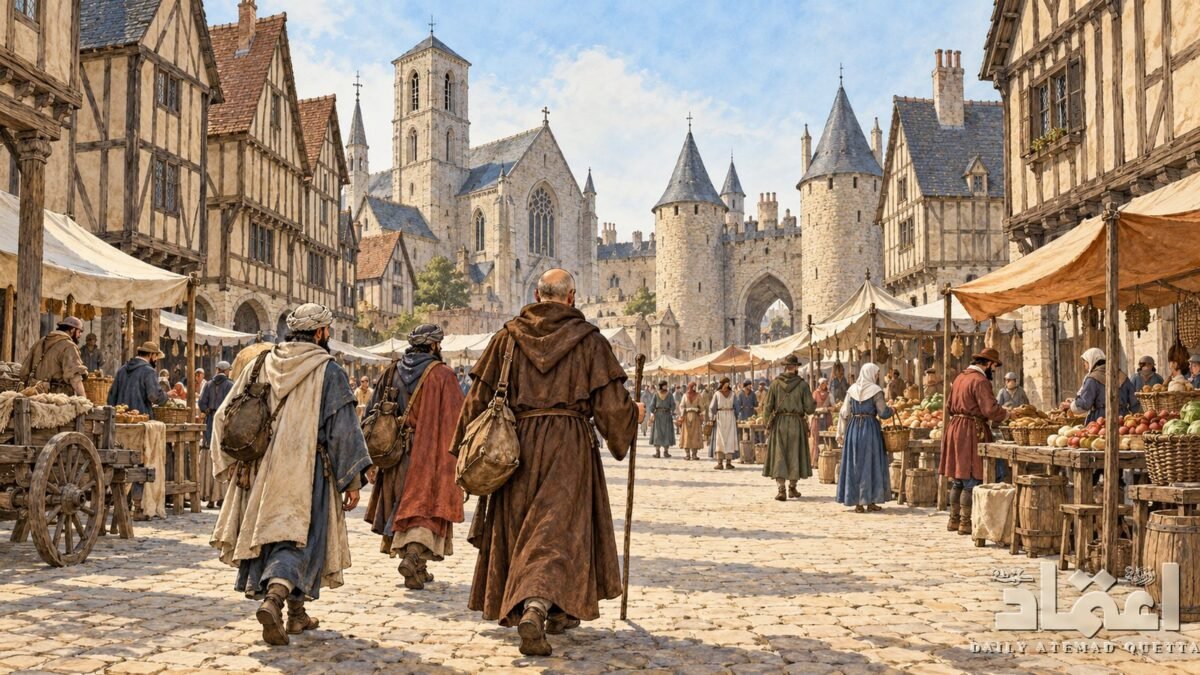
We remember Marco Polo, who travelled from Europe to China. But at about the same time, another traveller went the other way. An elderly monk from Beijing, Rabban Bar Sauma, became an envoy of the Mongol ruler. He reached Constantinople, Rome, Paris and the court of the King of England in the south of France. He looked at Europe with the same wonder with which European travellers looked at the East, and he left his own account.
The boy from Khanbaliq
In 1928 the British orientalist E. A. Wallis Budge published an English translation of this travel account under the title "The Monks of Kublai Khan". According to his introduction, Sauma’s father, Shiban, and mother, Qiamta, came from a well-off family and lived in "Khanbaliq", meaning "the city of the Khan", which is today’s Beijing. According to Wikipedia, Sauma was born around 1220. "Bar Sauma" means "son of the fast", and "Rabban" is an honorific title for monks in Syriac, meaning "our teacher".
According to Budge, Sauma gave up the world in his youth. He distributed his wealth among the poor and settled in a mountain cave a day’s journey from Beijing. As his fame spread, a young man from the city of Koshang, Mark, became his disciple. The two decided to make a pilgrimage to Jerusalem and set out westward.
Hardships on the Silk Road
According to Budge, the two first passed through the Tangut region. They then walked for two months through almost waterless deserts and reached Khotan. There a war was under way between Kublai Khan and one of his rivals, the roads were closed and grain was scarce, so they had to stay six months. After that they reached Kashgar, the same city that Marco Polo writes as "Cascar", but it had been plundered and its people had fled.
Beyond Kashgar lay the territory of Kublai’s rival Kaidu, where caravan routes were unsafe. Budge writes that the two monks reached Khorasan with great difficulty, having lost almost everything on the way, and took shelter in a monastery near Tus. They never reached Jerusalem. Instead, according to Budge, young Mark was first given a high religious office. In 1281 he was elected head of his church (Patriarch) and took the name Yahballaha III.
Arghun Khan’s envoy
Iran was then under Mongol Ilkhanid rule. According to Wikipedia, the Ilkhanid ruler Arghun wanted a military alliance with European kings against the Mamluk sultans of Egypt and Syria. In 1287 he sent the elderly Sauma to Europe for this purpose. According to Budge, Arghun had letters and gifts prepared for the kings of Greece (the Byzantine empire) and Rome. He gave Sauma the "paiza", a sign of royal authority, 2,000 mithqals of gold and 30 good riding horses.
Sauma travelled overland to Samsun on the Black Sea coast and from there sailed to Constantinople. The Byzantine emperor, Andronicus II, hosted him with honour. According to Wikipedia, Sauma wrote of the Hagia Sophia with great enthusiasm.
Italy: a volcano and a sea battle
On the sea voyage from Constantinople, Sauma saw a volcano erupting. According to Wikipedia, this was the great eruption of Mount Etna in Sicily on 18 June 1287. Budge writes that after a wearying two-month journey he landed at Naples. From the roof of a house there he watched a battle between the fleets of two kings.
When he reached Rome, he found that Pope Honorius IV had died. The cardinals received him with respect but said Arghun’s letter could not be answered until a new pope was elected. From there Sauma went to Tuscany and then to Genoa. According to Budge, Genoa had no king and its people lived under a republican system, which surprised a traveller from the East.
The schools of Paris and the King of England
After about a month’s journey, Sauma reached Paris. Philip IV, King of France, gave him a grand welcome, read Arghun’s letter and promised help. Sauma stayed a month in Paris and wrote in his account that 30,000 students were studying in the city. The king promised to send one of his nobles to Arghun with a reply. According to Wikipedia, this noble, Gobert de Helleville, set out on 2 February 1288.
From Paris, Sauma went to Gascony in south-western France, which was then under the King of England. There he met Edward I of England, who gave him gifts and travel expenses. According to Wikipedia, Edward welcomed the embassy warmly but, because of disputes within his own country, could not join a military alliance.
The return and the discovery of the account
Sauma spent the winter in Genoa. According to Budge, he complained there to a cardinal that he had wasted a whole year waiting for a new pope. At last, in February 1288, Nicholas IV was elected pope. He summoned Sauma to Rome, sent him off with honour and gave him 1,500 mithqals of gold for the return journey. According to Wikipedia, Sauma returned to the Ilkhanid court in 1288. In 1289 Arghun wrote a letter to the King of France in Mongol script that refers to Sauma’s embassy. The letter is still preserved in the French national archives. The alliance never came about.
Budge writes that Arghun was pleased and gave Sauma a place at his court. Sauma died in Baghdad in 1294.
According to Budge, the account was originally written in Persian, and a shortened Syriac translation of it has reached us. It was lost for centuries. In March 1887 a manuscript of it was found in a village in Kurdistan, and it was first published in Paris in 1888. In Wikipedia’s words, the account gives a picture of Europe in the last phase of the Crusades, seen through the eyes of an intelligent observer from the East.
Next instalment: Ibn Battuta: the traveller of three continents and his journey to Sindh.
Sources
- E. A. Wallis Budge (translator), The Monks of Kûblâi Khân, Emperor of China, or the History of the Life and Travels of Rabban Ṣâwmâ, Envoy and Plenipotentiary of the Mongol Khâns to the Kings of Europe, and Markôs who as Mâr Yahbh-Allâhâ III became Patriarch of the Nestorian Church in Asia, The Religious Tract Society, London, 1928 (Preface; Introduction pp. 42–72; translation of the embassy chapters). https://archive.org/details/monksofkublaikha0000eawa
- "Rabban Bar Ṣawma", Wikipedia (pointer only, for birth year, the 1287–1288 dates, the Samsun sea route, Etna, Gobert de Helleville, Edward I and death in Baghdad). https://en.wikipedia.org/wiki/Rabban_Bar_Sauma
- Marco Polo, The Book of Ser Marco Polo, tr. Henry Yule, rev. Henri Cordier, John Murray, London, 1903, vol. 1, Book I ch. xxxiii "Of the Kingdom of Cascar" (for Kashgar, cited by Budge). https://www.gutenberg.org/ebooks/10636
- Wikimedia Commons, "File:ArghunLetterToPhilippeLeBelExtract1289.jpg" (Arghun's letter to Philip IV, 1289; public domain). https://commons.wikimedia.org/wiki/File:ArghunLetterToPhilippeLeBelExtract1289.jpg
 More from E-Magazine
More → Aamer Sohail: the aggressive left-handed opener
 Abd al-Malik ibn Marwan: Arabic offices, new coins and the octagonal domed shrine
 Abd al-Rahman I: the emir who founded Cordoba's Great Mosque
 Abdul Hafeez Kardar: Pakistan cricket's first captain
 Abdul Razzaq: the all-rounder who either blocked or hit
 Abel Tasman: the Dutch voyage that found Tasmania and New Zealand
 Afanasy Nikitin: the Russian merchant who travelled to India
 Ahmad ibn Majid: master navigator of the Indian Ocean