
Muhammad V: the Granada sultan who built the Court of the Lions at the Alhambra
Muhammad V ruled Granada in two periods between 1354 and 1391, and the Court of the Lions at the Alhambra was built during his reign.
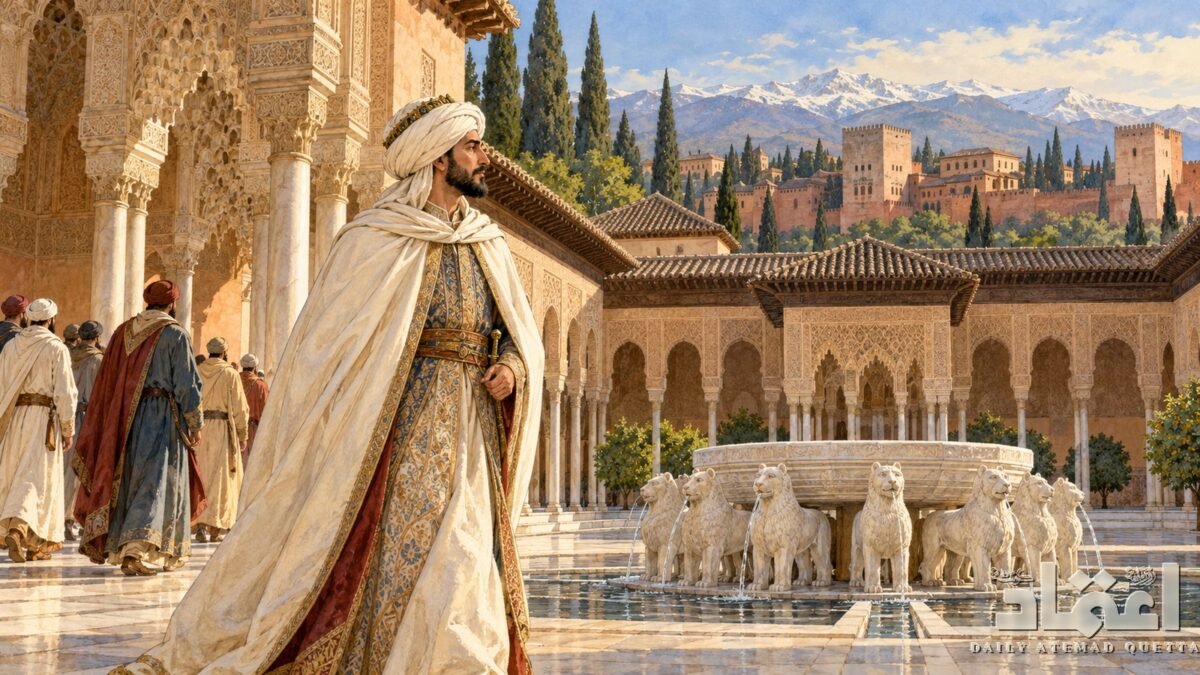
On a hill above the city of Granada in southern Spain stand the reddish fortresses and palaces of the Alhambra, now counted among the most famous historic buildings in the world. The best-known part of these palaces, the Court of the Lions, was built in the 14th century during the reign of Sultan Muhammad V of the Nasrid dynasty. Muhammad V ruled in two periods, from 1354 to 1359 and again from 1362 to 1391. His time is regarded as the high point of the Kingdom of Granada.
Granada and the Nasrids
According to Britannica, the Alhambra was built mostly between 1238 and 1358, in the time of Ibn al-Ahmar, the founder of the Nasrid dynasty, and his successors. In this period the Kingdom of Granada, in the south of the Iberian Peninsula, was a small but prosperous state. Besides Granada, it included coastal cities such as Málaga and Almería.
Muhammad V was the eldest son of Sultan Yusuf I. His date of birth is generally given as 4 January 1339. According to Britannica, much of the Alhambra’s splendid interior decoration is attributed to the time of Yusuf I, who died in 1354.
First reign and exile
Muhammad V was around 15 years old when his father died, so at first the government was run by experienced ministers. The best known of them was Ibn al-Khatib, whom Britannica describes as a “brilliant writer” and the vizier of Granada.
In 1359, a conspiracy inside the palace forced Muhammad V to give up the throne. He took refuge at the court of the Marinid ruler in Fez, Morocco, across the sea, and Ibn al-Khatib stayed with him. About three years later, in 1362, he returned to Granada and took the throne again. This time his rule lasted about 30 years.
Second reign: peace and diplomacy
Muhammad V’s second reign was relatively peaceful. He continued the policy of peace with Castile, the large Christian kingdom to the north, and kept his small state safe through diplomacy.
An interesting example of this diplomacy involves the famous historian and sociologist Ibn Khaldun. According to Britannica, Ibn Khaldun had rendered some service to the sultan of Granada in Fez. When he left Morocco for Granada at the age of 32, he was welcomed there. The next year the sultan sent him to King Pedro I of Castile in Seville to settle a peace treaty. In his autobiography, Ibn Khaldun wrote that Pedro treated him with great generosity and even offered him a post in his service, which he politely declined. The sultan of Granada gave him a village, and he brought his family to live there.
Buildings at the Alhambra
Muhammad V’s greatest legacy is his buildings at the Alhambra. According to Britannica, the decorated western doorway of the Comares Palace, known as the Comares Façade, was built by Muhammad V in the 14th century. The sultan met his nobles in this part of the palace.
His most famous work is the Palace of the Lions and its court, built during his second reign. According to Britannica, this rectangular court is about 35 metres long and 20 metres wide. It is surrounded by a decorated gallery resting on 124 white marble columns. At each end, two small pavilions with latticed walls and domed wooden roofs project into the court. In the middle is a fountain whose basin rests on the backs of 12 white marble lions.
One hall of the same palace, the Hall of the Two Sisters, is famous for its ceiling. According to Britannica, it takes its name from two large slabs of white marble in the floor. Its dome is made of thousands of small cells like a honeycomb, said to number nearly 5,000. It is counted among the finest examples of stalactite (muqarnas) work.
The hospital and the lion fountains
Muhammad V built more than royal palaces. According to the Alhambra’s governing body (Patronato de la Alhambra), he founded a hospital (maristan) in Granada in 1367. It stood near the River Darro, opposite the Alhambra, in the lower part of the city. It was a two-storey rectangular building with a courtyard in the middle, galleries on all sides and a pool at the centre. Today the site is almost an empty ruin.
According to the same body, Muhammad V used stone lion sculptures for water fountains in several of his buildings. Sixteen lions from the Nasrid period survive today: 12 in the Court of the Lions, and, of the rest, two that poured water into the hospital’s pool and are now kept in the Alhambra Museum.
Literature and learning
Muhammad V’s reign was also a high point of literary life in Granada. His minister Ibn al-Khatib was a leading writer, poet and historian of his time, and the poet Ibn Zamrak became vizier after him. The presence of a scholar like Ibn Khaldun in Granada is another example of this learned atmosphere.
Death
Muhammad V died on 16 January 1391 and was succeeded by his son Yusuf II. According to historians, after his death the Kingdom of Granada became tangled in succession disputes. A century later, in 1492, Nasrid rule came to an end.
Legacy
According to Britannica, much of the Alhambra’s interior decoration was lost after 1492. Some parts were demolished, and earthquakes and war caused damage in the 19th century. Since 1828, however, repair and conservation work has continued. UNESCO has declared the Alhambra, the Generalife gardens and the old Albayzín quarter a World Heritage Site. According to UNESCO, the Alhambra is the only surviving royal city of the Islamic period and the finest example of Nasrid art. Millions of tourists visit every year to see the Court of the Lions, a monument of Muhammad V’s era.
Sources
- Encyclopaedia Britannica, "Alhambra". https://www.britannica.com/topic/Alhambra-fortress-Granada-Spain
- Encyclopaedia Britannica, "Ibn Khaldūn" (his years in Granada and the embassy to Pedro I). https://www.britannica.com/biography/Ibn-Khaldun
- Patronato de la Alhambra y Generalife, "The lions from the Maristán" (element of the month). https://www.alhambra-patronato.es/en/elemento-del-mes/the-lions-from-the-maristan
- UNESCO World Heritage Centre, "Alhambra, Generalife and Albayzín, Granada". https://whc.unesco.org/en/list/314/
- James Dickie, "The Palaces of the Alhambra", in J. D. Dodds (ed.), Al-Andalus: The Art of Islamic Spain, The Metropolitan Museum of Art, New York, 1992, pp. 135–151. https://www.metmuseum.org/met-publications/al-andalus-the-art-of-islamic-spain
- Wikipedia, "Muhammad V of Granada" (pointer only: dates of birth and death, exile in Fez, return in 1362, Ibn Zamrak). https://en.wikipedia.org/wiki/Muhammad_V_of_Granada
 More from E-Magazine
More → Muhammad bin Tughluq: experiments with a new capital and new currency
 Mungo Park: the Scottish surgeon who found the direction of the Niger
 Nasim-ul-Ghani: 16-year-old Test cricketer who scored a century at Lord's
 Orellana: the first voyage down the Amazon
 Orhan: the Ottoman ruler who made Bursa his capital
 Pedro Álvares Cabral: Brazil
 Piri Reis map: the 1513 chart that may carry traces of Columbus
 Portuguese sailor Gil Eanes rounds Cape Bojador in 1434