
Muhammad bin Tughluq: experiments with a new capital and new currency
Muhammad bin Tughluq is usually remembered for two experiments: moving the capital from Delhi to the Deccan and replacing silver coins with those of cheaper metal.
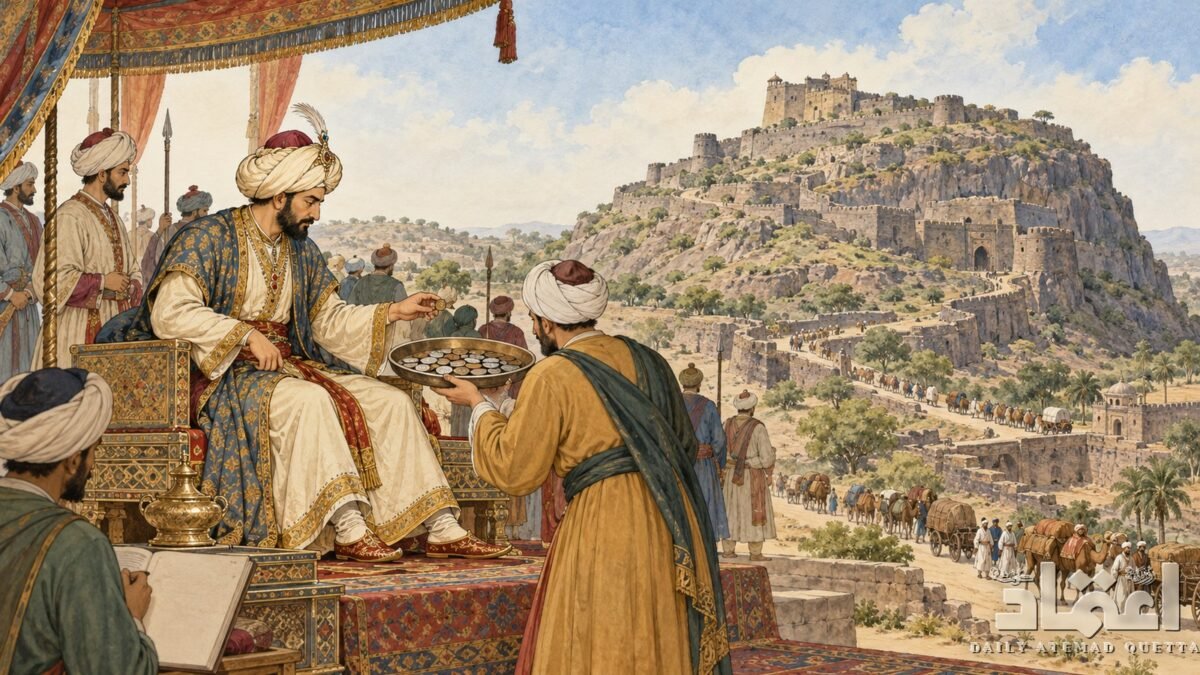
In the history of the subcontinent, the name of Muhammad bin Tughluq is usually linked with two experiments: moving the capital from Delhi to the Deccan, and introducing coins of a cheaper metal in place of silver. He ruled from 1325 to 1351. According to Britannica, his reign was both the high point of the Delhi Sultanate and the beginning of its decline. For a time, he extended the sultanate’s borders over a large part of the subcontinent.
Education and accession
According to Britannica, Muhammad bin Tughluq was born in Delhi around 1290. He was the son of Ghiyath al-Din Tughluq, founder of the Tughluq dynasty. Little is known about his childhood, but Britannica says he received a good education and had wide knowledge of subjects such as astronomy, logic, philosophy, medicine and rhetoric. He became sultan in 1325 after his father’s death.
According to Britannica, the historian Ziauddin Barani was his close companion and adviser for 17 years, and Barani’s book is the most important source for his reign.
The second capital: Daulatabad
In 1327, Muhammad bin Tughluq made the Deccan city of Devagiri, which was renamed Daulatabad, his second capital. According to Britannica, the aim was to strengthen control over southern India, and for this a large number of people from Delhi were moved to Daulatabad, in some cases by force. Britannica says that from Daulatabad the sultan could better oversee the fertile Deccan and Gujarat, and could reach the western and southern ports more easily, while the city was also at a safe distance from Mongol raids from the north-west.
According to Britannica, the administrative plan failed, because rebellions in the north soon forced the sultan to return to Delhi. But its cultural effects were far-reaching: Britannica writes that the spread of the Urdu language in the Deccan can be traced to this large migration.
Coinage and token currency
According to Britannica, Muhammad bin Tughluq made several reforms to the coinage, and his coins were better than those of his predecessors in design, craftsmanship and purity of metal.
His most famous experiment was a token currency: coins of cheaper metal whose official value was set equal to that of silver coins. According to Britannica, the experiment failed badly. Britannica gives a shortage of precious metals as the background: after Bengal and the southern provinces slipped from his hands, Delhi was cut off from important supply routes for gold and silver, while horses for the army were very expensive. According to Britannica, an ordinary Central Asian horse then cost 100 silver tankas, and a fine Arabian or Iranian horse from 1,000 to 4,000 tankas. In response to this crisis, the sultan reduced the weight of coins and tried the token currency.
Agriculture and famine
Muhammad bin Tughluq’s agricultural policies are less well known but important. According to Britannica, he was the first ruler to introduce rotation of crops, set up state farms, and improve artificial irrigation by creating a separate department of agriculture.
A famine struck northern India from 1338 to 1340. According to Britannica, the sultan moved his residence to Swargdwari to supervise relief for the famine victims himself. Britannica says he was the first Indian ruler in history to give farmers loans (taqavi) to rebuild villages after a famine.
Diplomacy with China and Ibn Battuta
According to Britannica, the expedition to Qarajal (Garhwal and Kumaon) in the northern hill states failed, but it was followed by an exchange of envoys between China and Delhi.
Muhammad bin Tughluq’s court drew scholars from far away. Among them was the famous Moroccan traveller Ibn Battuta. According to Britannica, Ibn Battuta served as a qazi in Delhi, and his travelogue gives a detailed account of Delhi and the sultan’s court of that time.
Difficulties
According to Britannica, Muhammad bin Tughluq faced 22 rebellions during his reign. After 1335, the southern provinces broke away one by one, and in 1347 the Bahmani Sultanate was founded in the Deccan. In 1328-1329, the land tax in the Doab was raised, which, combined with drought, caused severe hardship.
Death
According to Britannica, Muhammad bin Tughluq’s last campaign was in pursuit of a rebel chief in Gujarat, and he died during it on 20 March 1351 at Sonda in Sindh. He was succeeded as sultan by his cousin Firoz Shah Tughluq.
Legacy
Britannica counts Muhammad bin Tughluq among the most controversial and complex figures of the 14th century. Many of his schemes failed, but aspects such as the craftsmanship of his coins, the department of agriculture, taqavi loans during famine, and the beginnings of Urdu in the Deccan through Daulatabad still draw the attention of students of history.
Sources
- "Muḥammad ibn Tughluq", Encyclopaedia Britannica. https://www.britannica.com/biography/Muhammad-ibn-Tughluq
- Encyclopaedia Britannica, "India: The Tughluqs". https://www.britannica.com/place/India/The-Tughluqs
- Encyclopaedia Britannica, "Ibn Battuta". https://www.britannica.com/biography/Ibn-Battuta
 More from E-Magazine
More → Mungo Park: the Scottish surgeon who found the direction of the Niger
 Nasim-ul-Ghani: 16-year-old Test cricketer who scored a century at Lord's
 Orellana: the first voyage down the Amazon
 Orhan: the Ottoman ruler who made Bursa his capital
 Pedro Álvares Cabral: Brazil
 Piri Reis map: the 1513 chart that may carry traces of Columbus
 Portuguese sailor Gil Eanes rounds Cape Bojador in 1434
 Qabus ibn Wushmgir: the scholar-ruler of Gorgan and his brick tower