
James Cook: three voyages across the Pacific
Between 1768 and 1779, an English navigator crossed the Pacific three times, reaching Antarctic ice in the south and a wall of ice beyond the Bering Strait in the north.
From 1768 to 1779, over eleven years, an English navigator crossed the Pacific Ocean three times. In the south he reached the ice of Antarctica. In the north he went beyond the Bering Strait to a wall of ice. His name was James Cook. In the words of Britannica, he changed the map of the world more than any other individual.
From coal ships to the navy
According to the Encyclopaedia Britannica, Cook was born on 27 October 1728 in the village of Marton in Yorkshire, England, to a farm labourer. At the age of 18, in 1746, he became an apprentice to John Walker, a shipowner of Whitby, whose ships carried coal across the North Sea. In winter, when the ships were laid up for repairs, Cook studied mathematics at night. In 1755 he joined the Royal Navy as an ordinary seaman. From 1763 to 1767 he surveyed the coasts of Newfoundland.
First voyage: the transit of Venus
According to Britannica, in 1768 the Royal Society of London and the navy were jointly preparing the first scientific expedition to the Pacific. Cook, then 40, was made its commander. He was given a sturdy Whitby-built coal carrier, named the "Endeavour". She was of 368 tons and less than 30 metres long. According to W. J. L. Wharton, who edited Cook’s journal in 1893, there were 94 men aboard. The scientists were headed by 26-year-old Joseph Banks. With him was the Swedish botanist Daniel Solander.
The stated purpose of the expedition was to observe the transit of Venus across the Sun. According to Royal Museums Greenwich, the ship sailed in the summer of 1768 and reached Tahiti in April 1769. Of 3 June 1769 Cook writes: "Not a cloud was to be seen the whole day, and the air was perfectly clear." But a faint halo around the planet made it hard to fix the moments of contact. The times recorded by the three observers differed far more than expected. According to Greenwich, the observation was only partly successful.
New Zealand, Australia and the coral reef
According to Greenwich, Cook also carried secret instructions to search in the south for the hypothetical great continent believed to exist at the time. Britannica writes that Cook charted the whole of New Zealand in six months. According to Greenwich, he showed that it was not part of any large continent. Then, on 19 April 1770, he reached the south-eastern coast of Australia. He surveyed as he sailed north along its eastern coast, about 3,200 kilometres long.
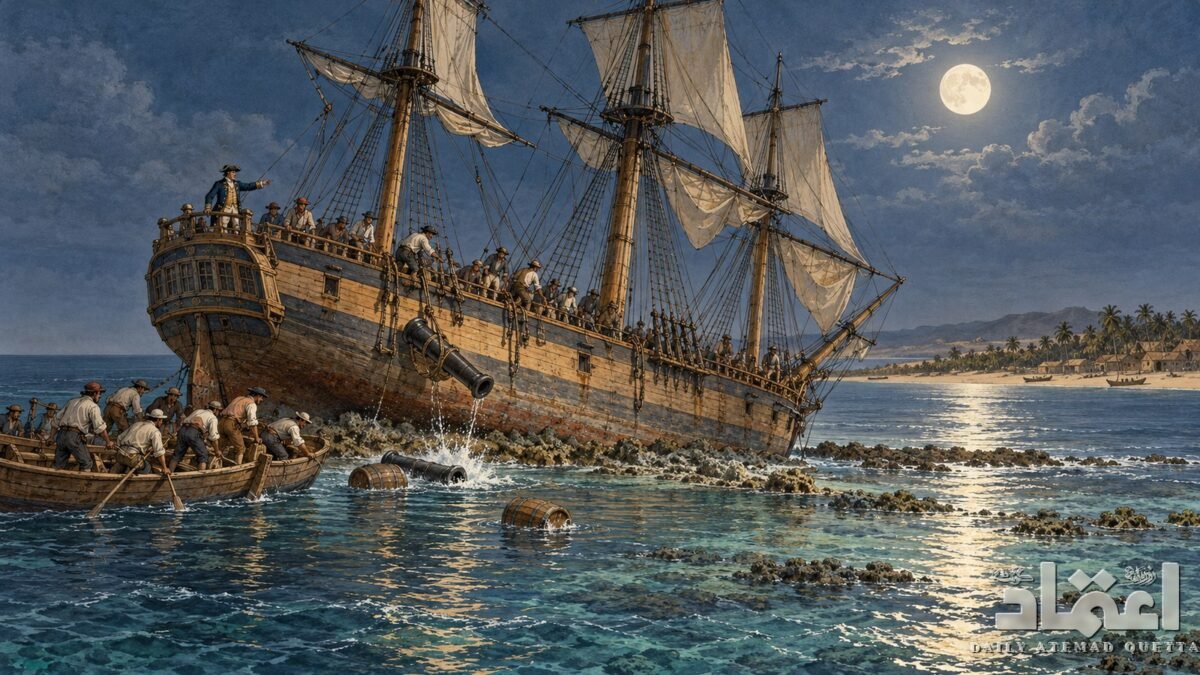
On the way lay the coral reefs of the Great Barrier Reef. According to Cook’s journal, on a moonlit night in June 1770, shortly before eleven o’clock, "the ship struck and stuck fast". To lighten her, the crew threw overboard guns, iron and stone ballast, casks and old stores, up to 40 or 50 tons. The next night the ship floated off with the tide, but she was leaking badly. According to Wharton’s notes, she was repaired in a nearby river, now called the Endeavour River.
On the return voyage, at Batavia in Java (today’s Jakarta), 30 men died of fever and dysentery, according to Britannica. But no one died of scurvy during the whole voyage. Cook insisted on cleanliness and ventilation, and fed the crew malt, sauerkraut (fermented cabbage) and orange extract. According to Cook’s journal, on 13 July 1771 the ship anchored in the Downs, off the English coast.
Second voyage: across the Antarctic Circle
According to Britannica, from July 1772 to July 1775 Cook sailed in the "Resolution", also built at Whitby, together with her companion ship the "Adventure". According to the Canterbury Museum in New Zealand, on 17 January 1773 the two ships crossed the Antarctic Circle (66 degrees 33 minutes south). The museum says this was the first recorded crossing of the circle. Later the two ships were separated in fog. According to Greenwich, the Adventure’s captain, Tobias Furneaux, sailed from New Zealand back to England.
Cook went beyond 70 degrees south, but according to Britannica he found no trace of a southern continent. On this voyage he charted Tonga and Easter Island, discovered New Caledonia, and reached South Georgia and the South Sandwich Islands in the Atlantic Ocean. Again no one died of scurvy. On his return Cook was elected a Fellow of the Royal Society. He received the society’s Copley Medal for the paper written on his work against scurvy.
Third voyage: the wall of ice in the north
One secret of the Pacific remained: was there a sea passage around North America linking the Atlantic and the Pacific? According to Britannica, in July 1776 Cook set out again on the Resolution, with another Whitby ship, the "Discovery", on this search. According to the official account, on the morning of 18 January 1778 an island suddenly came into view in the North Pacific, then another. According to Greenwich, Cook named these islands (today’s Hawaii) the "Sandwich Islands", after the Earl of Sandwich, head of the navy.
From there the ships went to Nootka Sound on the west coast of North America. They then charted the Alaskan coast, passed through the Bering Strait and reached the north. Cook writes that on 17 August 1778 the glare of ice was seen on the horizon, and then a vast field of ice came into view. The next day, at 70 degrees 44 minutes north, they were at the edge of the ice, which was "as compact as a wall" and appeared at least ten or twelve feet high. There were countless walrus on the ice. Cook named one tip of nearby land, surrounded by ice, "Icy Cape". There was no way forward.
The end in Hawaii
The ships returned to Hawaii to spend the winter. According to Greenwich, they left in February 1779, but had to turn back two days later when the Resolution’s foremast broke. According to Britannica, there was a brief clash with local people over the theft of a boat. On 14 February 1779 Cook was killed on the shore of Kealakekua Bay. According to Greenwich, Captain Clerke took command after him but died of tuberculosis six months later. Lieutenant Gore brought both ships back to England in October 1780.
Next instalment: La Pérouse: the lost French expedition.
Sources
- Alan John Villiers and Britannica Editors, "James Cook", Encyclopaedia Britannica (early life; Endeavour; New Zealand and Australia; Batavia and scurvy; second and third voyages; death). https://www.britannica.com/biography/James-Cook
- Royal Museums Greenwich, "Captain James Cook timeline". https://www.rmg.co.uk/stories/maritime-history/captain-james-cook-timeline
- Captain Cook's Journal during his First Voyage Round the World made in H.M. Bark "Endeavour" 1768–71, edited by W. J. L. Wharton, London, Elliot Stock, 1893 (introduction; entries for 3 June 1769, 11–12 June 1770, 13 July 1771). Project Gutenberg #8106. https://www.gutenberg.org/ebooks/8106
- James Cook and James King, A Voyage to the Pacific Ocean … performed under the direction of Captains Cook, Clerke, and Gore, in His Majesty's ships the Resolution and Discovery, in the years 1776, 1777, 1778, 1779, and 1780, vol. II, London, 1784 (January 1778; 17–18 August 1778, Icy Cape). https://archive.org/details/voyagetopacifico02cook
- Canterbury Museum (Christchurch), "Milestones and medals: Antarctica celebrates a 250th anniversary" (17 January 1773 crossing). https://www.canterburymuseum.com/explore/our-stories/milestones-and-medals-antarctica-celebrates-a-250th-anniversary
- J. C. Beaglehole (ed.), The Journals of Captain James Cook on his Voyages of Discovery, Hakluyt Society Extra Series, Cambridge University Press, 1955–1967 (standard edition; listed for readers, not consulted online).
 More from E-Magazine
More → John Cabot: the voyage that reached the North American coast in 1497
 Kaká: the fast-running star who led AC Milan to European glory
 Karl-Heinz Rummenigge: German forward who won the Ballon d'Or twice
 Keith Miller: Australia's daring all-rounder
 Kenny Dalglish: Celtic and Liverpool's goal-scoring forward
 Khan Mohammad: the bowler who took Pakistan's first Test wicket
 King Dinis: Portugal's farmer king and founder of its first university
 Kylian Mbappé becomes World Cup's all-time top goalscorer with 22 goals