
King Dinis: Portugal’s farmer king and founder of its first university
Portugal remembers King Dinis, who ruled from 1279 to 1325, as the "Farmer King" and the "Poet King" for his farming policies, verse and first university.
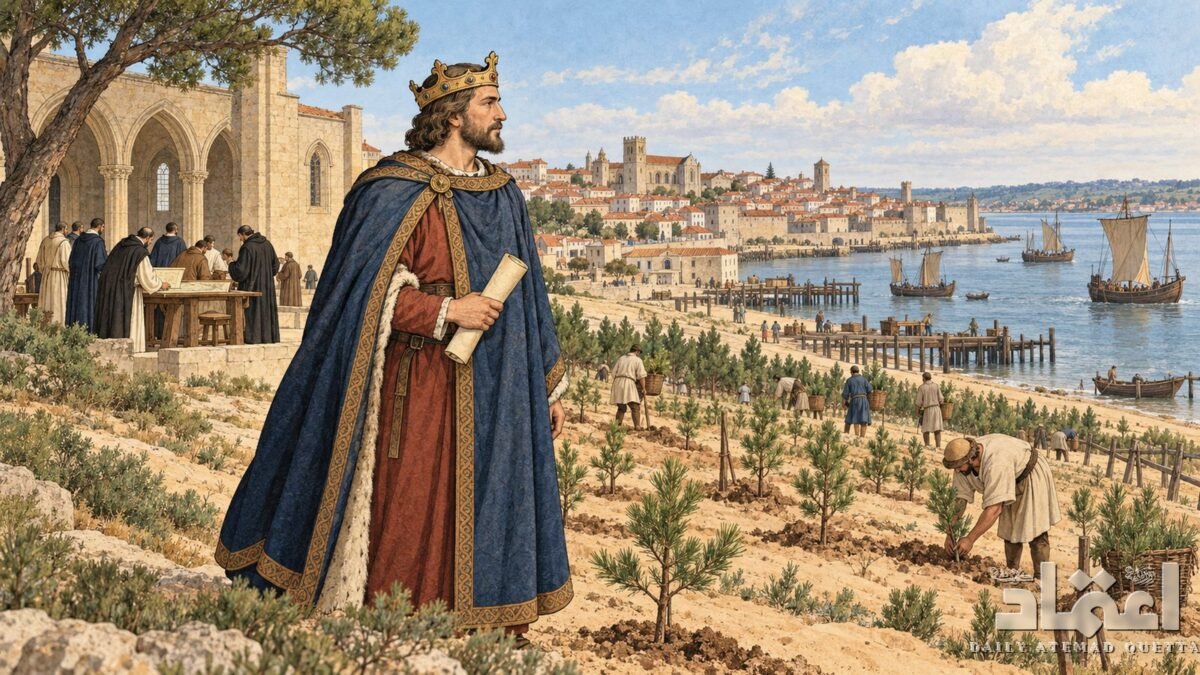
On the western edge of Europe, Portugal still remembers one king by two titles: the “Farmer King” (Rei Lavrador) and the “Poet King” (Rei Poeta). He was King Dinis, who ruled from 1279 to 1325, a reign of about 46 years. According to Britannica, he strengthened his kingdom by improving the economy and consolidating royal authority, and in 1290 he founded Portugal’s first university.
Early life
According to Britannica, Dinis was born on 9 October 1261. He was the son of King Afonso III of Portugal. He was educated at a court that bore the cultural influence of both France and Castile, and, according to Britannica, he became a fine poet himself. His mother was the daughter of King Alfonso X of Castile. Dinis became king in 1279, after the death of his father.
Fixing the border
According to Britannica, Dinis was a skilled negotiator and agreed a final border between Portugal and Castile. The treaty was signed at Alcañices in 1297. It is generally said that the border settled in that treaty remains the basis of the frontier between Portugal and Spain today. Peace between the two countries followed for several decades. Dinis is regarded chiefly as an administrator rather than a warrior king.
The Farmer King
Dinis’s best-known title, “Farmer King”, comes from his agricultural policies. According to Britannica, he took a special interest in the land, encouraged the planting of forests, and wanted to develop the country’s agricultural resources fully.
The best-known example is the large pine forest near Leiria. It is generally said that Dinis had the forest planted so that coastal sand would not advance and damage farmland, and so that its timber could be used to build royal ships. The forest survived for centuries. He set up regular markets and fairs in several towns, fixed their rules, and founded new towns.
Shipbuilding and trade
According to Britannica, Dinis also took a keen interest in expanding and protecting shipbuilding and trade. It is generally said that in 1308 he made Portugal’s first trade agreement with England. In 1317 he appointed Manuel Pessanha, an experienced Genoese seafarer, as hereditary admiral of the Portuguese fleet, on condition that he supply 20 Genoese captains to command the royal ships. In this way the royal fleet of Portugal gained permanent leadership.
The first university
According to Britannica, Dinis founded Portugal’s first university in Lisbon in 1290. It was called the “Estudo Geral”, or “general school”, and taught arts, law and medicine. In 1309 the king gave it a formal charter of privileges.
The university later moved to Coimbra. According to UNESCO, the University of Coimbra began as a school in the late 13th century, was permanently established in the royal palace of Alcáçova in 1537, and over seven centuries grew into a complete university city. UNESCO has declared it a World Heritage Site and says the university has had a deep influence on education and literature across the Portuguese-speaking world.
Language and literature
Under Dinis, the Portuguese language gained official status. It is generally said that he ordered the language of the people, Portuguese, to be used in place of Latin in the courts and in legal proceedings.
He was himself a poet in Galician-Portuguese. Many of his songs (cantigas) survive, and he was a patron of the poets and singers (troubadours) of his time. He also had a number of literary and scholarly books translated into the language.
Final years and death
According to Britannica, Dinis’s last years were troubled by the rebellion of his son, the future Afonso IV. According to Britannica, Dinis died on 7 January 1325, and Afonso IV succeeded him. He was buried at Odivelas, near Lisbon.
Legacy
Dinis made his name through administration, agriculture, trade and education rather than war. The settled border, the official status of Portuguese, the organisation of the fleet and the first university are all achievements of his reign that remained part of Portugal’s identity for centuries.
Sources
- Encyclopaedia Britannica, "Dinis". https://www.britannica.com/biography/Dinis
- UNESCO World Heritage Centre, "University of Coimbra – Alta and Sofia". https://whc.unesco.org/en/list/1387/
- Wikipedia, "Denis of Portugal" (pointer only: nicknames, Treaty of Alcañices, Leiria pine forest, markets and towns, 1308 agreement with England, Manuel Pessanha, Estudo Geral and its 1309 charter, Portuguese in the courts, poetry, burial at Odivelas). https://en.wikipedia.org/wiki/Denis_of_Portugal
 More from E-Magazine
More → Kylian Mbappé becomes World Cup's all-time top goalscorer with 22 goals
 La Pérouse: the French expedition that vanished in the Pacific
 Len Hutton: 364 at The Oval and England's first professional captain
 Logarithms: the trick that turns multiplication into addition
 Luka Modric: Croatia captain and 2018 Ballon d'Or winner
 Magellan and Elcano: the first voyage round the world
 Malik-Shah I: Isfahan, Omar Khayyam and the era of the Jalali calendar
 Manuel Neuer: the goalkeeper who plays outside his goal