
Keith Miller: Australia’s daring all-rounder
Keith Miller was the player who did most to light up cricket grounds in the years after the Second World War, scoring 2,958 Test runs and taking 170 wickets.
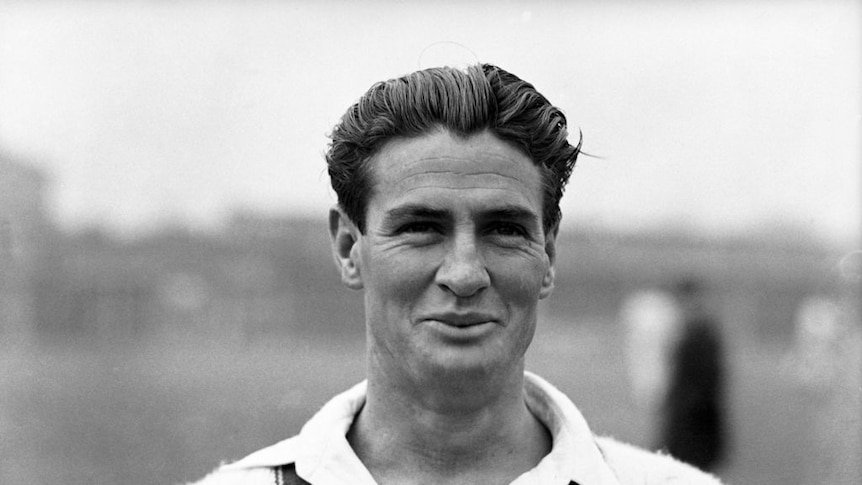
If one player did more than any other to brighten cricket grounds in the years after the Second World War, it was Australia’s Keith Miller. He could turn a match in a single innings or a single spell. In 55 Tests he scored 2,958 runs at an average of 36.97 and took 170 wickets at 22.971. According to ESPNcricinfo, he was one of Australia’s finest all-rounders and one of the best in the world2.
Early life and start in cricket
Keith Ross Miller was born on 28 November 1919 in Sunshine, Melbourne. He was named after two famous Australian aviators, Keith and Ross Smith, and his teammates called him “Nugget”3. He was a right-handed batter and a right-arm fast bowler2.
Domestic cricket in Australia is played between state teams. Miller began as a batter. In his first first-class match, for Victoria against Tasmania in Melbourne in 1937-38, he scored 181. In the Second World War he was a fighter pilot. His 105 in the first “Victory Test” at Lord’s in 1945 drew international attention to him. He later played for New South Wales as well2.
In the first Test against New Zealand in Wellington on 29 March 1946, he scored 30 and took 2 wickets for 6 runs in 6 overs1.
Match-winner with ball and bat
In the Ashes Test against England in Brisbane in November 1946, he first scored 79 and then took 7 wickets for 60, the best bowling figures of his career. In the same series he made an unbeaten 141 in Adelaide1.
Don Bradman’s side needed Miller more as a bowler than as a batter. According to ESPNcricinfo, he was the perfect partner for Ray Lindwall. Against Lindwall’s smooth, fast deliveries, Miller came in off a short run-up but could bowl a lightning-fast ball whenever he wished, or sometimes leg-spin, a yorker or a bouncer2. According to the ICC, the pairing of Lindwall and Miller with the new ball is famous in Test history3.
During the 1948 tour of England, spectators jeered him in the Nottingham Test for bowling too many bouncers. He sat down on the field and waited for the noise to die down. In the same Test he took 4 wickets for 1251. According to ESPNcricinfo, he suffered from back trouble throughout that tour but kept bowling. On the same tour, Australia scored 721 in a day against Essex at Southend. Uninterested in such a one-sided contest, Miller stepped aside from the first ball and was bowled2.
In the Sydney Test against England in January 1951, he took 4 wickets for 37 and scored an unbeaten 145. In 1951-52 against the West Indies he scored 129 in Sydney, took 5 for 60 in Melbourne and 5 for 26 in Sydney1. West Indies captain John Goddard once said: give us Keith Miller and we will beat the world2.
West Indies 1955 and Lord’s 1956
The 1955 tour of the West Indies was the peak of his batting. He scored 147 in Kingston, 137 in Bridgetown and then 109 in Kingston. In the same final Test of the series he also took 6 wickets for 1071.
In 1956, on his third and last tour of England, he was nearly 37 and hoped not to bowl much. But Lindwall was ruled out of the Lord’s Test, and his replacement, Pat Crawford, was injured in his fifth over. Miller carried the load. He took 5 for 72 in 34.1 overs in the first innings and 5 for 80 in 36 overs in the second. That gave him 10 wickets for 152 in the match, the best bowling figures of his career in a Test. According to ESPNcricinfo, it was Australia’s only win in that series. He had scored 109 at Lord’s in 1953, and so he is one of three visiting players whose names appear on the Lord’s honours boards for both batting and bowling. The other two are Garry Sobers and Vinoo Mankad12.
His last Test began against Pakistan in Karachi on 11 October 1956. He scored 21 and 11 and took 2 wickets for 401.
Statistics
| Tests | |
|---|---|
| Matches | 55 |
| Runs | 2958 |
| Highest score | 147 |
| Average (batting) | 36.97 |
| Centuries / half-centuries | 7 / 13 |
| Wickets | 170 |
| Best bowling | 7/60 |
| Average (bowling) | 22.97 |
| Five wickets in an innings | 7 |
Source: ESPNcricinfo Statsguru1. The figures are for his international career.
Influence and legacy
Of Miller’s 7 Test centuries, 3 came against England and 4 against the West Indies1. He never captained Australia, but according to ESPNcricinfo he led New South Wales impressively. After retirement he stayed involved in cricket as a journalist and columnist2.
He died on 11 October 2004 on the Mornington Peninsula, near Melbourne2. The celebrated writer Neville Cardus called him “an Australian at his fullest”. In 2009 the ICC inducted him into the Cricket Hall of Fame3. A player who could score a century in the morning and break up the opposition’s batting in the evening, Keith Miller remains the brightest example of an all-rounder in Australian cricket history.
Sources
- ESPNcricinfo Statsguru, Keith Miller, Test batting and bowling career summaries and innings lists: https://stats.espncricinfo.com/ci/engine/player/6612.html?class=1;template=results;type=batting , https://stats.espncricinfo.com/ci/engine/player/6612.html?class=1;template=results;type=batting;view=innings , https://stats.espncricinfo.com/ci/engine/player/6612.html?class=1;template=results;type=bowling , https://stats.espncricinfo.com/ci/engine/player/6612.html?class=1;template=results;type=bowling;view=innings
- ESPNcricinfo player profile, Keith Miller (archived copy; profile by Steven Lynch): https://web.archive.org/web/2016/http://www.espncricinfo.com/ci/content/player/6612.html
- ICC Cricket Hall of Fame, Keith Miller (archived copy, Apr 2026): https://web.archive.org/web/20260416075919/https://www.icc-cricket.com/hall-of-fame/hall-of-famers/hall-of-famer-keith-miller
 More from E-Magazine
More → Kenny Dalglish: Celtic and Liverpool's goal-scoring forward
 Khan Mohammad: the bowler who took Pakistan's first Test wicket
 King Dinis: Portugal's farmer king and founder of its first university
 Kylian Mbappé becomes World Cup's all-time top goalscorer with 22 goals
 La Pérouse: the French expedition that vanished in the Pacific
 Len Hutton: 364 at The Oval and England's first professional captain
 Logarithms: the trick that turns multiplication into addition
 Luka Modric: Croatia captain and 2018 Ballon d'Or winner