
John Cabot: the voyage that reached the North American coast in 1497
In May 1497 a small ship with about 20 men left Bristol under an Italian merchant known in England as John Cabot and sighted a coast across the Atlantic.
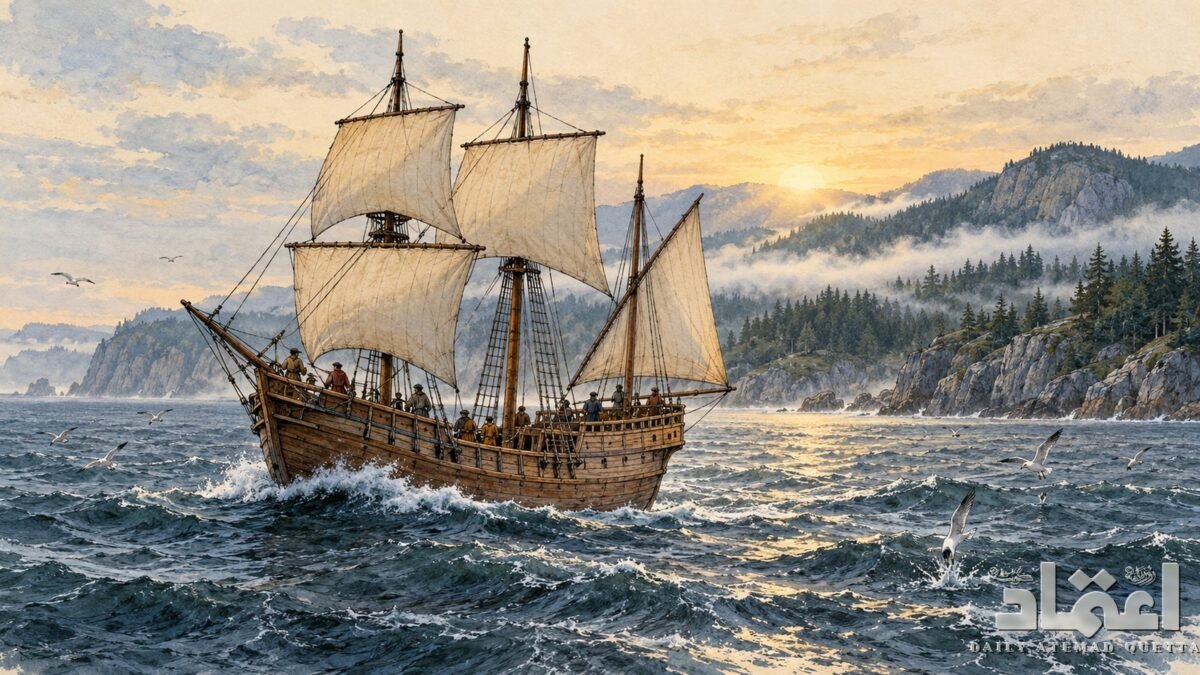
In May 1497, a small ship carrying about 20 men left the English port of Bristol. Its captain was an Italian merchant, a citizen of Venice, who was known to the English as John Cabot. In Italian his name was Giovanni Caboto. About five weeks later, the ship’s sailors sighted a coast across the Atlantic, in what is today part of North America. No journal of the voyage survives, but a few letters of the time have preserved its story.
From Venice to Bristol
Writing in The Canadian Encyclopedia, researcher Douglas Hunter says very little is known about Cabot’s early life. He was probably born in Italy before 1450 and became a citizen of Venice in 1476. In the early 1490s he was involved in harbour construction projects in Spain. He appeared in England in 1496.
On 5 March 1496, King Henry VII of England gave him royal letters patent. The document also names Cabot’s three sons, Lewis, Sebastian and Sancio. They were permitted to search the eastern, western and northern seas with five ships for unknown islands and countries, but at their own expense. The condition was that they must return only to the port of Bristol and that, after costs, one-fifth of the profit would go to the king.
According to Hunter, Cabot made his first attempt from Bristol in 1496 itself, but returned unsuccessful because of stormy weather.
The Matthew and her crew
The second attempt was made in May 1497 aboard a ship named the Matthew. According to the Newfoundland and Labrador Heritage website, she was a small vessel of 50 “tuns”, meaning she could carry about 50 tons of wine or other cargo. She had three masts. The same website says the ship was probably named after Cabot’s wife, Mattea.
Two accounts give different crew numbers: one letter says 20 men and another says 18. According to the Heritage website, besides Cabot the ship carried a surgeon from Genoa, a man from Burgundy, two merchants of Bristol and Bristol sailors.
Across the ocean: John Day’s letter
The most detailed account of the voyage is a letter written by the English merchant John Day to Spain’s “Lord Grand Admiral” in the winter of 1497-98. The letter was found in 1956 in the state archive at Simancas, Spain. Day writes that the ship left England around the end of May and that land was sighted after about 35 days. According to the Heritage website, land was probably sighted on 24 June 1497.
According to the letter, Cabot set foot on land at only one place, near where the land was first seen. There were tall trees of the kind used to make ship masts, and the land was full of grass. The sailors found a trail leading inland, a place where a fire had burned, animal dung and a carved and coloured piece of wood half a yard long. From these they concluded that the land was inhabited. Cabot did not go further inland than the range of a crossbow shot, and returned to the ship with fresh water.
The ship then sailed along the coast. Day writes that the whole coast was full of the fish which in Iceland are dried in the open air and sold to England, and which are called “stockfish” in English. At one place the sailors saw two figures running one behind the other on the shore, but could not tell whether they were human beings or animals. After sighting the coast for about a month, they turned back and reached the coast of Europe in 15 days. The sailors confused Cabot by telling him he was heading too far north, so the ship first landed in Brittany, in France. According to the Heritage website, Cabot returned to Bristol on 6 August.
The talk of London
On 23 August 1497, Lorenzo Pasqualigo, a Venetian merchant, wrote from London to his brothers that “our Venetian”, who had gone from Bristol in a small ship, had returned. He said Cabot claimed to have discovered a large land 700 leagues away, which he took to be the “country of the Grand Khan”, that is, Asia. Cabot had seen the coast for 300 leagues and met no one, but brought back snares for catching game and a needle for making nets. The king promised ten ships for the next spring, and people began calling Cabot the “Grand Admiral”.
On 18 December 1497, Raimondo di Soncino, the Milanese ambassador, wrote to his duke that Cabot had gone in a small ship with 18 men. His companions said the sea there was so full of fish that they could be caught not only with nets but also with baskets weighted with stones and lowered into the water. They said enough fish could be brought back that England would no longer need Iceland. According to Soncino, Cabot’s next plan was to sail further along the same coast until he reached Japan. According to John Day, the king fixed an annual pension of £20 for Cabot; according to Hunter, it was granted in December 1497.
1498: the last voyage
According to Hunter, Cabot received new royal letters patent in February 1498, and in early May a fleet of probably five ships sailed from Bristol. According to an old London chronicle, the accompanying ships were loaded with trade goods such as coarse cloth and caps. The fate of the fleet is still unknown. Hunter writes that at least one ship must have returned, because a 1500 map by the Spanish cartographer Juan de la Cosa marks this coast with the words “sea discovered by the English”. Cabot’s pension was paid until 1499, but no one knows when or where he died.
Where did Cabot land?
Researchers differ on where Cabot landed. Hunter believes the latitudes given by John Day point to southern Labrador and northern Newfoundland. According to the Heritage website, some researchers think ocean currents and compass variation would have pushed him well to the south, and southern sites such as Cape Breton have therefore also been proposed.
For the 500th anniversary of the voyage in 1997, an exact replica of the Matthew was built in Bristol. The ship left Bristol on 2 May 1997 with a crew of 19. According to the Heritage website, after 54 days at sea she reached the Newfoundland town of Bonavista on 24 June 1997.
Next instalment: Vasco da Gama: the sea route from Europe to India.
Sources
- James A. Williamson, The Cabot Voyages and Bristol Discovery under Henry VII, Hakluyt Society, Second Series no. 120, Cambridge University Press, 1962 (London chronicles of the 1498 voyage, pp. 220–23, as transcribed on the University of Bristol page "London Chronicles of John Cabot's voyage of 1498"). https://www.bristol.ac.uk/Depts/History/Maritime/Sources/1498chronicles.htm
- University of Bristol, Department of History, "The Smugglers' City" source pages: First letters patent to John Cabot, 5 March 1496 (from H. P. Biggar, The Precursors of Jacques Cartier, Ottawa, 1911, pp. 8–10); Lorenzo Pasqualigo to his brothers, 23 August 1497 (Biggar, pp. 14–15); Raimondo de Soncino to the Duke of Milan, 18 December 1497 (Calendar of State Papers, Milan, vol. I, 1912, no. 552). https://www.bristol.ac.uk/Depts/History/Maritime/Sources/1496cabotpatent.htm ; https://www.bristol.ac.uk/Depts/History/Maritime/Sources/1497pasqualigo.htm ; https://www.bristol.ac.uk/Depts/History/Maritime/Sources/1497soncino.htm
- John Day to the Lord Grand Admiral, winter 1497/8, English translation from L. A. Vigneras, "The Cape Breton landfall: 1494 or 1497. Note on a letter from John Day", Canadian Historical Review 38 (1957), pp. 219–28; University of Bristol source page. https://www.bristol.ac.uk/Depts/History/Maritime/Sources/1497johnday.htm
- Douglas Hunter, "John Cabot", The Canadian Encyclopedia, 2008, last edited 2017 (early life, letters patent, the three voyages, pension, landfall reading). https://www.thecanadianencyclopedia.ca/en/article/john-cabot
- Newfoundland and Labrador Heritage Web Site, "John Cabot's Voyage of 1497" and "The Matthew" (ship, crew, dates, landfall debate, 1997 replica). https://www.heritage.nf.ca/articles/exploration/cabot-1497.php ; https://www.heritage.nf.ca/articles/exploration/matthew.php
- Government of Newfoundland and Labrador, news release "Follow the Matthew on the World-Wide Web", 9 May 1997 (replica's departure on 2 May 1997 with a crew of 19). https://www.releases.gov.nl.ca/releases/1997/tcr/0509n06.htm
 More from E-Magazine
More → Kaká: the fast-running star who led AC Milan to European glory
 Karl-Heinz Rummenigge: German forward who won the Ballon d'Or twice
 Keith Miller: Australia's daring all-rounder
 Kenny Dalglish: Celtic and Liverpool's goal-scoring forward
 Khan Mohammad: the bowler who took Pakistan's first Test wicket
 King Dinis: Portugal's farmer king and founder of its first university
 Kylian Mbappé becomes World Cup's all-time top goalscorer with 22 goals
 La Pérouse: the French expedition that vanished in the Pacific