
Roberto Carlos: the left-back behind the impossible free-kick
Roberto Carlos was a Brazil left-back who won the 2002 World Cup and three European Cups with Real Madrid, and scored a famous free-kick against France in 1997.
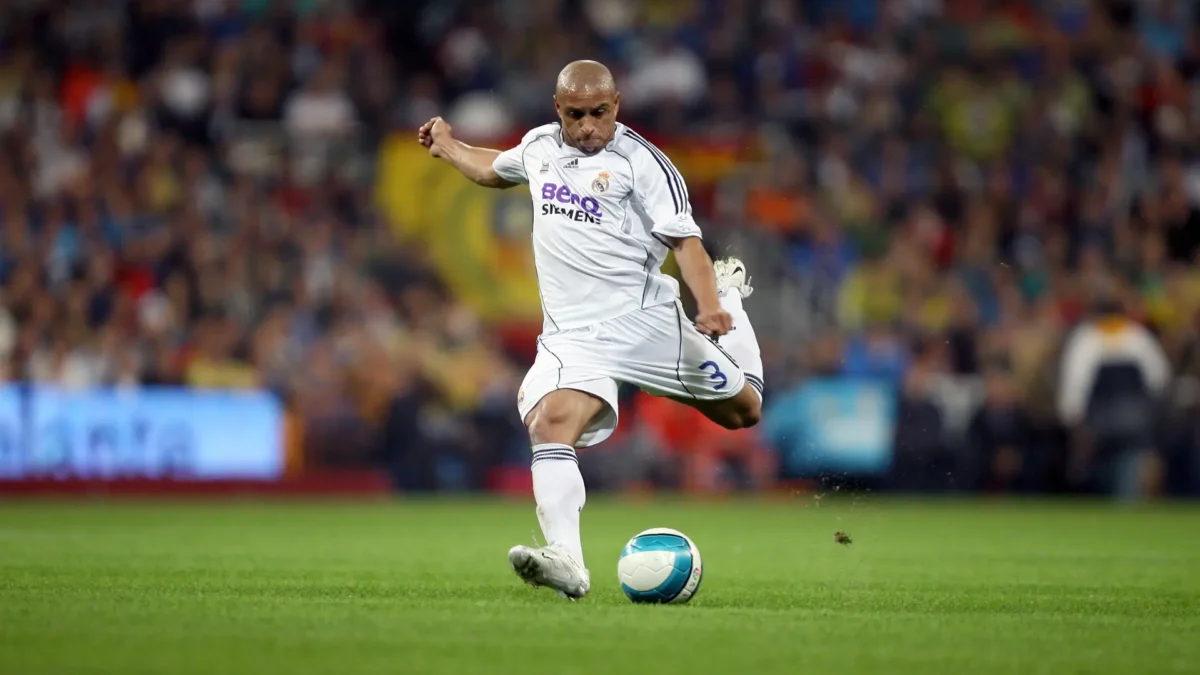
Roberto Carlos was a Brazil left-back who became world champion in 2002 and won the European Cup three times with Real Madrid2. Though a defender, he was known for his speed, his constant attacking runs down the left flank and a shot that flew like a bullet4. His 40-yard free-kick against France in 1997, which curled around the wall into the goal, is still counted among the most famous free-kicks in football1.
Early life and beginnings
Roberto Carlos was born on 10 April 1973 in Garça, a town in the Brazilian state of Sao Paulo. He began his career as a forward but soon became a left-back. In 1993 he joined Palmeiras, a major Sao Paulo club, and in 1995 the Italian club Inter Milan, where he spent one season4.
Club career
In 1996 Roberto Carlos joined Real Madrid and played there for eleven seasons. According to the club, he scored 69 goals in 527 official matches, and in that time Real Madrid won four Spanish league titles and three Champions League trophies (1998, 2000, 2002)2. According to Goal, 370 of his matches were in the Spanish league3. He also remained a regular on the left in the “Galacticos” side of Zinedine Zidane, Luis Figo, Ronaldo and David Beckham, and in later years was among the club’s captains, along with Raul and Guti4.
In 2007 he moved to the Turkish club Fenerbahce, and later played for Corinthians in Brazil and Anzhi Makhachkala in Russia4.
International career
Roberto Carlos began playing for Brazil in 1992 and played in three World Cups4. On 3 June 1997, in a tournament called Le Tournoi, a year before the World Cup in France, Brazil and France met in Lyon. In the 21st minute, Didier Deschamps brought down Romario about 40 yards from goal. According to Sky Sports, captain Dunga was standing over the ball but stepped aside for Roberto Carlos, who began his run from inside the centre circle. The ball first appeared to be going well wide of the right side of the wall, then bent in the air, struck the post and went into the goal past goalkeeper Fabien Barthez. The match ended 1-1. Roberto Carlos himself said: “When the ball left my boot, I thought it would go well wide.” He also said: “A goal like that happens only once in a career”1. Students at the University of Leicester in Britain later wrote a research paper on the physics of the kick5.
A year later, in the 1998 World Cup final, Brazil lost to France1. But in 2002, in Japan and South Korea, Brazil won their fifth World Cup, and Roberto Carlos was the regular left-back of that team. Earlier, Brazil had won the Copa America in 1997 and 1999 and the Confederations Cup in 1997. He played 125 matches for Brazil and left the national team after the 2006 World Cup4.
Style of play
Roberto Carlos was short but had very strong legs. As a left-back, he ran up and down the entire flank, and in attack he either crossed like a winger or took shots himself. The speed of his free-kicks and long-range shots was his trademark. Speaking about the Lyon free-kick, he said: “I only wanted to hit the post, nothing more”1. In 1997 he finished second in the FIFA World Player of the Year voting, which was unusual for a defender4.
Statistics
| Team | Years | Matches | Goals |
|---|---|---|---|
| Real Madrid | 1996–2007 | 527 | 69 |
| Brazil | 1992–2006 | 125 | — |
The Real Madrid figures are from the club’s website and ESPN (all official matches). Wikipedia gives 584 matches and 71 goals in a separate count. Brazil’s 125 matches are from Wikipedia. The number of goals (10 or 11) is disputed, so it is not listed here. The full figures for his other clubs could not be confirmed from a reliable source. These figures were collected on 20 October 2026234.
Honours
- FIFA World Cup: 2002 [4]
- Copa America: 1997, 1999 [4]
- FIFA Confederations Cup: 1997 [4]
- UEFA Champions League: 1998, 2000, 2002 [2][4]
- Spanish league: 4 times [2][4]
- FIFA World Player of the Year: second place in 1997 [4]
Legacy
Roberto Carlos showed that a full-back could also be a team’s most dangerous attacking weapon. After him, attacking full-backs became still more common in Brazil and Europe4. The Lyon free-kick, still shown again and again nearly thirty years later, is his most famous moment1.
Sources
- Sky Sports, "Roberto Carlos' brilliant Brazil free-kick against France remembered", 3 June 2017, https://www.skysports.com/football/news/11095/10899358/roberto-carlos-brilliant-brazil-free-kick-against-france-remembered
- Real Madrid CF, "Roberto Carlos" (club legends), https://www.realmadrid.com/es-ES/el-club/historia/leyendas-futbol/roberto-carlos-da-silva
- Goal, "Marcelo ya suma 300 partidos con el Real Madrid en LaLiga", https://www.goal.com/es/noticias/marcelo-ya-suma-300-partidos-con-el-real-madrid-en-laliga/1bpesjf8s2kpc188gl73j9tafb
- Wikipedia, "Roberto Carlos" (pointer; accessed 20 October 2026), https://en.wikipedia.org/wiki/Roberto_Carlos
- University of Leicester, Journal of Physics Special Topics, "S4_4 Roberto Carlos' 'Impossible' Free Kick", https://journals.le.ac.uk/index.php/pst/article/view/2500
 More from E-Magazine
More → Romário: the king of the penalty area
 Sadiq Mohammad: the left-handed opener of the Mohammad brothers
 Saeed Ahmed: the batsman of big centuries and glorious drives
 Samuel Eto'o: the striker who won back-to-back trebles
 Sana Mir: Pakistan women's cricket captain and trailblazer
 Seydi Ali Reis: the Ottoman admiral who came home via Gwadar, Sindh and Central Asia
 Steven Gerrard: the captain of the Istanbul night
 Sultan Sanjar: the Seljuk ruler of Merv and his domed mausoleum