
Ibn Jubayr’s travelogue: Granada to Mecca and back, through storms at sea
A dark night, a storm at sea, a broken rudder and a useless anchor. Passengers await death. At dawn, the shore and city lie less than half a mile away.
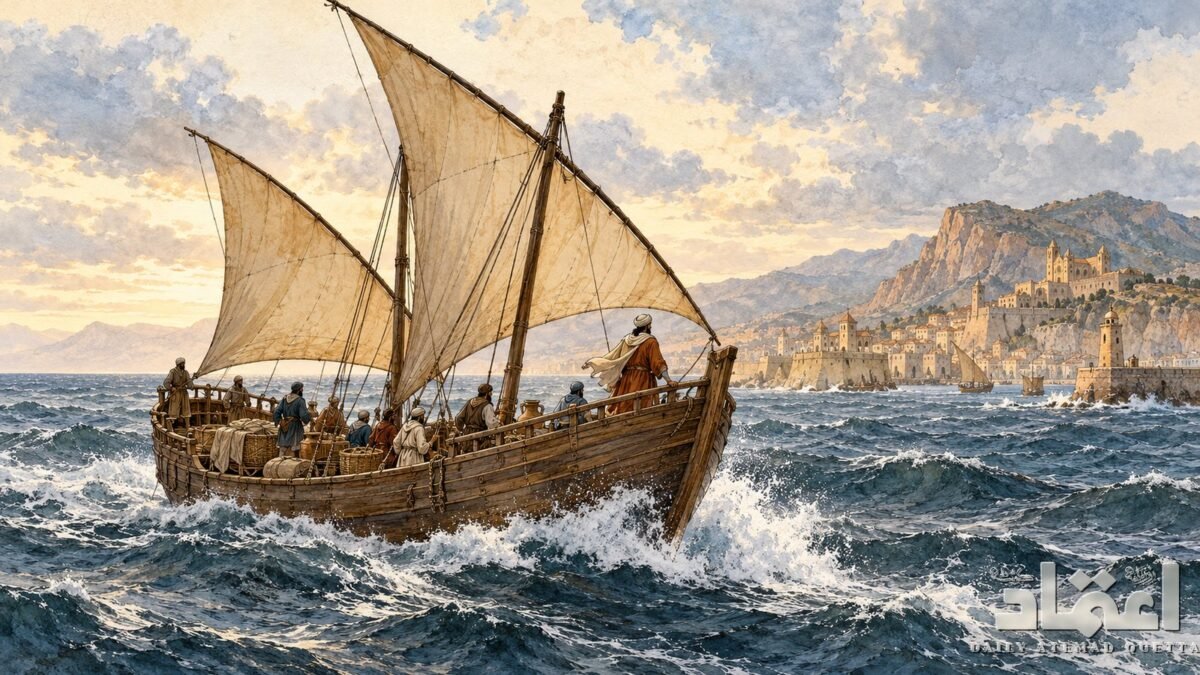
A dark night, a storm at sea, a broken rudder and an anchor that does not work. The passengers are waiting for death. Then morning comes, and the shore and the city are found to be less than half a mile away. This scene is not from a film. It comes from the diary of a 12th-century Andalusian pilgrim named Ibn Jubayr, whose travelogue is counted among the foundational books of the Arabic genre called "rihla".
Departure from Granada
Ibn Jubayr’s full name was Abul Hussain Muhammad bin Ahmad bin Jubayr al-Kinani. According to Encyclopaedia Britannica, he was born in Valencia, Andalusia, in 1145, served as secretary to the Almohad governor of Granada, and died in Alexandria in 1217.
His travelogue is written like a diary, entry by entry, and its very first page gives dates. He writes that he left Granada for the Hijaz on Thursday, 8 Shawwal, which was 3 February by the non-Arab calendar. This was February 1183. He crossed the Strait of Gibraltar and reached Ceuta. On 24 February he sailed on a Genoese ship. After 30 days at sea, he landed at Alexandria on 26 March.
From Egypt to the Red Sea
After Alexandria and Cairo, Ibn Jubayr took the pilgrimage route that was common at the time. He went by boat up the Nile to Qus in the south, then crossed the desert to the Red Sea port of Aidhab, and from there sailed across the sea to Jeddah.
One scene on this desert route is linked to our own region. Ibn Jubayr writes that he tried to count the caravans going and coming but could not, especially the caravans of Aidhab carrying Indian goods that reached Yemen first and then Aidhab from Yemen. Most of the cargo was black pepper, and so much of it that Ibn Jubayr felt it was worth no more than dust. He also writes that loads of pepper, cinnamon and other goods lay by the roadside without guards. When camels grew tired, their owners left the goods there. Despite countless passers-by, the goods stayed safe until the owner came back and took them. Thus one end of the Indian Ocean trade, which started from the coasts of the subcontinent, extended to the Egyptian desert.
Mecca, Medina and Baghdad
Ibn Jubayr’s travelogue describes Mecca and Medina in detail. After the Hajj he did not go straight home. He travelled via Medina towards Iraq, passed through Baghdad, Mosul and Damascus, and reached the coast of Syria.
About Baghdad, he writes that there were usually two bridges over the Tigris, but a flood had swept one away. People therefore crossed in boats. The boats were countless, and men and women kept coming and going in them day and night. He described the city’s famous hospital (maristan). In his words, it is a large palace-like building on the bank of the Tigris, with rooms and every facility for residence. Physicians come every Monday and Thursday to examine the patients and prescribe the medicines and food they need, and attendants prepare them. This account, written eight centuries ago, presents the picture of an organised hospital.
From Acre to Sicily: three months at sea
For the return journey, Ibn Jubayr reached Acre on the Syrian coast. He writes that on Monday, 23 Jumada, the first day of October, he paid his fare on a large ship bound for Messina in Sicily. People said the voyage took ten to fifteen days, so the cautious carried provisions for 30 days. But Ibn Jubayr writes in astonishment that he saw three new moons at sea: those of Rajab, Shaban and Ramadan.
The storm mentioned at the start came at the end of this voyage. Wind and waves battered the ship until one of its rudders broke. The anchor was dropped but was useless, and its rope had to be cut. When the sailors lowered a small boat, the waves smashed it against the shore. When morning came, the city of Messina lay less than half a mile ahead. According to Ibn Jubayr, William, the King of Sicily, himself came to the shore with his men to watch the scene, and boats came from the city to take the passengers off.
In Sicily he also wrote about volcanic mountains. From the sea he saw smoke rising continually from two islands, and flames of fire at night. He was told that a strong wind rising from inside makes the fire and sometimes throws large stones into the air. Of the island’s great mountain, which he calls "Jabal al-Nar" (the Mountain of Fire), he writes that in some years fire flows from it like a flood, burning everything in its path until it reaches the sea.
On 28 December he set out for Trapani, a city in western Sicily, because two ships were anchored there, one bound for Andalusia and the other for Ceuta. The continuous villages and fields along the way reminded him of the fertile land around Cordoba.
Return home and the value of the travelogue
Ibn Jubayr finally reached his home in Granada on Thursday, 22 Muharram, which was 25 April. It was the spring of 1185. He writes that two full years and three and a half months passed between leaving Granada and returning.
The orientalist William Wright first published the Arabic text of the travelogue in 1852. The Dutch scholar M. J. de Goeje brought out a revised edition in 1907. According to Wright’s preface, Ibn Jubayr’s literary fame among the people of Andalusia rested on his poetry and especially on this travelogue, which he wrote during his first journey to the East. The complete text survives in a single manuscript, kept in the library of Leiden University in the Netherlands and copied in Mecca in 875 AH. Wright writes that Ibn Jubayr later went to the East again. Ronald Broadhurst published an English translation in 1952.
Ibn Jubayr’s travelogue tells us how long, costly and dangerous a pilgrim’s journey was eight hundred years ago. Even so, his eye kept recording everything it saw: markets, hospitals, bridges and mountains.
Sources
- Ibn Jubayr, Riḥlat Ibn Jubayr (Arabic text), ed. William Wright (1852), 2nd ed. revised by M. J. de Goeje, The Travels of Ibn Jubayr, E. J. W. Gibb Memorial Series vol. V, E. J. Brill, Leiden / Luzac & Co., London, 1907; English preface by W. Wright. https://archive.org/details/travelsibnjubay00goejgoog · also https://archive.org/details/travelsofibnjuba05ibnjuoft
- "Ibn Jubayr", Encyclopaedia Britannica (birth in Valencia 1145, secretary to the Almohad governor of Granada, death in Alexandria 1217). https://www.britannica.com/biography/Ibn-Jubayr
- Ibn Jubayr, The Travels of Ibn Jubayr, tr. R. J. C. Broadhurst, Jonathan Cape, London, 1952.
- "Ibn Jubayr", Wikipedia (pointer only). https://en.wikipedia.org/wiki/Ibn_Jubayr
- "File:Yabar-IbnJubair.PNG", Wikimedia Commons (route map). https://commons.wikimedia.org/wiki/File:Yabar-IbnJubair.PNG
 More from E-Magazine
More → Aamer Sohail: the aggressive left-handed opener
 Abd al-Malik ibn Marwan: Arabic offices, new coins and the octagonal domed shrine
 Abd al-Rahman I: the emir who founded Cordoba's Great Mosque
 Abdul Hafeez Kardar: Pakistan cricket's first captain
 Abdul Razzaq: the all-rounder who either blocked or hit
 Abel Tasman: the Dutch voyage that found Tasmania and New Zealand
 Afanasy Nikitin: the Russian merchant who travelled to India
 Ahmad ibn Majid: master navigator of the Indian Ocean