
Humayun’s passage through Balochistan in 1543
In 1543 the deposed Mughal emperor crossed Sibi, Mastung and Shal on his way to Kandahar and left his infant son Akbar behind.
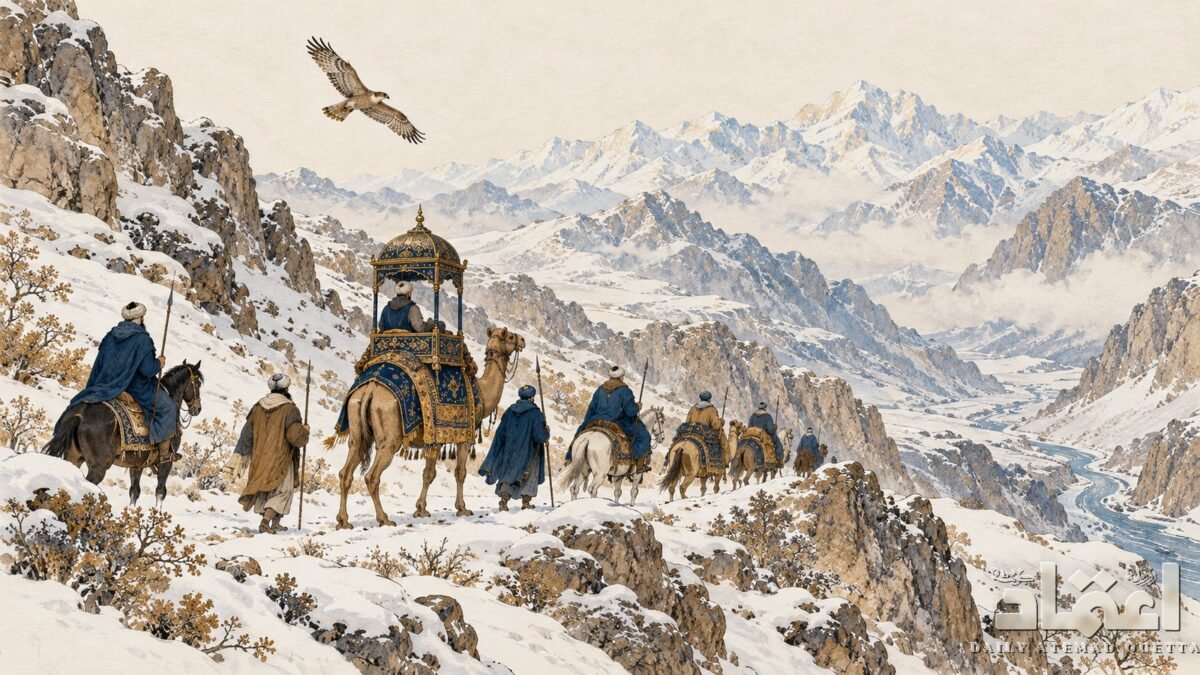
In the previous chapter we saw that in the 16th century Kandahar became a field of contest between the Mughals and the Safavids, and that the areas of Shal (today’s Quetta) and Mastung lay on the edge of that contest. In the middle of the same century an event took place that tied this region to a critical turning point in Mughal history. In 1543, Humayun, the deposed emperor of India, having lost his empire, left Sindh with a handful of companions. He passed through Sibi, Mastung and Shal and reached the Kandahar frontier. From there he fled towards Iran, leaving behind his one-year-old son.
Three narrators
There are three main sources for the event. The first is the “Humayun-nama” of Humayun’s sister, Gulbadan Begum. She wrote it on royal orders, probably at the request of her nephew Akbar. Annette Beveridge published its English translation in 1902. The second is the “Tazkirat al-Waqiat” of Jauhar, Humayun’s aftabchi, the attendant who looked after the water and vessels for his ablutions. Charles Stewart translated it in 1832. One chapter of the book, titled “His Majesty marches from Sinde, and proceeds towards Candahar, A.H. 950 – A.D. 1543”, deals with this very journey. The third is Abul Fazl’s “Akbarnama”. Its first volume, in Henry Beveridge’s translation, describes Akbar’s birth and Humayun’s exile. In the 19th century William Erskine compiled a detailed history of Humayun from the same sources. It was published in 1854, after his death.
Two years in Sindh
After being defeated by Sher Shah Suri in 1539 and 1540, Humayun moved towards western India. According to Malleson, by January 1541 he was in Sindh as a fugitive. Shah Husain of the Arghun dynasty ruled there. Shah Husain stalled and gave no help, and Humayun’s sieges came to nothing. Elphinstone writes that Shah Husain, who wanted to be rid of his guest on any terms, finally agreed to help him on his journey if he set out for Kandahar at once.
In the meantime, in 1541, Humayun married Hamida Banu Begum. Some sources describe her as the daughter of Shaikh Ali Akbar Jami, a teacher of Hindal Mirza. Gulbadan Begum writes that Hamida Banu was at first unwilling to accept the match. She stayed with Humayun throughout the journey of the next two years.
Umerkot: the birth of Akbar
Wandering in Sindh, Humayun reached Umerkot on the edge of the desert. According to the Akbarnama, Akbar was born to Hamida Banu here on 5 Rajab 949 AH, that is 15 October 1542. Jauhar describes a memorable scene. Humayun was then away from Umerkot with the army. When news of his son’s birth reached him, he had nothing to give away. He broke open a pod of musk and shared it among his companions. He said this was the only gift he had, and prayed that the child’s name would spread through the world as the fragrance of the musk spread.
From Sindh to Sibi, Mastung and Shal
According to Malleson, in July 1543 Humayun was forced to leave Sindh. He set out with his wife, his son and a few companions, intending to reach Kandahar. The Akbarnama gives the date of departure as 11 July 1543. But Kandahar was then held by his brother Kamran Mirza. The Gazetteer of Balochistan volume “Sarawan” (1907) says that the province of Kandahar remained with Kamran Mirza from 1530 to 1545. According to Gulbadan Begum, the view of Humayun’s advisers, Tardi Muhammad Khan and Bairam Khan, was that there was nowhere to go but Shal-Mastung, on the Kandahar frontier to the north.
On the route, Jauhar writes that after Sehwan the caravan reached Fatehpur Gandava, then passed a halting place with brackish water and an open plain before arriving at Mastung. Gulbadan Begum mentions passing near Siwi (Sibi). The “Sarawan” gazetteer records that in the summer of 1543, during his retreat from India, Humayun reached Shal-Mastung via Sibi. But Gulbadan Begum and Jauhar both mention snow and severe cold on this journey, and according to Annette Beveridge’s note the event belongs to the end of 950 AH (1543). The gazetteer volume “Quetta-Pishin” (1907) also mentions, in its historical chapter, Humayun’s coming to Quetta in 1543. On this journey Humayun also encountered a Baloch chief, who is mentioned later.
The night at Shal: the son left behind
At Shal, Humayun learnt that his brother Askari Mirza, Kamran Mirza’s governor of Kandahar, had come close with a large force. Malleson writes that Humayun had no option but immediate flight. He left the camp with Hamida Banu and a few people. One-year-old Akbar, whom it was not thought possible to take along in such a swift flight, stayed in the tent with his attendants. Askari Mirza reached the camp, took the child into his custody and sent him to Kandahar. Humayun’s small party spent the night in the snow and reached a settlement of Baloch in the mountains. Gulbadan Begum and Jauhar both write that the Baloch chief there had received an order from Kamran Mirza to seize Humayun, but did not do so. Jauhar gives the chief’s name as “Mulk Khutty” and says he escorted Humayun safely for 15 kos, to the limit of his territory.
Gulbadan Begum goes on to write that in 1545, when Askari Mirza heard of Humayun’s return, he sent Akbar from Kandahar to Kamran Mirza in Kabul. In her introduction Annette Beveridge writes that all the histories tell of the wintry journey from Kandahar that Akbar made with his half-sister Bakhshi Banu, Humayun’s daughter. One was under three years old and the other nearly four.
Iran, Kandahar and the return
Leaving Shal, Humayun reached Iran in 1544. According to Encyclopaedia Iranica, the Safavid governor of Herat received him with hospitality under a royal decree. He then went through Mashhad, Nishapur, Sabzevar and Qazvin and met Shah Tahmasp at Soltaniya. The Shah gave him a force of 10,000 horsemen to take back Kandahar and Kabul from his brothers. Iranica also writes that on 25 Jumada II 952 AH / 3 September 1545 Kandahar was taken back from Askari Mirza and, as agreed, handed over to a young Safavid prince. Bairam Khan was governor of Kandahar from 1545 to 1554 in reward for his services in the conquest. In November 1545, when Humayun entered Kabul, Akbar met his father again after two years of separation. Hamida Banu was later summoned from Kandahar, and Gulbadan Begum describes in particular the celebration of Akbar’s circumcision in Kabul.
The Gazetteer volumes “Sarawan” and “Quetta-Pishin”, Erskine and Iranica all record one more thing. After his return, Humayun is traditionally said to have given the areas of Shal and Mastung to a Baloch chief, Lawang Khan. According to the Gazetteer, history does not say who this man was. Later, the “Ain-i-Akbari” of Akbar’s time lists Shal and Pishin as part of the Sarkar of Kandahar, supplying military service and revenue to the Mughal government.
Mir Chakar and Humayun: a tradition
In Baloch tribal tradition Humayun’s name appears in another way too. In his book “The Baloch Race” (1904), Dames writes that, according to tradition, Mir Chakar Rind later joined Humayun’s march towards Delhi and finally settled at Satgharah in Montgomery district of Punjab, where his tomb still stands. This return of Humayun took place in 1555, when he defeated the Suri rulers and again sat on the throne of Delhi. Dames records this only as a tradition, and in the accounts of the 1543 journey cited above we do not find the name of Mir Chakar. The two matters should therefore be viewed separately. The first event is recorded in the Mughal histories. The second is preserved in tribal tradition.
Humayun’s passage through Balochistan was an event of a few months. But it tied this region to a critical turning point in Mughal history. The child left behind in the tent at Shal went on to become Akbar the Great. In the following century Balochistan was to see a state of its own emerge.
Next Sunday: the founding of the Khanate of Kalat, with which Part Three of this series, the Khanate of Kalat, begins.
Sources
- Gulbadan Begam, The History of Humāyūn (Humāyūn-nāma), translated with introduction and notes by Annette S. Beveridge, Royal Asiatic Society, Oriental Translation Fund New Series, London, 1902: royal order to write, p. 83; introduction on Akbar's winter journey with Bakhshi-banu ("All the histories tell of his wintry journey from Qandahar"), p. 37; Shah Husain's delays and hostility, pp. 148–152; Hamida's resistance and marriage (Jumada I 948/1541), pp. 149–151; the Siwi (Sibi) approach, pp. 163–164; Tardi Muhammad Khan and Bairam Khan advising "Shal-mastan, the frontier of Qandahar", flight and Akbar left behind, pp. 165–166; the Baluch chief, pp. 167–168; Akbar sent to Kabul (1545), p. 174 and n. 4; circumcision feast, p. 179; Appendix on Bakhshi-banu, p. 214, and on Hamida's father, p. 237. Scan: https://archive.org/details/historyofhumayun00gulbrich (e.g. p. 165: https://archive.org/details/historyofhumayun00gulbrich/page/n198)
- Jauhar Āftābchī, The Tezkereh al Vakiat; or, Private Memoirs of the Moghul Emperor Humayun, translated by Charles Stewart, Oriental Translation Fund, London, 1832: birth of Akbar and the musk, pp. 44–45; chapter XIII, "His Majesty marches from Sinde, and proceeds towards Candahar. A.H. 950. — A.D. 1543", pp. 49–53 (route via Sehwan and Fatehpur Gandava to "Salmustan or Mustung", p. 51; Akbar left and taken to Kandahar, p. 52; the Baluch chief "Mulk Khutty", p. 53). Scan: https://archive.org/details/tezkerehalvakiat00jawhuoft (p. 53: https://archive.org/details/tezkerehalvakiat00jawhuoft/page/n68)
- Abu'l-Fazl, The Akbarnāma, vol. I, translated by H. Beveridge, Asiatic Society of Bengal (Bibliotheca Indica), Calcutta, 1907 (scan of the 2000 reprint): Akbar's birth on 5 Rajab 949 / Sunday 15 October 1542, with Beveridge's note on Gulbadan's 4 Rajab, p. 54; departure from Jun "for Qandahar via Siwi (Sibi) on 7th Rabi'u-l-akhir, 950 (11th July, 1543)", p. 389; Shal and Mastung, Askari's advance and Humayun's flight, pp. 390–392. Scan: https://archive.org/details/in.ernet.dli.2015.55648 (p. 389: https://archive.org/details/in.ernet.dli.2015.55648/page/n400)
- William Erskine, A History of India under the Two First Sovereigns of the House of Taimur, Báber and Humáyun, Longman, Brown, Green and Longmans, London, 1854: vol. I, "Notice" on the late Mr. Erskine; vol. II, march to Shal-Mustung in the cold season, p. 266; entry into Kabul and reunion with Akbar (Nov. 1545), p. 325; Hamida's arrival and the circumcision, p. 326; "Lawang Baluch … was rewarded with the country of Shal and Mustung", p. 327. Scans: vol. II https://archive.org/details/in.ernet.dli.2015.82698 (p. 327: https://archive.org/details/in.ernet.dli.2015.82698/page/n349); vol. I https://archive.org/details/india.history.resource.512
- G. B. Malleson, Rulers of India: Akbar and the Rise of the Mughal Empire, Clarendon Press, Oxford, 1890 (scan of the 1894 printing): Humayun a fugitive in Sind, January 1541, p. 51; July 1543 departure, Askari near Shal, "immediate flight was necessary", child "only a year old", p. 53; Akbar conveyed to Kandahar, Askari its governor, p. 54. Scan: https://archive.org/details/akbarriseofmugha00mallrich
- Mountstuart Elphinstone, The History of India, 2nd ed., vol. II, John Murray, London, 1843, book VII, chapter 2: Husain Arghun, "glad to get rid of him on any terms", agrees to help if Humayun sets out for Candahar, p. 146. Scan: https://archive.org/details/wbsl.15253 (https://archive.org/details/wbsl.15253/page/n181)
- W. M. Thackston, "Homāyun Pādešāh", Encyclopaedia Iranica, vol. XII, fasc. 4, 2004, pp. 437–439 (1544 journey to Iran, reception at Herat, meeting with Tahmasp at Soltaniya, recapture of Kandahar 25 Jumada II 952 / 3 September 1545 and its cession to a Safavid prince; Kabul 17 November 1545; Delhi entered 23 July 1555). https://www.iranicaonline.org/articles/homayun-padesah/
- Encyclopaedia Iranica, "Bayram Khan" (governor of Qandahar 952/1545–961/1554 for his role in its conquest). https://www.iranicaonline.org/articles/bayram-or-bayram-khan-mohammad-kan-e-kanan-an-illustrious-and-powerful-iranian-noble-at-the-court-of-the-mugh/
- Encyclopaedia Iranica, "Baluchistan i. Geography, History and Ethnography" (Homāyūn "reputed to have given Shal (Quetta) and Mastung to a Baluch named Lawang Khan", citing Gazetteer V, p. 34). https://www.iranicaonline.org/articles/baluchistan-index/baluchistan-i/
- Baluchistan District Gazetteer Series, vol. V: Quetta-Pishin District, by R. Hughes-Buller assisted by Jamiat Rai, Scottish Mission Industries, Ajmer, 1907, history section, p. 33 (Kandahar under Kamran 1530–45; Humayun at Quetta in 1543; Lawang Khan, "who Lawang Khan was, history does not relate"; Shal and Pushang in the Kandahar Sarkar of the Ain-i-Akbari). Scan: https://archive.org/details/in.ernet.dli.2015.46886 (https://archive.org/details/in.ernet.dli.2015.46886/page/n55)
- Baluchistan District Gazetteer Series, vols. VI, VI-A and VI-B: Sarawan, Kachhi and Jhalawan, Times Press, Bombay, 1907, Sarawan history, pp. 83–84 (Kandahar under Kamran 1530–45; "in the summer of 1543, that Humayun came to Shal-Mastan via Sibi"; Akbar carried to Kandahar in December 1543; Lawang Khan). Scan: https://archive.org/details/in.ernet.dli.2015.22668 (p. 83: https://archive.org/details/in.ernet.dli.2015.22668/page/n47)
- M. Longworth Dames, The Baloch Race: A Historical and Ethnological Sketch, Royal Asiatic Society Monographs vol. IV, London, 1904, pp. 44–45 (the legend that Chakur "joined Humayun afterwards on his march to Dehli, and at last settled down at Satgarha"; "no historical evidence of the fact"). Scan: https://archive.org/details/balochracehistor00damerich (https://archive.org/details/balochracehistor00damerich/page/n53)
- Imperial Gazetteer of India, Provincial Series: Baluchistan, Superintendent of Government Printing, Calcutta, 1908: "Baluchistan under Akbar", p. 13 (upper highlands in the sarkar of Kandahar in 1590); Quetta-Pishin District, p. 120 ("The Ain-i-Akbari mentions both Shal and Pishin as supplying military service and revenue to Akbar"). Scan: https://archive.org/details/ImperialGazetteerOfIndiaBaluchistan (p. 120: https://archive.org/details/ImperialGazetteerOfIndiaBaluchistan/page/n134)
 More from E-Magazine
More → Aamer Sohail: the aggressive left-handed opener
 Abd al-Malik ibn Marwan: Arabic offices, new coins and the octagonal domed shrine
 Abd al-Rahman I: the emir who founded Cordoba's Great Mosque
 Abdul Hafeez Kardar: Pakistan cricket's first captain
 Abdul Razzaq: the all-rounder who either blocked or hit
 Abel Tasman: the Dutch voyage that found Tasmania and New Zealand
 Afanasy Nikitin: the Russian merchant who travelled to India
 Ahmad ibn Majid: master navigator of the Indian Ocean