
Rahm Ali Marri: the poet between the palace and the dry crust
The Marri tribe gave Balochi poetry many great names; this week's column looks at Rahm Ali Marri, whose few surviving verses speak of injustice around him.
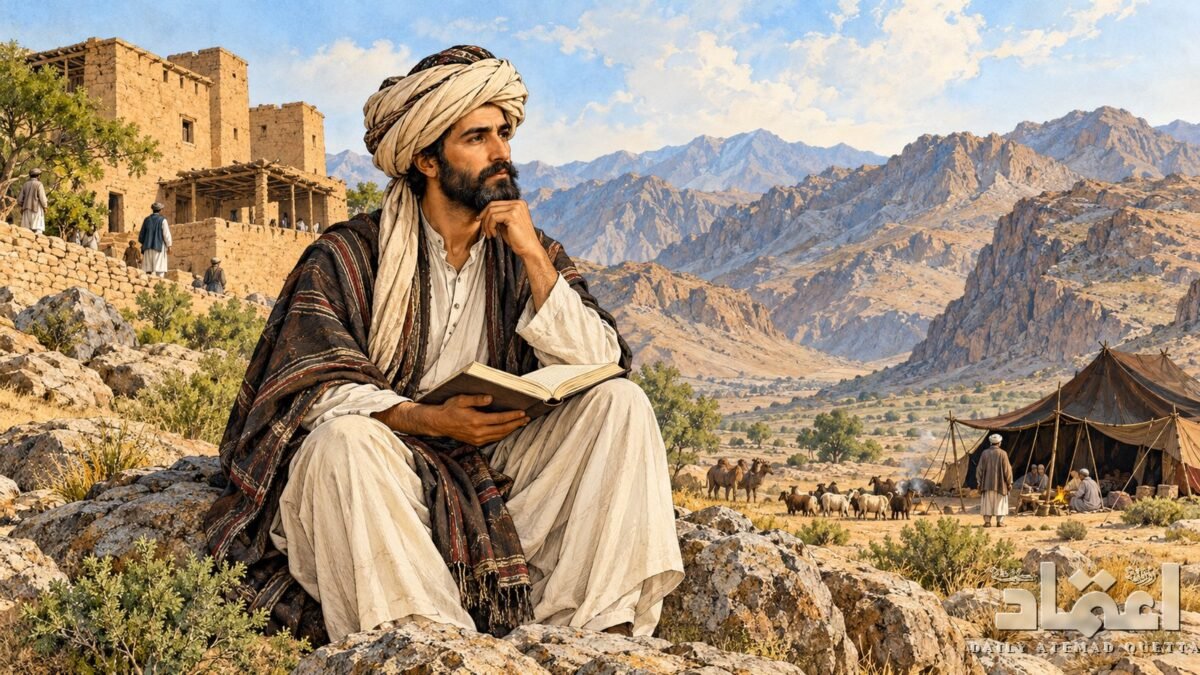
The Marri tribe gave Balochi poetry many great names. Last Friday we wrote about the most famous of them, Mast Tawakkali. Today it is the turn of another poet of the same tribe, whose name Urdu readers may have heard less often: Rahm Ali Marri. Very little has been written about him, but the few verses that survive point to a poet whose eye was on the injustice around him.
Life and times
Hamidullah Baloch writes in his Balochi book “Balochi Labzanak e Tareekh” (1999) that Rahm Ali Marri was born in Kahan in the last years of the 19th century. He belonged to the Bijarani branch of the Marri tribe. The book does not give the year of his death, and it was not found in the other sources consulted for this series either.
According to Hamidullah Baloch, Rahm Ali is among the noted poets of Balochi literature and was a powerful poet of the Marri tribe. The tribe took pride in his poetry. He writes that Rahm Ali was a man without equal and without greed. He wanted nothing from anyone and regarded his poetry as a gift from God.
According to Hamidullah Baloch, Mast Tawakkali was also born in Kahan.
Style
Hamidullah Baloch calls Rahm Ali an “olasi poet”, that is, a poet of the people. In his words, Rahm Ali wrote verse on every aspect of the lives of ordinary people, and his poems hold a full picture of his surroundings. He saw that some people lived happily in palaces and mansions while others were in need of a dry crust. That difference became the theme of his poetry.
Rahm Ali’s poetry is thus not about love but about society. In classical Balochi poetry, Jam Durrak and Mulla Fazil write of the beloved’s beauty and the journey of the clouds. Rahm Ali writes of the divide between rich and poor.
Selected verse
The lines below are taken from Hamidullah Baloch’s book, with its printed Balochi text. The Urdu translation is the newspaper’s own and is provisional. It will be checked with a Balochi speaker before publication.
The first passage is on the gap between rich and poor:
نیم کهٹانی سرائیں نیم ٹلی ماں شفاں
Some are in mansions, enjoying what they earn, and some toss and turn through the nights.
نیم دهغی زمیے نه گندی نیم داری نوکراں
Some do not get even a patch of land, and some keep servants.
(Rahm Ali Marri, quoted in Hamidullah Baloch, Balochi Labzanak e Tareekh, p. 98)
The third line of the same passage repeats “nim”, meaning “half”: some are in joy and some cry out in grief. Half the world is on one side, half on the other. The point is plain, and its force lies in that plainness.
The year of Rahm Ali Marri’s death is not known and his verse is considered to be in copyright, so only two lines are quoted here.
Influence and legacy
Little has been written about Rahm Ali Marri, and this instalment is also an admission of that gap. Hamidullah Baloch gave him a place in the history of Balochi literature and preserved a few of his verses. The rest of the work falls to researchers and readers who may have more memories or handwritten notebooks of this poet. The few verses before us show that this poet of the Marri hills was raising an old but ever new question: when will the distance between the palace and the dry crust grow smaller?
To readers: If you have any information about the life or poetry of Rahm Ali Marri, especially the year of his death or more of his verses, please write to us. Information you send will be checked against its source and published under your name.
Next Friday: From Balochi to Brahui: Mulla Malik Dad Qalati, whose “Tohfat ul-Ajaib” is among the earliest written books in Brahui.
Sources
- Hamidullah Baloch, Balochi Labzanak e Tareekh (Balochi), Zamurd Publications, Quetta, 1999, pp. 97–98 (Rahm Ali Marri) and 118–119 (Kahan, birthplace of Mast Tawakkali). https://archive.org/details/balochi-labzankh-tarikh (the archive record lists the author as Muhammad Yusuf Mujahid and the year as 1993)
 More from E-Magazine
More → Aamer Sohail: the aggressive left-handed opener
 Abd al-Malik ibn Marwan: Arabic offices, new coins and the octagonal domed shrine
 Abd al-Rahman I: the emir who founded Cordoba's Great Mosque
 Abdul Hafeez Kardar: Pakistan cricket's first captain
 Abdul Razzaq: the all-rounder who either blocked or hit
 Abel Tasman: the Dutch voyage that found Tasmania and New Zealand
 Afanasy Nikitin: the Russian merchant who travelled to India
 Ahmad ibn Majid: master navigator of the Indian Ocean