
Quetta: the birth of a cantonment town
How the small settlement of Shal, built around a mud mound, became a major military cantonment and the capital of the province within a few decades.
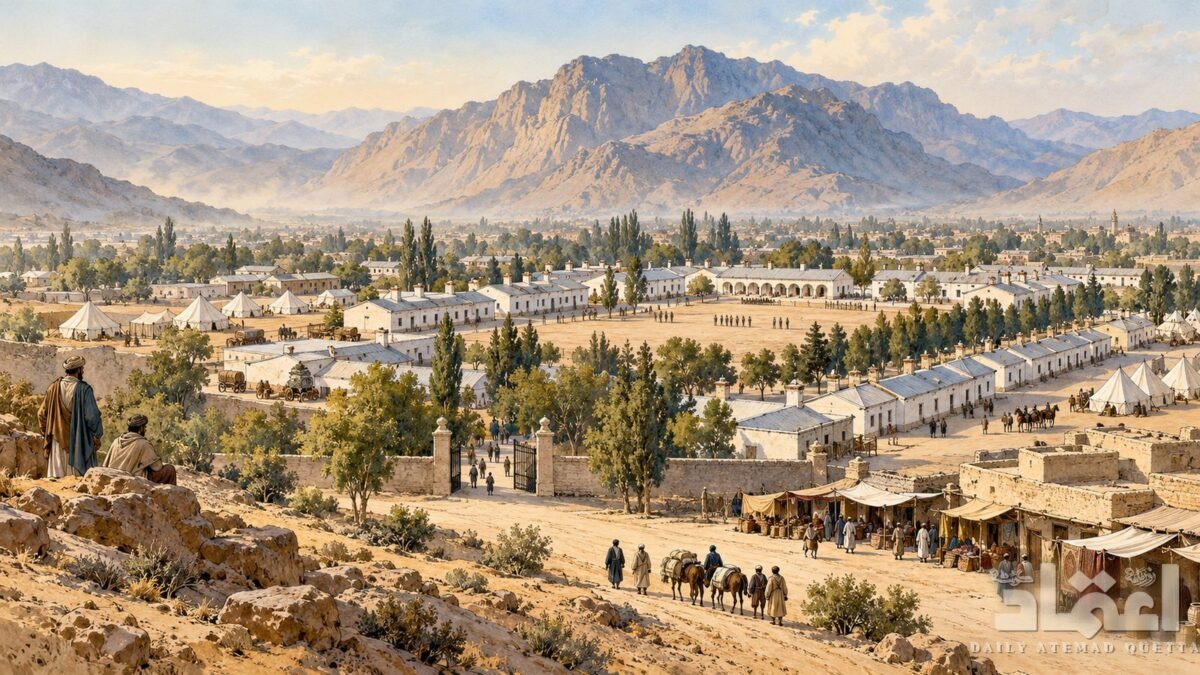
In the previous chapter, we saw Robert Sandeman become Agent to the Governor General for Balochistan in 1877 and make Quetta his headquarters. In this chapter, we look at the story of that headquarters: how a small settlement called Shal, built around a mud mound, became a large military cantonment and the capital of the province within a few decades. Our main source is the 1907 Quetta-Pishin District Gazetteer, written during this very transformation.
Shal: before 1876
The 1908 Imperial Gazetteer writes the name of the city as “Quetta (Kwatah)” and says that local people called it “Shal” or “Shalkot”. According to the Quetta-Pishin Gazetteer, the Ain-i-Akbari of Akbar’s time shows Shal and Pishin as part of the eastern portion of the Kandahar sarkar. In the 18th century, Nadir Shah assigned the revenue of Shal to the expenses of Mir Nasir Khan and his mother. The Gazetteer writes that, according to tradition, Ahmad Shah Durrani finally gave the area to the Brahuis after Nasir Khan I helped him in the Iranian campaign of 1751.
Among European travellers, Charles Masson was the first to pass through, in 1828. According to the Gazetteer, he wrote that the town stood around the “miri”, or fort, surrounded by a thin crenellated mud wall, and had some 300 houses. The Gazetteer estimates that about 4,000 people lived here in 1876, before the British occupation. In the First Afghan War, the British stayed here from 1839 until October 1842, and Shal became the headquarters of a political agent. When Dr Bellew came in 1872, he found it in a state of decline. In 1876 the miri held a small detachment of the Khan of Kalat: the crew of one gun, a company of infantry and twenty horsemen.
Occupation, 1876-77
According to the Quetta-Pishin Gazetteer, even before the Treaty of Jacobabad was ratified, part of Sandeman’s escort, 300 men of the 4th Sikh Infantry (Punjab Frontier Force), was stationed at Quetta under Captain Scott with the Khan’s consent. Thornton’s biography says the same. Early in 1877, the Baluchistan Agency was established here. According to Aitchison, British troops were stationed at Quetta and Mittri.
That year, while the Agency building was under construction, three Pathans killed Lieutenant Hewson and wounded Lieutenant Kunhardt. According to Thornton, Captain Scott killed all three attackers. According to the Gazetteer, British troops occupied the miri in July 1877 after this incident. The old settlement was moved to its present site and the miri was turned into an arsenal. When the Second Afghan War began in 1878, Quetta became the centre of military operations.
The 1883 lease
Legally, Quetta was still territory of the Khan of Kalat. According to Aitchison, it was agreed in 1879 that British officers would run its administration and the surplus revenue would go to the Khan. A new agreement was made on 8 June 1883 (Aitchison’s Agreement No. XIV). According to its text, the Khan made over to the British Government “fully” the entire administration of the Quetta district and niabat from 1 April 1883, including revenue and civil and criminal powers. In return, the Government promised an annual rent of Rs25,000, payable every year on 31 March without deduction. In the same agreement, the Khan also gave up his right to levy tolls on trade through the Bolan Pass in return for Rs30,000 a year. The lease lasted only as long as the British Government administered the district.
Cantonment and civil town
According to the Quetta-Pishin Gazetteer, between 1878 and 1883 the Government bought about 3,754 acres of land. Of this, 3,496 acres were for the cantonment and 258 acres for the civil town, and the total spent on land and water was Rs2,54,848. The cantonment boundaries were first fixed in March 1885. According to the Imperial Gazetteer, the cantonment lay to the north, covering about 15 square miles, and the civil town lay to the south, separated from the cantonment by the Habib Nullah.
The town was at first built of mud. The Gazetteer quotes Sir Thomas Holdich as saying that in 1884 even the Residency was little more than a better kind of mud bungalow, but that Quetta in 1884 had changed completely from Quetta in 1878. In the severe cold of 1891, many mud domes collapsed and were replaced by iron roofs. In 1881, Hugh Barnes had two or three hundred camel-loads of cuttings brought from Kandahar and planted along the roadsides, as Quetta had until then been almost treeless. A sanitation tax began in the town in 1878, and the Quetta Municipal Law came into force in 1896: on 1 October according to the Quetta-Pishin Gazetteer, and on 15 October 1896 according to the Imperial Gazetteer and Notification No. 6992. At that time Quetta was the headquarters of the 4th Division of the Western Army. The Sind-Pishin section of the railway was begun in 1879, and according to the Imperial Gazetteer, Quetta was 727 miles from Lahore and 536 miles from Karachi by rail.
Population
According to the Quetta-Pishin Gazetteer, the population grew rapidly between 1876 and 1891, when the first census was held. In 1891 the population of the town was 18,802: 7,500 in the cantonment and 11,302 within the civil lines and railway limits. According to the Imperial Gazetteer, it rose to 24,584 in 1901, of whom 10,399 were Muslims, 8,678 Hindus and 3,678 Christians; most of the Christians were European soldiers. The Gazetteer writes that whenever the army grew, the civil population grew too, and that this population came almost entirely from outside, mostly from Punjab and Sindh. According to it, trade and the educated professions were mostly in the hands of Punjabis and Sindhis.
The miri: the old heart of the city
The Quetta-Pishin Gazetteer describes the miri as an artificial mound with a base about 600 feet long and 400 feet wide, rising 80 feet above the plain. It quotes the 1887 account of Major J. F. Garwood. According to this, excavation of the upper part brought out bones, broken pottery and layers of charcoal, and at the deepest level a bronze or copper statue of Heracles was found. Some of the objects were declared prehistoric by the Indian Museum in Calcutta. Garwood also wrote that the excavation had gone down only 20 of the 80 feet. Holdich called the miri the “crown of Quetta” and wrote that it had been the city’s stronghold since ancient times.
The Staff College
The 1907 Quetta-Pishin Gazetteer, which describes the situation here as of 1905, writes that a Staff College is being built on the Hanna Road, about a mile from the old cantonment. The college and its houses stood on about 70 acres, the estimate was about Rs6 lakh, and it was hoped the work would be complete by the end of 1906. According to the history of the Command and Staff College itself, the building at Quetta was sanctioned in January 1905 at Rs6,33,440. Under a military order of 21 March 1905, the college was set up temporarily at Deolali near Bombay until the building was complete, and the first course began there with 24 officers on 1 July 1905. The college was formally inaugurated at Quetta on 1 June 1907. Thus the city that began with an escort detachment had, within thirty years, become known also for a military educational institution.
Next Sunday: the British Balochistan province (1887).
Sources
- R. Hughes-Buller and Rai Bahadur Jamiat Rai (comp.), Baluchistan District Gazetteer Series, vol. V: Quetta-Pishin, Bombay/Ajmer, 1907. Pages used: 33 and 35 (Ain-i-Akbari: Shal and Pishin in the Kandahar sarkar; Nadir Shah's assignment; Ahmad Shah Durrani and the Brahuis, 1751); 42–43 (300 men of the 4th Sikhs under Captain Scott; Agency established early 1877; lease at Rs 25,000 from 1883); 45–47 (the miri: dimensions, Garwood's 1887 excavations, Heracles statue); 271 (miri occupied in July 1877 after the attack on Lt Hewson; Quetta as headquarters of the 4th Division); 331–337 (Quetta town: Barnes's tree planting, 1881; climate; population about 4,000 before 1876, 18,802 in 1891; Masson in 1828; first occupation 1839–42; Bellew in 1872; Holdich on 1878–84; land bought 1878–83; municipality; cantonment boundaries 1885); 341 (Staff College under construction, about 70 acres, about Rs 6 lakhs, completion hoped by end of 1906). https://archive.org/details/in.ernet.dli.2015.46886
- Imperial Gazetteer of India, Provincial Series: Baluchistan, Superintendent of Government Printing, Calcutta, 1908. Pages 54 (Sind-Pishin railway begun 1879); 129–130 (Quetta town: "Kwatah", locally Shal or Shalkot; cantonment of about 15 sq. miles and civil town divided by the Habib Nullah; population 18,802 in 1891 and 24,584 in 1901, by religion; distances by rail; Staff College "in course of erection (1906)"); p. 74 (Quetta Municipal Law in force 15 October 1896). https://archive.org/details/in.ernet.dli.2015.146799 · https://archive.org/details/in.ernet.dli.2015.120382
- C. U. Aitchison (comp.), A Collection of Treaties, Engagements and Sanads relating to India and Neighbouring Countries, vol. XI ("revised and continued up to 1929"), Government of India, Calcutta; read in the Mittal Publications reprint. Pages used: 330 (troops cantoned at Quetta and Mittri; 1879 arrangement; 1883 lease); 365–366 (Agreement No. XIV, 8 June 1883: Quetta district and niabat made over from 1 April 1883 for Rs 25,000 a year; Bolan tolls given up for Rs 30,000 a year). https://archive.org/details/acollectionoftreatiesengagementsandsanadsaitchisonc.u.vol11_83_O
- T. H. Thornton, Colonel Sir Robert Sandeman: His Life and Work on Our Indian Frontier, John Murray, London, 1895. Pages 89 and 93 (escort left at Quetta with the Khan's consent before the treaty was signed); 116–117 (murder of Lt Hewson, wounding of Lt Kunhardt, Captain Scott; footnote on the occupation of the fort and the quit-rent of Rs 25,000). https://archive.org/details/in.ernet.dli.2015.209278
- Command and Staff College, Quetta, "College History" (official website; sanction in January 1905 at Rs 6,33,440; Deolali period 1905–07; first course on 1 July 1905; inauguration at Quetta on 1 June 1907). https://cscquetta.gov.pk/?p=44
- Government of India, British Enactments in Force in Indian States, vol. I, 4th ed., 1930: footnote to the Quetta Municipal Law, "The 15th October, 1896, was so appointed by Notification No. 6992". https://archive.org/details/in.ernet.dli.2015.100329
 More from E-Magazine
More → Aamer Sohail: the aggressive left-handed opener
 Abd al-Malik ibn Marwan: Arabic offices, new coins and the octagonal domed shrine
 Abd al-Rahman I: the emir who founded Cordoba's Great Mosque
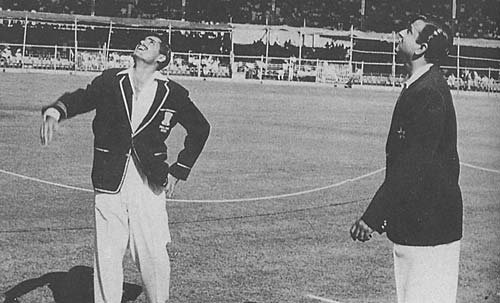 Abdul Hafeez Kardar: Pakistan cricket's first captain
 Abdul Razzaq: the all-rounder who either blocked or hit
 Abel Tasman: the Dutch voyage that found Tasmania and New Zealand
 Afanasy Nikitin: the Russian merchant who travelled to India
 Ahmad ibn Majid: master navigator of the Indian Ocean