
Land of Punt: Egypt’s sea voyages and Queen Hatshepsut’s fleet
Ancient Egyptians called Punt the "Land of God". Reliefs at Deir el-Bahri record Queen Hatshepsut's expedition there, and new evidence has joined the debate over its location.
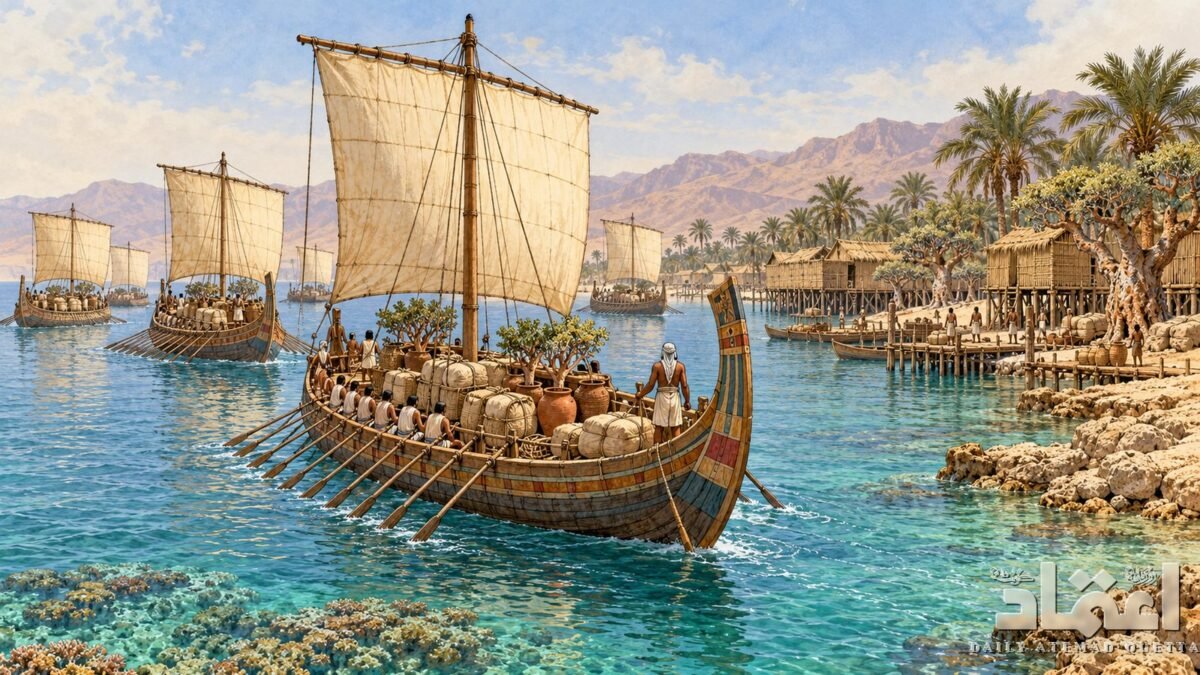
The ancient Egyptians called one country the “Land of God”. Fragrances such as myrrh and frankincense came from there, and without them the rites of their temples were incomplete. So did ebony, ivory, gold and monkeys. The name of that country was Punt. For centuries Egyptian fleets sailed south down the Red Sea in search of it. The most famous expedition is that of Queen Hatshepsut, whose whole story is still preserved today in pictures carved on stone.
Background: the older journeys to Punt
In the previous instalment, we saw that King Pepi II wrote to Harkhuf that he wanted to see the dwarf more than the “gifts of Sinai and Punt”. Punt is mentioned even earlier than that. According to James Henry Breasted’s 1906 translation, the Palermo Stone records that in the time of Sahure, a king of the Fifth Dynasty, 80,000 measures of myrrh were brought from Punt. In the reign of King Isesi, the treasurer Burded brought a dancing dwarf from there. An official of Pepi II’s time was building ships on the Red Sea coast for a journey to Punt when desert tribes killed him. In the Eleventh Dynasty, a treasurer named Henu crossed the desert from the Nile town of Koptos to the coast and sent ships from there to Punt.
This means that Egyptian ships were often built or assembled not on the Nile but on the Red Sea shore, and that materials and timber were brought across the desert.
Mersa Gawasis: the port of Punt
The most solid proof of this came in the 21st century. Kathryn Bard, an archaeologist at Boston University, and Rodolfo Fattovich of Italy had been excavating an ancient port at Mersa/Wadi Gawasis on Egypt’s Red Sea coast since 2003. On Christmas Day 2004, Bard’s hand went through a hole and found empty space inside. It was a man-made cave.
According to Boston University’s magazine, these caves yielded seafaring equipment about 3,800 years old. There were stone anchors, ship timbers, and two curved cedar planks that Bard believes were the blades of steering oars from a ship about 65 feet long. In one cave, about 26 coils of rope lay as if sailors had just left them. Outside, an inscription was found that mentions two royal expeditions in the time of King Amenemhat III, one to Punt and the other to “Bia-Punt”. More than 40 cargo boxes were also found. Two of them bore the name of Amenemhat IV and the words: “wonderful things of Punt”.
Hatshepsut’s fleet
According to the Encyclopaedia Britannica, Hatshepsut was the female ruler of Egypt who reigned with the full titles of a pharaoh from about 1473 to 1458 BC. Britannica writes that her reign was essentially peaceful and that her foreign policy rested on trade rather than war. On the walls of her temple at Deir el-Bahri, on the west bank of the Nile, scenes of the Punt expedition are carved. Breasted calls them among the most interesting reliefs in Egypt and the first and only complete source on Punt. He says the expedition was successfully completed shortly before the ninth year of the queen’s reign.
The inscription on the wall says the expedition was sent at the command of the god Amun, to bring “the marvels of every country”. The first scene shows five ships. Two are still moored and the rest have unfurled their sails. On the shore, an offering is being made in the name of the goddess Hathor, “mistress of Punt”, so that she may send the wind. Behind one ship is written the helmsman’s order: “Turn to the left.”
Welcome in Punt
In the next scene, the fleet has reached Punt. The queen’s envoy advances with soldiers. In front of him are laid necklaces, axes and daggers, which Breasted says were for trade. From the other side comes Parehu, the chief of Punt. Behind him come his wife Ati, two sons and a daughter, and a donkey above which is written: “The donkey that carries his wife.” In the background, among the trees, are the houses of the people of Punt, built high on wooden stilts.
The people of Punt ask in amazement: “How have you come to this land which people know not? Did you descend by the ways of heaven, or did you sail on the sea of the Land of God?” The Egyptian envoy pitched his tent in the myrrh gardens and offered the chiefs of Punt bread, wine, meat and fruit.
The return: 31 living trees
Then the ships were loaded. According to the list on the wall, they carried living myrrh trees, heaps of myrrh resin, ebony, pure ivory, gold, cinnamon wood, incense, eye cosmetic, monkeys, dogs and the skins of southern panthers. Above the labourers carrying the trees is written: “Mind your feet! The load is very heavy!” The inscription claims that “the like has never been brought for any king since the beginning”.
On reaching Thebes, the goods were presented to Amun. In one scene, beside the trees, it is written: “Thirty-one fresh myrrh trees, brought as marvels of Punt.” According to Britannica, these trees were planted in the gardens of Deir el-Bahri. In another scene the queen herself measures electrum (a natural alloy of gold and silver), and the scent of myrrh is applied to her body.
Breasted writes that in the period after Hatshepsut, her name and images were scraped off these reliefs, so many of the inscriptions are hard to read.
Where was Punt?
The exact location of Punt is still debated among researchers. Breasted held that it was certainly in Africa and probably on the coast of Somalia. Other researchers point to the coastal regions of Sudan, Eritrea and Ethiopia, and some have also proposed southern Arabia. Kathryn Bard’s own view is eastern Sudan.
New evidence has recently entered this debate. In a study published in the scientific journal eLife in December 2020, Nathaniel Dominy and colleagues tested oxygen and strontium isotopes in the remains of mummified baboons from Egyptian tombs and temples. They compared them with 155 baboons from 77 locations. Two baboons from the New Kingdom came from a region that includes much of present-day Ethiopia, Eritrea and Djibouti, and parts of Somalia and Yemen. According to the researchers, this result supports the majority view among scholars on the location of Punt.
Significance
The Punt expeditions are among the oldest organised maritime trade of mankind. Building ships, bringing goods across the desert, waiting for the seasonal winds and dealing with a distant people were all possible thousands of years ago. The wall of Hatshepsut’s temple tells this whole story like an illustrated travelogue, which is why the queen is remembered in history as a ruler who was both trader and builder.
Next instalment: Phoenician sailors and the circumnavigation of Africa: the expedition of Pharaoh Necho II.
Sources
- James Henry Breasted, Ancient Records of Egypt, vol. II (The Eighteenth Dynasty), University of Chicago Press, Chicago, 1906, §§246–295 (“The Punt Reliefs”). https://archive.org/details/ancientrecordsof02brea_0
- James Henry Breasted, Ancient Records of Egypt, vol. I, University of Chicago Press, Chicago, 1906, §161 (Palermo Stone, Sahure), §351 (Burded), §360 (the ship-builder killed on the coast), §§429–433 (Henu). https://archive.org/details/cu31924082479233
- Britannica Editors, “Hatshepsut”, Encyclopaedia Britannica, last updated 8 November 2025. https://www.britannica.com/biography/Hatshepsut
- Jean Hennelly Keith, article on Kathryn Bard's excavations at Mersa/Wadi Gawasis, Arts & Sciences magazine, Boston University, Fall 2010. https://www.bu.edu/cas/magazine/fall10/Egypt/
- Nathaniel J. Dominy, Salima Ikram, Gillian L. Moritz, Patrick V. Wheatley and others, “Mummified baboons reveal the far reach of early Egyptian mariners”, eLife 9:e60860, 15 December 2020. https://doi.org/10.7554/eLife.60860
- Wikimedia Commons, “File:Relief of Hatshepsut's expedition to the Land of Punt by Σταύρος.jpg” (CC BY 2.0). https://commons.wikimedia.org/wiki/File:Relief_of_Hatshepsut%27s_expedition_to_the_Land_of_Punt_by_%CE%A3%CF%84%CE%B1%CF%8D%CF%81%CE%BF%CF%82.jpg
 More from E-Magazine
More → Aamer Sohail: the aggressive left-handed opener
 Abd al-Malik ibn Marwan: Arabic offices, new coins and the octagonal domed shrine
 Abd al-Rahman I: the emir who founded Cordoba's Great Mosque
 Abdul Hafeez Kardar: Pakistan cricket's first captain
 Abdul Razzaq: the all-rounder who either blocked or hit
 Abel Tasman: the Dutch voyage that found Tasmania and New Zealand
 Afanasy Nikitin: the Russian merchant who travelled to India
 Ahmad ibn Majid: master navigator of the Indian Ocean