
Jam Durrak: the love poet of the Kalat court
For centuries much Balochi poetry went unwritten and passed by word of mouth; in 18th-century Kalat, the court of Mir Nasir Khan I gave rise to Jam Durrak.
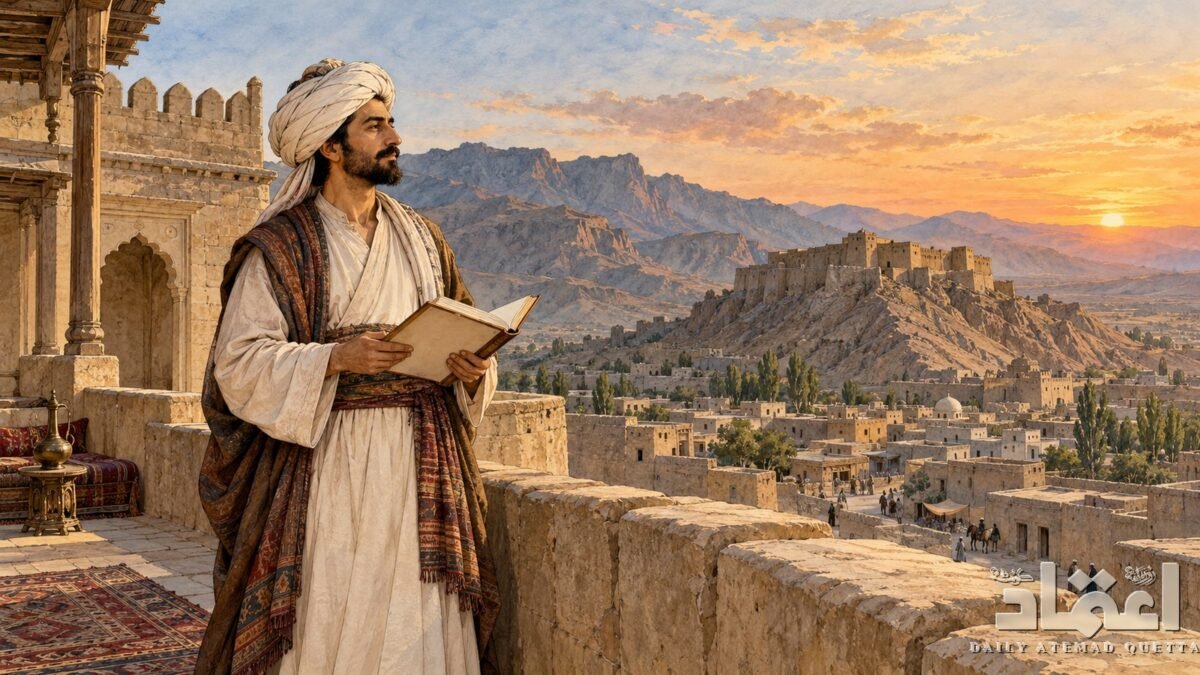
For centuries, much of Balochi poetry was not written down. It passed from one generation to the next on the tongues of minstrels and musicians. In the 18th century, when Mir Nasir Khan I ruled Kalat, a voice rose from his court that gave Balochi love poetry a new colour. Baloch tradition remembers this poet as Jam Durrak. With this instalment, the “Poetry and Literature” series moves from the classical poets of Urdu to the poets of Balochistan, and it is hard to think of a better beginning than Jam Durrak.
Life and times
Very little written information exists about the life of Jam Durrak. In 1907, the British scholar M. Longworth Dames published his collection of Balochi folk poetry, “Popular Poetry of the Baloches”. He wrote that Durrak was a poet of the Dombki tribe, lived in the 18th century at the court of the Brahui Khan of Kalat, Mir Nasir Khan, is commonly called “Jam Durrak” and in his poems calls himself simply “Jam”. According to Dames, the tradition is that Durrak fell in love with a lady of the Khan’s palace and, as a penalty for it, suffered severe hardships at the Khan’s hands.
Dames wrote down these poems between 1875 and 1896, hearing them from minstrels in Dera Ghazi Khan, Rajanpur, Sibi, the Marri-Bugti hills and the Leghari and Gorchani tribes. By his account, he took down two of Durrak’s poems from Marri minstrels in 1879 and printed them in the journal of the Asiatic Society of Bengal in 1880. In other words, almost a century after his death, Durrak’s verse was still being sung in the hills of Balochistan.
In his “History of Balochi Language and Literature”, published in 1986, Syed Zahoor Shah Hashmi wrote that Durrak probably died before Nasir Khan, since his name is nowhere found alongside that of Nasir Khan’s successor, Mahmud Khan.
Hamidullah Baloch writes in his Balochi book “Balochi Labzank-e Tarikh” (1999) that Nasir Khan gave Durrak the title “Great Poet”, and that, though a court poet, he was also a poet of the people. No verse of his is found that has the tone of a panegyric.
Style
In Dames’s view, Jam Durrak was the most famous poet of love songs in Balochi. He said Durrak’s poems are delicate and beautiful, but their expression is bound by a fixed tradition. Many Persian words appear, but the form and metre of the poems are not borrowed from Persian; they are purely Balochi forms. Dames also noticed an interesting difference. The old Balochi epic and romantic tales have mountains, huts and a girl coming to fetch water after rain, whereas Durrak’s world is that of the city bazaars, with bangles, nose-rings, perfume and musk. Even so, according to Dames, the desert wind keeps blowing over this bazaar: clouds, rain, lightning and the smell of wood fires recur in Durrak’s similes.
According to Hamidullah Baloch, the virtues of Durrak’s poetry are its simplicity, clarity and gentle tone. He says Jam Durrak is among the leading poets of the second period of Balochi poetry, who showed the way to later generations.
Selected verse
The first three extracts are from Hamidullah Baloch’s book, with his Balochi text. The sections after that are rendered in Urdu prose with the help of Dames’s English translation, because Dames printed the Balochi text in Roman letters.
دوشی په هیالے نوکیںمردمے دستوں لڈوخیں
کندینت ءُ رچنت مرواردجنزیت گلزمین روخ بیت
اچ همایاں که ماں صد ءِ یکےمول ماں گهاراں ده صد ءِ یکے
Explanation of the verses
“Doshi pa hayale nokein…” Last night, in a strange fancy, I saw a being coming towards me, swaying. In Dames this is the first verse of the poem. Dames himself says the poem is spoken in the voice of Miran, and that only later minstrels attribute it to Durrak.
“Kandinat o rachant marwarid…” When she laughs, pearls seem to scatter; when she walks, the flowery ground lights up. (The translation of this verse is provisional.)
“Ach hamayan ke man sad e yake…” She is one of those who come one in a hundred; among her sisters her worth is one in a thousand. Dames called these lines very obscure and read them in a different sense. Our translation is provisional.
In Dames’s translation, one of Durrak’s poems begins thus: “Jam Durrak the Dombki sings, the martyr of love sings.” The poet then says that the lightning that came last night, staggering like a drunkard from the direction of Julgu, brought news of the beloved, and that this news seemed to dress his body in flowers. A rainbow rose in the south, with a violet cloud beside it, and the scene was like the beloved in every way.
In the same poem the state of the heart is described thus: I am a fool who fights with my heart, and the heart is a fool that fights with me. It weeps like a child with a golden forehead and strains like a marauding Turk.
The poet then tells his mare the state of his heart, and the mare gallops off carrying the news, her tail waving like a vine of zamur. The mare tells her rider that the musk of Khorasan is in his turban, and asks him for God’s sake to mind the road. In the evening she will take him to the house where the cypress-tall, deer-eyed one lives. This talk with the mare recurs in Baloch poetry. Durrak made her a messenger of love.
Another poem, in Dames’s translation, is a memory of the court at Dhadar: early in the morning I shall praise the true God; friends, listen to the songs of Jam. Minstrel, learn my verses by heart and play them on yellow strings, and carry them to my ruler and chief. The poet then says that he went on some errand to the court at Dhadar and saw in the bazaar a beauty whose hem touched the ground and whose lips were red like the pomegranate flower.
The end of another of Durrak’s poems, in Dames’s translation, runs thus: Jam’s body is in the dust. Now only farewell remains to be said, the King and the Creator to be remembered, and sighs to be drawn in the cold of midnight.
Influence and legacy
The name of Jam Durrak appears today in every history of Balochi literature. According to Hamidullah Baloch, a collection of his poetry was compiled by Wajah Bashir Ahmed Baloch under the title “Durchin” and published by the Balochi Academy, Quetta. Hashmi objected to that same collection, saying that it includes the verse of other poets under Durrak’s name. The debate continues among researchers today. But one thing is proved by it: even centuries later, when minstrels heard a good love song, they would attribute it to Jam. There is little greater testimony to a poet’s fame.
To readers: Have you heard any verse of Jam Durrak from your elders or from a minstrel? Write to us with the Balochi text and its meaning. Selected verses will be published with your name on next Friday’s page.
Next Friday: the Makran poet Mulla Fazil Rind, whom Syed Zahoor Shah Hashmi called the greatest poet of Balochi.
Sources
- M. Longworth Dames, Popular Poetry of the Baloches, Vol. I (translations), published for the Folk-Lore Society by David Nutt, London (title page dated 1906; usually cited as 1907): introduction pp. xiii–xiv, xxvi–xxvii; "Love-Songs by Durrak", XLII–XLVI, pp. 124–128. https://archive.org/details/popularpoetryofb01dameuoft
- M. Longworth Dames, Popular Poetry of the Baloches, Vol. II (Balochi texts), David Nutt, London, 1907: XLII–XLVI, pp. 125–130. https://archive.org/details/in.ernet.dli.2015.70178
- Syed Zahoor Shah Hashmi, History of Balochi Language and Literature (A Survey), Syed Hashmi Academy, Lyari, Karachi, 1986, pp. 83–85 and 89–90. https://archive.org/details/BalochiZabanOAdabKiTarikh (the archive record wrongly gives the author as Muhammad Yousuf Mujahid; the book’s cover and title page say Syed Zahoor Shah Hashmi)
- Hamidullah Baloch, Balochi Labzank-e Tarikh (Balochi), Zamurd Publications, Quetta, 1999, pp. 93–94. https://archive.org/details/balochi-labzankh-tarikh (the archive record gives the author as Muhammad Yousuf Mujahid and the year as 1993; the book’s title page says Hamidullah Baloch and October 1999)
 More from E-Magazine
More → Aamer Sohail: the aggressive left-handed opener
 Abd al-Malik ibn Marwan: Arabic offices, new coins and the octagonal domed shrine
 Abd al-Rahman I: the emir who founded Cordoba's Great Mosque
 Abdul Hafeez Kardar: Pakistan cricket's first captain
 Abdul Razzaq: the all-rounder who either blocked or hit
 Abel Tasman: the Dutch voyage that found Tasmania and New Zealand
 Afanasy Nikitin: the Russian merchant who travelled to India
 Ahmad ibn Majid: master navigator of the Indian Ocean