
Herodotus, the father of history, who travelled to ask questions himself
Two and a half thousand years ago, a Greek decided to go, see and ask for himself rather than rely on the hearsay of sailors and traders.
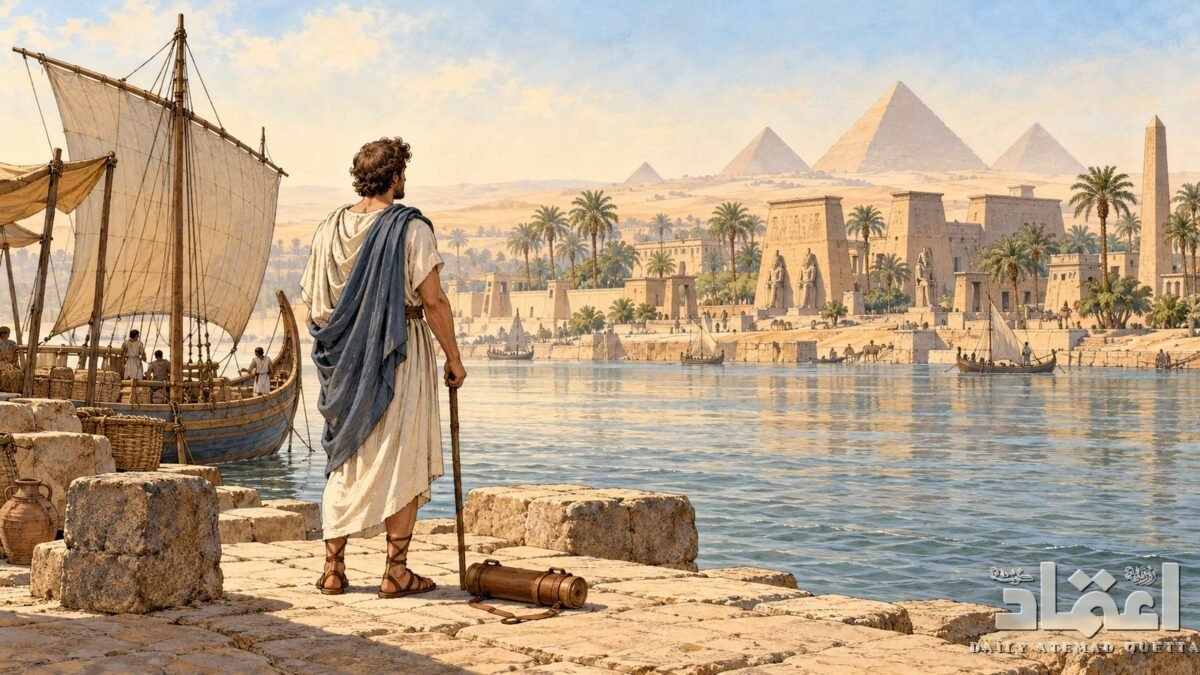
Two and a half thousand years ago, most of what was known about distant lands was hearsay from sailors and traders. In such an age, a Greek decided that he would go, see, ask and then write. His name was Herodotus. The Roman orator Cicero called him the “father of history”, while his critics called him the “father of lies”. His book, the “Histories”, is half research and half travel narrative.
Background: the son of Halicarnassus
According to the World History Encyclopedia, Herodotus was born in about 484 BC in Halicarnassus, today the Turkish city of Bodrum, and died between 425 and 413 BC. For part of his life he also lived in Thurii, a Greek settlement in southern Italy.
In the first sentence of his book, he says that these are the “researches of Herodotus of Halicarnassus”, set down so that the great deeds of men may not fade with time. The Greek word “historia” itself meant research or inquiry. The main subject of the book is the wars between the Greeks and the Persians, but before reaching it Herodotus takes the reader on a tour of Egypt, Babylon, Scythia and India.
Travels: from the Nile to Phoenicia
The strongest proof of Herodotus’s travels is his own writing, since in many places he states plainly what he saw with his own eyes and what he heard from others. About Egypt, he writes that he spoke with the priests of the god Hephaestus at Memphis. He then went to Thebes and Heliopolis to check whether the priests of other cities said the same thing. His famous remark that Egypt is the “gift of the river” is a memento of that journey.
He went south in search of the source of the Nile. He writes that he went as far as the city of Elephantine as an eyewitness, and that he wrote down what lay beyond it from hearsay.
To check the age of a god, he also sailed to the Phoenician city of Tyre. There he saw the temple of Heracles, which had two pillars, one of pure gold and the other of green stone that shone at night. The priests told him that their city was 2,300 years old.
The Black Sea and Babylon
In the north, Herodotus reached the land of the Scythians across the Black Sea. He writes that he could not learn the number of the Scythians, but he saw one thing himself. At a place called Exampaeus, between the rivers Borysthenes and Hypanis, stood a huge bronze vessel whose wall was six fingers thick. Local people told him that their king, to count his people, had asked every Scythian for one arrowhead, and that the vessel was made by melting those arrowheads.
He describes Babylon in great detail: the square walls of the city, the water-filled moat around them, and the hundred bronze gates of the wall. Here, however, scholars are cautious. According to the World History Encyclopedia, archaeology shows that Babylon was not so large and had eight gates, not a hundred, so many scholars think the account rests on hearsay. Herodotus himself admits in one place that he did not see the golden statue, twelve cubits high, in the precinct of the great temple of Babylon, but repeated what the Chaldeans told him. Whether he actually went to Babylon remains an open question among scholars.
What he saw: India and the Persian provinces
For readers in our region, the most interesting part of the “Histories” is the third book, where Herodotus lists the twenty provinces of the empire of the Persian king Darius and their annual tribute. The seventh province included the Sattagydae, Gandarii, Dadicae and Aparytae, who together paid 170 talents of silver. The fourteenth province included the Sagartii, Sarangees and “Mycians”, along with the people of the islands of the “Erythraean Sea”, that is, the southern sea.
The twentieth province belonged to the Indians. Herodotus writes that the Indians outnumber all the nations known to him, and that their tribute was also the highest: 360 talents of gold dust.
He also says that Darius sent Scylax of Caryanda to find the course of the Indus. Scylax went down the river from the city of Caspatyrus to the sea. He then sailed west and in the thirtieth month reached the place from which the Egyptian king had sent the Phoenician sailors to sail round Libya (Africa). That voyage was covered in the fourth part of this series.
Herodotus’s most famous story about India is that of the “gold-digging ants”. By his account they were bigger than a fox and smaller than a dog, and brought gold up as they dug the sand. For centuries it was taken as a tall tale, though a possible explanation has now emerged. According to the World History Encyclopedia, in 1984 the French traveller Michel Peissel reported that in one Himalayan region fox-sized marmots do dig burrows and throw up particles of gold, and that the Persian words for “mountain ant” and “marmot” are similar.
Importance: between truth and story
The charge that Herodotus preferred story to fact is an old one. But according to the scholar Robin Waterfield, cited in the World History Encyclopedia, Herodotus himself does not expect the reader to believe everything. He repeatedly says which things he saw and which he heard. He does not call his book the inspiration of the gods, but his own research.
His importance in the history of travel is that he was the first to try to gather a large world into one book: the priests of Egypt, the temples of Tyre, the customs of the Scythians and the people living along the Indus. His statement about the couriers of the Persian empire became very famous: that nothing human travels faster than they do, and that neither snow, rain, heat nor the darkness of night stops them from reaching their destination.
Legacy
According to the World History Encyclopedia, several cities, including Athens and Thurii, claimed to be his burial place. Even today, any traveller who goes to a new place, asks people for their story and then writes it, separating what was seen from what was heard, is following the path opened by this traveller from Halicarnassus.
Sources
- Herodotus, The History of Herodotus, Volume 1 (Books I–IV), translated by G. C. Macaulay, Macmillan, London, 1890; Project Gutenberg eBook #2707. Book I.1, I.183; Book II.3, II.5, II.29, II.44; Book III.89–102; Book IV.44, IV.81. https://www.gutenberg.org/ebooks/2707
- Joshua J. Mark, “Herodotus”, World History Encyclopedia, 19 October 2022. https://www.worldhistory.org/herodotus/
- Joshua J. Mark, “Silk Road”, World History Encyclopedia, 1 May 2018 (for Herodotus on the Persian royal couriers, Histories VIII.98). https://www.worldhistory.org/Silk_Road/
- Herodotus, The History of Herodotus, Volume 2 (Books V–IX), translated by G. C. Macaulay, Macmillan, London, 1890; Project Gutenberg eBook #2456. Book VIII.98 (the Persian couriers). https://www.gutenberg.org/ebooks/2456
- Wikimedia Commons, “File:Herodotus world map-en.svg” (image only). https://commons.wikimedia.org/wiki/File:Herodotus_world_map-en.svg
 More from E-Magazine
More → Aamer Sohail: the aggressive left-handed opener
 Abd al-Malik ibn Marwan: Arabic offices, new coins and the octagonal domed shrine
 Abd al-Rahman I: the emir who founded Cordoba's Great Mosque
 Abdul Hafeez Kardar: Pakistan cricket's first captain
 Abdul Razzaq: the all-rounder who either blocked or hit
 Abel Tasman: the Dutch voyage that found Tasmania and New Zealand
 Afanasy Nikitin: the Russian merchant who travelled to India
 Ahmad ibn Majid: master navigator of the Indian Ocean