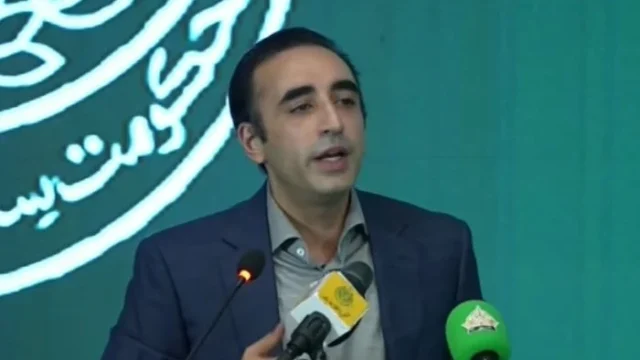
Maulana Fazlur Rehman says mineral reserves belong to people; Sargodha rally will be held

LAHORE: Jamiat Ulema-i-Islam chief Maulana Fazlur Rehman has said that the country’s mineral reserves belong to the people, and no one may be allowed to plunder them.
He said that they had not come to seek a certificate of loyalty to the homeland from anyone. He said they were advocates and champions of peace in the country, that they had loved the homeland, remained faithful to it, and never accepted the servitude of any powerful person. He said their loyalty was beyond doubt.
“We are fighting the case of Pakistan and this state, and every Pakistani citizen should fulfil his duty,” he said. “God willing, the conspiracies will be exposed.”
Addressing the Lahore High Court Bar via video link, Maulana Fazlur Rehman said he was currently under state siege and that all of Lahore was filled with state barricades. All routes are closed, checkpoints have been set up, and a civilised citizen is being prevented from attending a gathering of intellectuals.
He said oppression never enjoys permanence, but patience has always endured throughout history. He said they had always offered their lives for the establishment of peace.
He said every worker of Jamiat Ulema-i-Islam stands as a mountain of steadfastness and is not ready to bow before oppression.
Maulana Fazlur Rehman said that on November 26 the Jamiat Ulema-i-Islam is going to hold a very large conference in Sargodha. Workers across the entire Sargodha division are being targeted by state oppression, local leaders’ businesses have been shut, and shops are being sealed.
He said workers are being arrested and pursued in Bhakkar, Mianwali, Khushab and Sargodha. “Our resolve is that the Sargodha conference will be held come what may. We urge the public to make this gathering a success.”
Maulana Fazlur Rehman said the state forces’ attitude hardened when they exposed the state’s role regarding mineral reserves in the tribal areas. “We are fighting for the rights of the people of Khyber Pakhtunkhwa, Balochistan, Gwadar, Sindh, the coastal areas and Punjab.”
He said they were holding fast to patience but remained firmly committed to their position with steadfastness. He said state oppression and obstacles had deprived them of the opportunity to address the lawyers of the Lahore High Court Bar directly.
More from Pakistan
Federal Cabinet approves national policy to deregulate sugar sector

PM Shehbaz Assures Governor Kundi of Full Federal Support Against Terrorism

JUI-F moves Lahore High Court against alleged house detention of Fazl ur Rehman

PM Shehbaz Asks Ministers to Avoid Public Attacks on Each Other Over New Provinces
Latif Khosa Briefs PTI Core Committee on Founder Meeting and Instructions
Naqvi Urges Social Media Platforms to Act Against Banned BLA
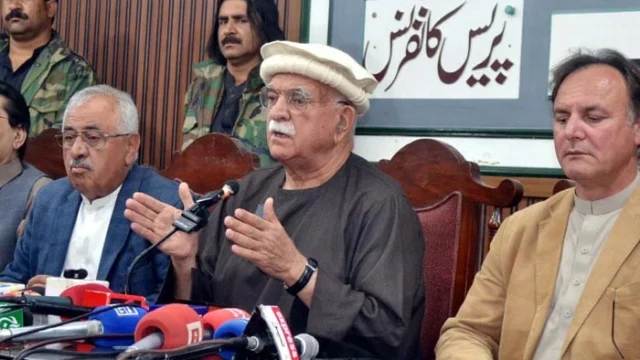
Mahmood Achakzai: We will not let Imran Khan be isolated; calls for national government

Ishaq Dar Congratulates SUPARCO as Pakistan Prepares Historic Space Milestone

Field Marshal Asim Munir Inducted into Malaysia’s Hall of Fame; Tariq Fazal Chaudhry Congratulates

Pakistan’s First Astronaut Leaves for Tiangong Space Station; PM Congratulates Nation

Imran Khan Seeks Live Streaming of Appeals in £190 Million Case