Mahmood Achakzai: We will not let Imran Khan be isolated; calls for national government
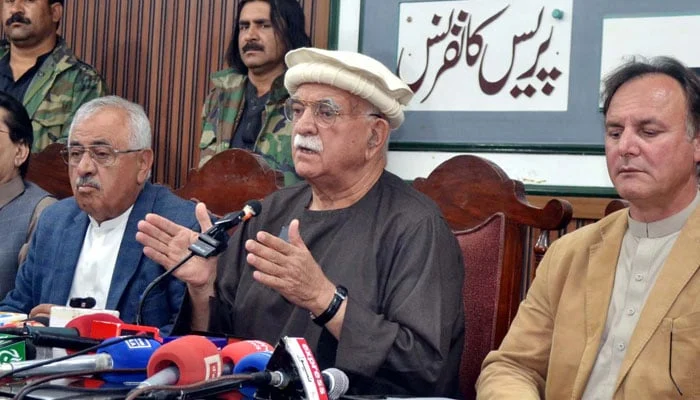
Quetta: Mahmood Khan Achakzai, chairman of the Pashtunkhwa Milli Awami Party and leader of the opposition in the National Assembly, has said that the country’s serious political, economic and law and order crises should be resolved by taking decisions on national affairs in consultation with the elected representatives of the people and the relevant political and democratic forces, rather than by a few individuals.
He described urgent constitutional and political reforms as indispensable for the supremacy of the constitution, the sovereignty of parliament and the restoration of democracy.
Addressing an All Parties Conference held at the Javed Iqbal Auditorium of the Lahore High Court Bar Association, he said that the city of Lahore and its bar association had played a historic role in the struggle for the constitution and democracy. When such institutions fail to discharge their constitutional and democratic responsibilities, he said, the consequences are borne by the whole of society and the state.
Law and order and the international situation
He expressed serious concern over the law and order situation in various parts of the country, saying that violence and bloodshed continue in Khyber Pakhtunkhwa and Balochistan, and that the situation is now deteriorating in Azad Jammu and Kashmir as well. According to him, around 20 civilians are being killed by gunfire every day.
In such circumstances, he said, the primary responsibility of state institutions and political leadership is to protect the lives and property of citizens and to establish peace in the country.
Warning about the international situation, he said that growing rivalry among the great powers and a struggle over mutual interests could once again push our region towards war and instability. Pakistan, he said, should learn from past experience and avoid becoming part of wars fought for the interests of other powers, because the consequences this time could be far more dangerous than before.
He said that the basic duty of the great armed forces of the world is to defend their countries, not to violate the constitution or seize political power. All state institutions, he said, should perform their functions within the limits set by the constitution.
Imran Khan and national resources
On Imran Khan, he said the people had given him a majority mandate, but that this mandate had been snatched away. According to him, there is a need to stay fully alert and attentive to Imran Khan’s political situation and health.
He said efforts are being made to split Imran Khan and isolate him, involving some external and some internal elements. He made clear that he and Allama Raja Nasir Abbas would not allow any attempt to isolate Imran Khan to succeed.
On the right of the people to national resources, he said the resources of the country belong to the people, not to a few individuals. Pointing to economic inequality, he said that on one side lakhs of rupees are spent on the breakfast of the wealthy class, while on the other the majority of the country is struggling for bread. He asked how long a system based on oppression, economic inequality and exploitation could continue.
He said that after the First World War the League of Nations had around 66 member states, whereas today the United Nations has 193 member states. According to him, new states have continued to emerge as a result of injustice, coercion and political change, so lasting stability requires justice, equality and respect for the rights of the people.
He criticised Pakistan’s rulers over the war against Iran and over the nomination of US President Donald Trump for the Nobel Peace Prize.
He urged all political parties and leaders to pledge that they will not engage in secret or open political collusion with the establishment in order to reach power. He said that if he himself or Allama Raja Nasir Abbas were found violating this pledge, the nation should not forgive them.
To lead the country out of the present crises, he proposed the formation of a national government that would bring together all key state institutions, political parties and relevant stakeholders at one table. Through this process, he said, the mistakes and injustices of the past should be remedied, comprehensive constitutional and political reforms introduced, and the army provided with a safe and constitutional path to separate itself from politics and power.
Finally, he strongly condemned the detention of Maulana Fazl-ur-Rehman in Lahore and the refusal to allow him to attend the All Parties Conference. He said that preventing political leaders from expressing their views and carrying out political activity is contrary to democratic principles. He once again invited Maulana Fazl-ur-Rehman to join other political forces in playing his part in the struggle to restore and uphold the constitution.
More from Pakistan
Federal Cabinet approves national policy to deregulate sugar sector

PM Shehbaz Assures Governor Kundi of Full Federal Support Against Terrorism

JUI-F moves Lahore High Court against alleged house detention of Fazl ur Rehman

PM Shehbaz Asks Ministers to Avoid Public Attacks on Each Other Over New Provinces
Latif Khosa Briefs PTI Core Committee on Founder Meeting and Instructions
Naqvi Urges Social Media Platforms to Act Against Banned BLA

Ishaq Dar Congratulates SUPARCO as Pakistan Prepares Historic Space Milestone

Field Marshal Asim Munir Inducted into Malaysia’s Hall of Fame; Tariq Fazal Chaudhry Congratulates

Pakistan’s First Astronaut Leaves for Tiangong Space Station; PM Congratulates Nation

Imran Khan Seeks Live Streaming of Appeals in £190 Million Case

Maulana Fazlur Rehman says mineral reserves belong to people; Sargodha rally will be held