
Fani Badayuni: the master of Urdu’s poetry of despair
Fani Badayuni made grief a philosophy in the Urdu ghazal. His life, style and best couplets are traced here, with brief explanations.
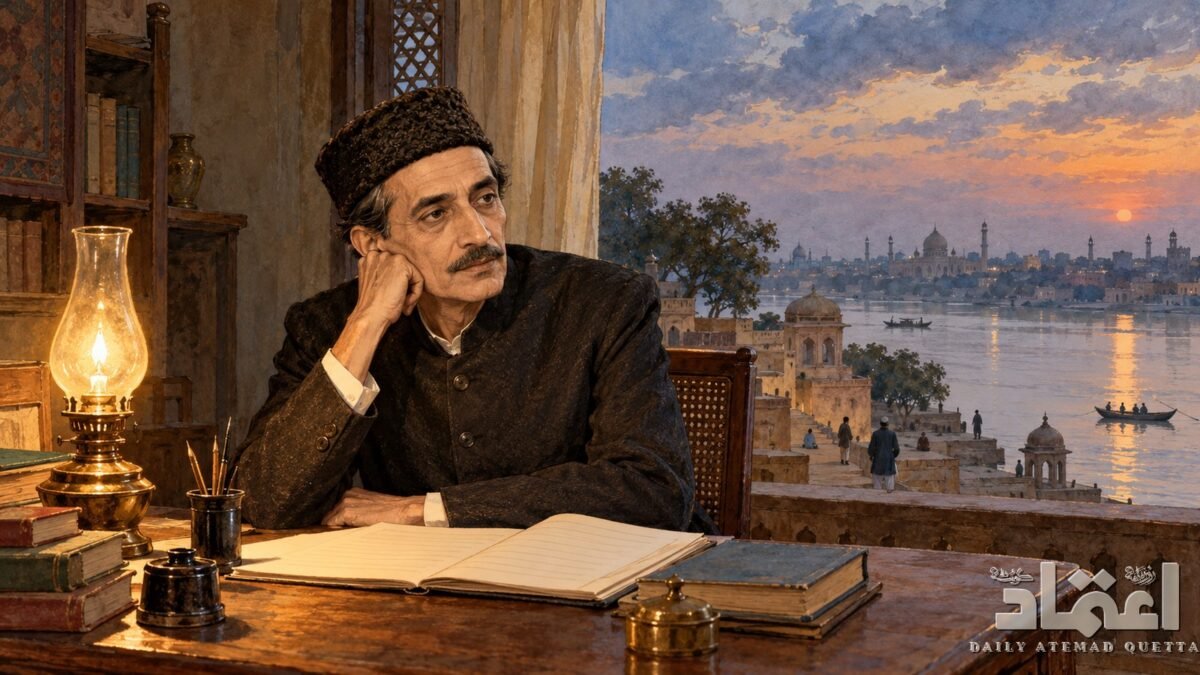
In the early twentieth century, the Urdu ghazal faced a charge. It was said to have grown old, its themes worn out, and the new age was said to need the nazm. At that time a few poets brought the ghazal back to life. Hasrat Mohani was one of them, and he has been covered earlier in this series. The other great name is Fani Badayuni, in whose ghazal grief is not merely a mood but a philosophy. Rekhta calls him the “imam of yasiyat” (the poetry of despair). His whole poetry is contained in this one couplet:
Every moment passed in upheavalWhat torment my life was spent in
Life and times
According to Rekhta, Fani’s name was Shaukat Ali Khan. He first wrote under the pen name Shaukat and later adopted Fani. He was of Afghan descent. His forefathers owned a large estate, which the British seized after the turmoil of 1857. His father, Shujaat Ali Khan, was a police station head in Islam Nagar, a town in Badaun. Fani was born there on 13 September 1879.
He began writing verse at the age of eleven, and his first diwan was ready by 1898. But his father was strongly opposed to poetry. When his son would not give it up, he burnt the diwan. For this reason, we do not know the character of Fani’s early poetry. In 1901 he took his BA from Bareilly College. The cousin to whom he had been betrothed in childhood was married elsewhere, and some time later she died. According to Rekhta, this was the first great shock of Fani’s life.
A restless life followed. He taught at a school and resigned. He became a sub-inspector of schools and left the job. Then he studied law at Aligarh. According to Rekhta, it was at Aligarh that Ghalib and Mir left a deep mark on his poetry, because Hali’s “Yadgar-e-Ghalib” was much talked of there and Hasrat Mohani was campaigning for a revival of the classical ghazal. He started practising law in Lucknow and was at first successful. But within a single year both his mother and his father died, he lost heart for the legal profession, and he fell into debt. He tried his luck in Lucknow, Badaun, Agra and other cities. Everywhere, poverty and failures in love stayed with him.
In the end he went to Hyderabad Deccan, where, according to Rekhta, Maharaja Kishen Pershad was an admirer of his. There he spent some of the best days of his life, and then the worst. He saw the death of his young daughter and then of his wife. He died in Hyderabad on 27 August 1941, in a state of great helplessness.
Style
Mir too is called a poet of grief. But Rekhta’s introduction describes the difference this way: Mir’s couplet touches the heart and still draws a “wah” from the listener, whereas when Fani recited a ghazal in his sorrowful voice, listeners sometimes forgot to applaud. Other poets speak of the beloved’s beauty and the pain of separation. Fani’s real beloved is his own grief.
But this grief is not mere lamentation. Fani’s poetry revolves around love, grief, Sufism and the secrets of the universe. Love gave him grief, grief led him to Sufism, and Sufism placed the great questions of life before him. He looks at death too with a new eye:
Somewhere the chain of life’s captivity breaks with deathBut only this much: the shackle changes
Where does the chain of life’s captivity break with death? All that happens is that one shackle is replaced by another.
This same compulsion is the central idea of his poetry:
Life is compulsion, and no sign of compulsion is seenAlas, this prison does not even need a chain
Selected verse
One story they heard, one they toldWhen I wept, they merely smiled
Fani, the people of taste have left the worldOnly I remain alive, to die
With every breath I am goingI am coming closer to you
Part of life was spent in the courage to askPart passed in hope of an answer
The night of solitude is unjustly ill-namedThat too is one face of your gathering
There is no prayer on my lipsThis favour has no limit
Break the boat of trust and seeGod exists too, not only the boatman
The heart seeks a home far from both worldsApart from this earth of yours, far from the sky
The sum of my search for you is thisYou are not found here, nor there
Someone called me here and hid himselfI am the guest who finds no host
In the land of life there is now a famine of kindness, FaniNo one is found kind except death
Notes on the couplets
“One story they heard, one they told…” They came, heard one story and told one, and when I burst into tears they only smiled. A shorter picture of the beloved’s indifference is hard to find.
“Fani, the people of taste have left the world…” All those with understanding and taste have departed the world. Only I remain, alive merely to die.
“With every breath I am going…” With every breath life grows shorter, and so I come closer to you at every moment. The “you” here may be the beloved, death or God.
“Part of life was spent in the courage to ask…” Half a lifetime went in gathering the courage to ask a question, and the rest passed in hope of an answer.
“The night of solitude is unjustly ill-named…” The night of solitude is needlessly given a bad name. It too is one face of your gathering, because even in solitude it is you who is remembered.
“There is no prayer on my lips…” There is no prayer left on my lips, and this too is your favour, which has no limit. That is, the fading of desire is itself a blessing.
“Break the boat of trust and see…” Break the boat of trust and see, and you will learn that the boatman is not everything and God exists too. It points away from worldly supports to the true support.
“The heart seeks a home far from both worlds…” The heart seeks a home far from both this world and the next, apart from this earth and from the sky too.
“The sum of my search for you is this…” The whole outcome of seeking you is only this: you are found neither here nor there. The search itself became the destination.
“Someone called me here and hid himself…” Someone has called me into this world and hidden himself. I am the guest who finds no host. This couplet, on human loneliness and the search for God, is among Fani’s finest.
“In the land of life there is now a famine of kindness, Fani…” In the city of life a famine of love has now set in. No one looks kind except death.
Influence and legacy
Fani gave the Urdu ghazal a tone that had not been heard before him. According to Rekhta’s introduction, he gave the ghazal new breadth in both content and style, and what he wrote on grief and related themes is a masterpiece of the Urdu ghazal. Hasrat, Fani, Asghar Gondvi and Jigar are regarded as the great names in the revival of the ghazal in the twentieth century. Among them, Fani’s voice is the most distinct and the saddest.
His life was one long tragedy, but from that tragedy came poetry that still keeps readers company in moments of solitude.
To readers: Which couplet of Fani came to your mind in a difficult time? Write and send it to us. Selected couplets will be published with your name on next Friday’s page.
Next Friday: Jigar Moradabadi, the king of mushairas, whose recitation in song-like tarannum took the ghazal to the common people.
Sources
- Rekhta, Fani Badayuni: profile. https://www.rekhta.org/poets/fani-badayuni/profile?lang=ur
- Rekhta, Fani’s ghazals (couplets in this instalment are from these pages): https://www.rekhta.org/ghazals/har-ghadii-inqalaab-men-guzrii-fani-badayuni-ghazals?lang=ur ; https://www.rekhta.org/ghazals/mar-ke-tuutaa-hai-kahiin-silsila-e-qaid-e-hayaat-fani-badayuni-ghazals?lang=ur ; https://www.rekhta.org/ghazals/zindagii-jabr-hai-aur-jabr-ke-aasaar-nahiin-fani-badayuni-ghazals?lang=ur ; https://www.rekhta.org/ghazals/ik-fasaana-sun-gae-ik-kah-gae-fani-badayuni-ghazals?lang=ur ; https://www.rekhta.org/ghazals/har-saans-ke-saath-jaa-rahaa-huun-fani-badayuni-ghazals?lang=ur ; https://www.rekhta.org/ghazals/naam-badnaam-hai-naahaq-shab-e-tanhaaii-kaa-fani-badayuni-ghazals?lang=ur ; https://www.rekhta.org/ghazals/mere-lab-par-koii-duaa-hii-nahiin-fani-badayuni-ghazals?lang=ur ; https://www.rekhta.org/ghazals/jii-dhuundhtaa-hai-ghar-koii-donon-jahaan-se-duur-fani-badayuni-ghazals?lang=ur ; https://www.rekhta.org/ghazals/khushii-se-ranj-kaa-badlaa-yahaan-nahiin-miltaa-fani-badayuni-ghazals?lang=ur
- Muhammad Sadiq, A History of Urdu Literature, 2nd edition, Oxford University Press, Delhi, 1984 (the twentieth-century ghazal: Hasrat, Fani, Asghar, Jigar).
- Ram Babu Saksena, A History of Urdu Literature, Ram Narain Lal, Allahabad, 1927 (notice of Fani among living poets).
 More from E-Magazine
More → Aamer Sohail: the aggressive left-handed opener
 Abd al-Malik ibn Marwan: Arabic offices, new coins and the octagonal domed shrine
 Abd al-Rahman I: the emir who founded Cordoba's Great Mosque
 Abdul Hafeez Kardar: Pakistan cricket's first captain
 Abdul Razzaq: the all-rounder who either blocked or hit
 Abel Tasman: the Dutch voyage that found Tasmania and New Zealand
 Afanasy Nikitin: the Russian merchant who travelled to India
 Ahmad ibn Majid: master navigator of the Indian Ocean