
1 November 1887: British Baluchistan becomes part of British India
On 1 November 1887, a resolution of the Government of India joined the assigned districts to British India as the chief commissionership of British Baluchistan.
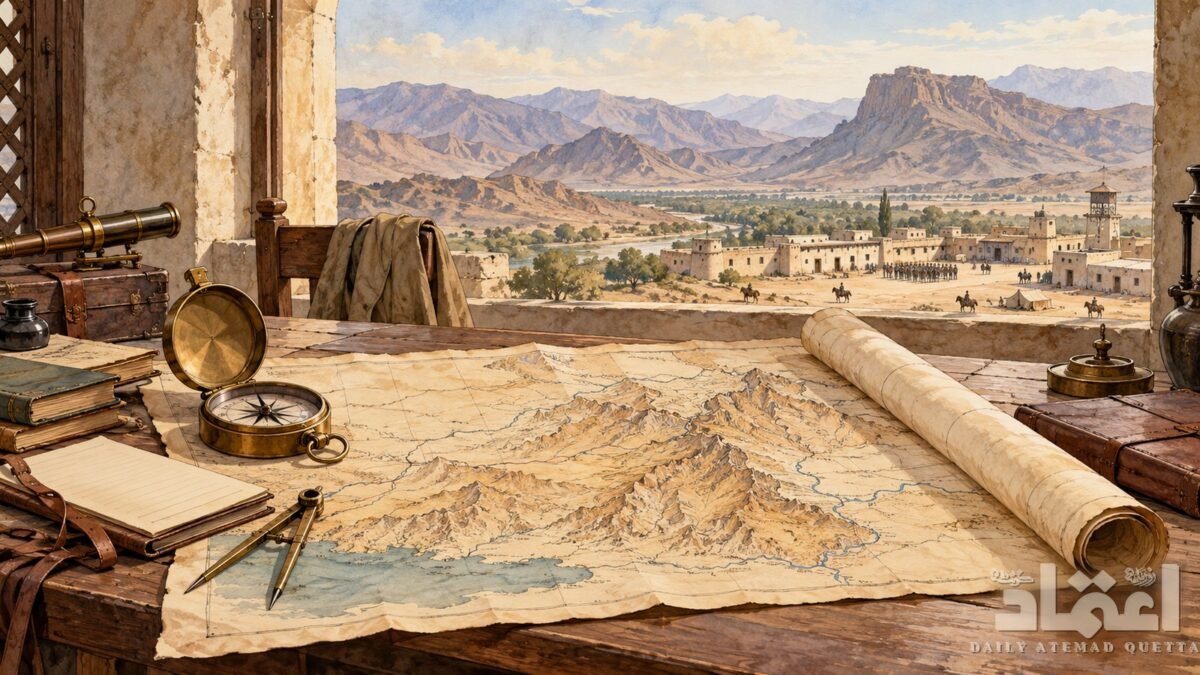
Pages from history: this account of a day before the launch of Roznama Atemad (October 1970) has been compiled from available historical sources.
Tuesday, 1 November 1887. Winter has set in at Quetta. In the Pishin valley to the north, the Harnai pass to the east and the warm Sibi plain below, life goes on as usual. But on this day a resolution of the Government of India changed the legal status of these areas. For eight years they had been called the "assigned districts", land taken from Afghanistan but not formally part of India. Now they were incorporated into British India and made a chief commissionership, named British Baluchistan.
From Gandamak to 1 November
The story begins with the Second Afghan War. According to the Quetta-Pishin District Gazetteer, the first phase of the war ended on 26 May 1879 with the Treaty of Gandamak. Amir Yakub Khan signed it and agreed to hand over the districts of Sibi, Pishin and Kurram to the British government. The Imperial Gazetteer says Pishin, Sibi, Harnai and Thal Chotiali were given on condition that the revenue left after administrative costs would go to the Amir.
The treaty did not last long. After the killing of the British Resident in Kabul and his escort, the war flared up again. Yakub Khan was deposed and the British were defeated at Maiwand in July 1880. According to Aitchison’s collection of treaties, after the war the new Amir, Abdur Rahman Khan, was told that these districts were no longer part of Afghanistan. The Sibi Gazetteer says the decision to keep them was taken at the strong urging of Robert Sandeman, although the final orders for permanent occupation were issued only in 1882.
Meanwhile, Quetta followed a separate course. According to the Quetta-Pishin Gazetteer, the Khan of Kalat gave the Quetta district to the British government on a perpetual lease from 1 April 1883, and it was combined with Pishin as a single administrative unit. The difference is worth remembering: Quetta was territory leased from Kalat, so even after the resolution of 1 November it remained "agency territory", while Pishin became part of British Baluchistan.
What happened that day
Sandeman’s biographer T. H. Thornton, who wrote his life in 1895 using his official papers, describes the year in three steps. In the spring of 1887 Sandeman went to England on short leave. On 19 June Baluchistan was made a first-class Residency. And on 1 November a chief commissionership named British Baluchistan was formed from Pishin, Shorarud, Kach, Kowas, Harnai, Sibi and Thal Chotiali. The Governor-General’s Agent in Baluchistan would also be Chief Commissioner by virtue of his office.
The Sibi District Gazetteer says the same of its own area. In November 1887 the Kach-Kowas and Harnai valleys, Sibi, Duki and Thal Chotiali were declared parts of British India, and the post of Political Agent for these areas was redesignated Deputy Commissioner. In the 1902 edition of the Encyclopaedia Britannica, Sir Thomas Holdich writes that under the resolution of 1 November 1887 the territory was incorporated into British India and divided into two districts, Quetta-Pishin and Thal Chotiali.
Thornton had some reservations about the name. He wrote that the districts were incorporated into British territory under the "somewhat inappropriate" name of "British Baluchistan". He did not give his reason. Aitchison, however, recalls that until 1878 these areas were part of the Amir of Afghanistan’s dominions, and the state of Kalat was left out of the resolution.
Sandeman himself was not in Quetta that day. According to Thornton, he returned from leave and took up work on 9 December 1887, now holding the rank of first-class Resident and serving as Chief Commissioner for British Baluchistan. The Imperial Gazetteer also lists the same three changes for 1887: the Agent’s rank was raised, the assigned districts were declared British territory, and the Agent was made their Chief Commissioner.
Two kinds of Baluchistan
After the resolution, the province had two legal categories. The Imperial Gazetteer (1908) describes the position at the start of the twentieth century. One part was British Baluchistan, which was regular British India. The other was the "agency territories". These included the Quetta tahsil, the Bolan Pass, Nushki and Nasirabad, which were leased from Kalat, as well as railway lands, Chagai, and the Zhob and Loralai agencies. According to the Gazetteer, British Baluchistan covered 9,476 square miles. The 1901 census report gives the area as 9,403 square miles.
The difference was not merely on paper. Thornton writes that regulations for British Baluchistan were made under an Act of the British Parliament. For areas such as Quetta, Bolan and Zhob, where the Agent ran the administration with the consent of the Khan of Kalat or the tribes, separate rules called "Laws" were made under another Act. According to the Quetta-Pishin Gazetteer, the Baluchistan Laws Law and Regulation and the rules for civil and criminal justice came into force in 1890, reflecting the same dual system.
The world at the time
- England: On the same day, 1 November 1887, the painter L. S. Lowry was born. He later became famous for his pictures of the industrial towns of northern England.
- Indochina: That year France joined Cochin China, Annam, Tonkin and Cambodia to form the "Indochinese Union", or French Indochina.
- Chicago: Ten days later, on 11 November, four of those convicted over the Haymarket affair were hanged.
What happened next
- 9 December 1887: Sandeman returned from leave and began work as the first Chief Commissioner of British Baluchistan.
- 1890: Baluchistan’s own laws and regulations came into force.
- 29 January 1892: Sir Robert Sandeman died at Bela in Lasbela.
- 12 November 1893: The Durand Agreement was signed in Kabul. It laid the basis of the border between British Baluchistan and Afghanistan. From 1894 to 1896 a joint commission marked the border on the ground.
- 1903: According to Aitchison, Duki and Thal Chotiali were joined with Bori, Barkhan and Musa Khel to form the new district of Loralai.
- 1 July 1970: The old chief commissioner’s province, the Union of States and Gwadar were joined to form the province of Balochistan.
Do you have old official documents from Sibi, Pishin or Harnai, a photograph from Sandeman’s time, or a family memory? Please send it to us. We will add it to this page with your name.
Sources
- T. H. Thornton, Colonel Sir Robert Sandeman: His Life and Work on Our Indian Frontier, John Murray, London, 1895: assigned districts incorporated with British territory "under the somewhat inappropriate designation, 'British Baluchistan'" (pp. 171–172); spring 1887 leave, 19 June 1887 First-class Residency, 1 November 1887 Chief Commissionership of British Baluchistan with the tracts named, AGG ex officio Chief Commissioner (p. 196); return on 9 December 1887 as Chief Commissioner (p. 199); "Resolution of November 1, 1887", two districts (p. 203); regulations under 33 Vic. cap. 3 for British Baluchistan and separate "Laws" for agency areas (pp. 205–206). https://archive.org/details/in.ernet.dli.2015.506312
- T. H. Holdich, "Baluchistan", Encyclopaedia Britannica, 10th ed., vol. 26 (1902), p. 132 (Wikisource transcription): incorporation "by the resolution of 1st November 1887", two districts, Quetta-Pishin and Tal Chotiali. https://en.wikisource.org/wiki/Page:1902_Encyclop%C3%A6dia_Britannica_-_Volume_26_-_AUS-CHI.pdf/132
- A. McConaghey (comp.), Baluchistan District Gazetteer Series, Vol. III: Sibi District, Bombay, 1907: Gandamak (May 1879), retention at Sandeman's instance, final orders 1882 (p. 30); "In November 1887" Kach-Kowas, Harnai, Sibi, Duki and Thal-Chotiali declared parts of British India, Political Agent redesignated Deputy Commissioner (p. 32). https://archive.org/details/sibidistricttext00mccouoft
- R. Hughes-Buller (comp.), Baluchistan District Gazetteer Series, Vol. V: Quetta-Pishin District, Bombay, 1907: Treaty of Gandamak 26 May 1879; final orders for retention of Pishin end-1882; Quetta made over in perpetuity from 1 April 1883 and combined with Pishin; Quetta in Agency Territories, Pishin with Shorarud and Chaman in British Baluchistan; 1890 Baluchistan Laws Law and Regulation. https://archive.org/details/in.ernet.dli.2015.46886
- Imperial Gazetteer of India, Provincial Series: Baluchistan, Superintendent of Government Printing, Calcutta, 1908: Gandamak cession of Pishin, Sibi, Harnai and Thal-Chotiali; 1887 changes (Resident first class, assigned districts British territory, AGG Chief Commissioner); British Baluchistan 9,476 sq miles and the Agency Territories; Sandeman "died at Bela in January, 1892" (his death on 29 January 1892 is from Thornton, source 1). https://archive.org/details/ImperialGazetteerOfIndiaBaluchistan
- C. U. Aitchison (comp.), A Collection of Treaties, Engagements and Sanads, vol. XI (Baluchistan section), Government of India, Calcutta (5th ed., 1933): the districts part of the Amir's dominions till 1878; Abdur Rahman informed they had ceased to be part of Afghanistan; "incorporated with British India in 1887" and "officially known as the Province of British Baluchistan"; Loralai district formed 1903. https://archive.org/details/acollectionoftreatiesengagementsandsanadsaitchisonc.u.vol11_83_O
- R. Hughes-Buller, Census of India, 1901, Vol. V: Baluchistan, Part I, Report, Bombay, 1902: British Baluchistan ceded by Gandamak and "formally declared to be part of British India in 1887"; area 9,403 sq miles. https://archive.org/details/in.ernet.dli.2015.55929
- World items: "L.S. Lowry", Encyclopaedia Britannica (born November 1, 1887, Manchester), https://www.britannica.com/biography/L-S-Lowry · "Haymarket Affair", Encyclopaedia Britannica (four of the convicted men hanged on November 11, 1887), https://www.britannica.com/event/Haymarket-Affair · "Vietnam: the conquest of Vietnam by France", Encyclopaedia Britannica (the Indochinese Union created in 1887), https://www.britannica.com/place/Vietnam/The-conquest-of-Vietnam-by-France . Pointer only: "1887", Wikipedia (gives 17 October for French Indochina and lists "British Empire takes over Balochistan" under 1 October, neither used). https://en.wikipedia.org/wiki/1887
 More from E-Magazine
More → Aamer Sohail: the aggressive left-handed opener
 Abd al-Malik ibn Marwan: Arabic offices, new coins and the octagonal domed shrine
 Abd al-Rahman I: the emir who founded Cordoba's Great Mosque
 Abdul Hafeez Kardar: Pakistan cricket's first captain
 Abdul Razzaq: the all-rounder who either blocked or hit
 Abel Tasman: the Dutch voyage that found Tasmania and New Zealand
 Afanasy Nikitin: the Russian merchant who travelled to India
 Ahmad ibn Majid: master navigator of the Indian Ocean