
PkMAP holds advisory jirga in Qila Saifullah, empowers Nawab Ayaz Jogezai on executive council
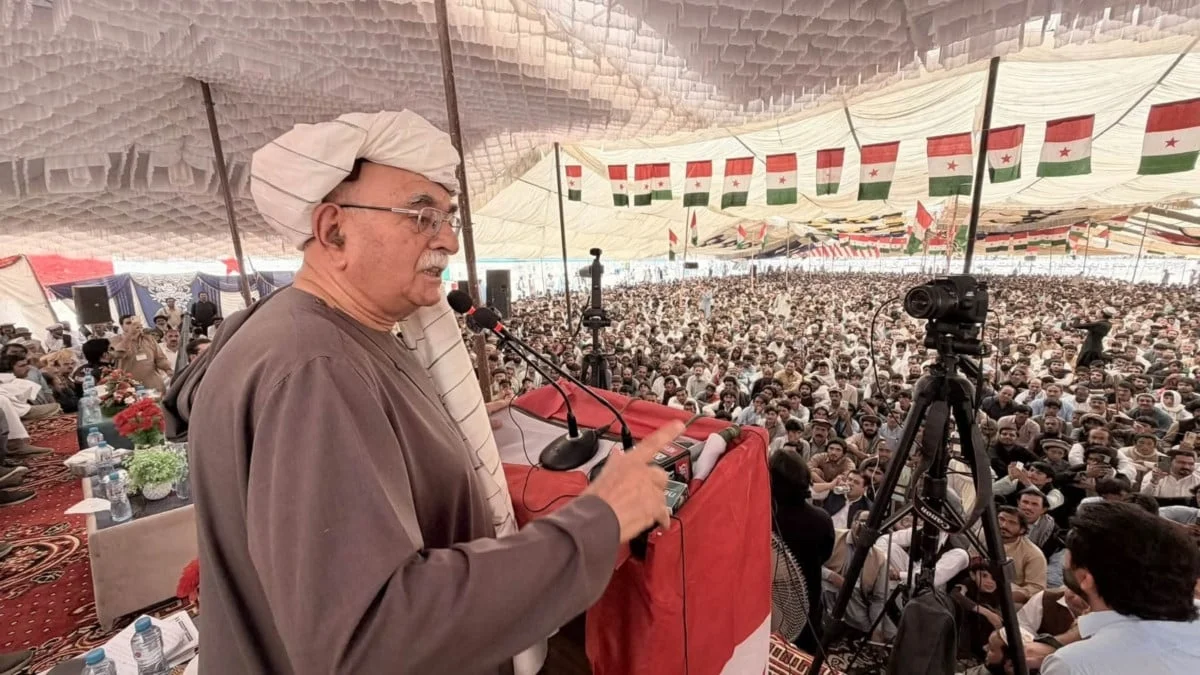
Consultative jirgas continue across all districts as a follow-up to the three-day Pashtun nation and people’s jirga in southern Pashtunkhwa, Quetta. As part of this series, a jirga for the Qila Saifullah district was held under the chairmanship of Nawab Muhammad Ayaz Khan Jogezai, central secretary of the Pashtunkhwa Milli Awami Party (PkMAP). The jirga elected a working jirga, which gave Nawab Ayaz Khan Jogezai full authority to appoint the district’s executive council.
Hundreds of Pashtun elders, tribal chiefs, maliks, religious scholars, and political and social workers attended. Besides Nawab Ayaz Khan Jogezai, central general secretary Abdul Rahim Ziaratwal, provincial general secretary Kabir Afghan and Qila Saifullah district secretary Haji Dara Khan Jogezai addressed the gathering. Central secretary Abdul Haq Abdal, district deputy chairman Manzoor Khan, deputy secretary Nimatullah Kakar and Waranga Luni were also present.
Speakers said that, after the government had trampled on the independence of the judiciary and the media, the jirga must play its role in settling disputes among the public in accordance with Pashtun traditions.
They said the law and order situation was deteriorating by the day. Speakers stressed that maintaining peace on highways, including Quetta-Karachi, Quetta-Sukkur, Quetta-Taftan, Quetta-Dera Ghazi Khan, Quetta-Dera Ismail Khan and other routes, was the government’s responsibility, and that the jirga would compel the government to restore order.
Speakers alleged that people did not have access to electricity, gas or clean drinking water, while petrol in Pakistan was among the most expensive in the world. They warned that the risks of water scarcity were growing and that the government could not absolve itself of its responsibilities.
They claimed that a conspiracy was being prepared to seize the mineral wealth of the Pashtun homeland through insecurity and violence. They further alleged that, under a plan, unrest and terrorism were being sustained through state proxies, that police stations in Pashtun districts had been handed over to these proxies, and that people were being forced to leave their homes amid a climate of fear.
Speakers said that in the country, thieves, robbers, bribe-takers and corrupt elements were described as the best Pakistanis, while those who speak of the public’s peace and rights were labelled traitors. According to them, education, health and treatment facilities were scarce in the province, there was no arrangement for water storage, the administration had been paralysed, and civilian authority had been abolished.
Speakers strongly condemned the incident in Tangi Mosazai, Qila Abdullah district. The jirga declared its full support for demands for the recovery of abducted Haider Kakar, the arrest of the killers of martyrs Hanifa Kakar and Wali Kakar alias Walo, an end to drugs, and the purging of Jangal Pir Alizai of criminal and anti-social elements.
Participants were told that any action plan adopted against insecurity, mismanagement, and the neglect of Pashtuns in every sphere of life would be implemented with each district’s jirga playing its part.
The session ended with thanks to participants, appreciation for the organisers, and a prayer.
More from Balochistan

Balochistan CM Meets World Bank Country Director, Agrees to Expand Development Cooperation

Free eye camp in Usta Muhammad treats 1,600 patients, performs 200 surgeries

Chaman Deputy Commissioner and DEO Greet Hindu Community at Diwali Ceremony

Turbat University’s Dr Dardana Rafique Defends PhD Thesis in Islamabad

Security Forces Praised for Foiling Suicide Car Bomb Attack in Mastung

Chaman AC Ida Judith Gill Inspects Markets, Checks Quality of Food Items

Chaman Deputy Commissioner Chairs Review Meeting on Anti-Polio Campaign Performance

QESCO Recruitment Interviews in Kech to Run 16 to 20 November at Turbat

Quetta: Food Authority Seals Bakery Unit, Fines Multiple Outlets Across Balochistan

Security Forces Praised for Foiling Suicide Car Bomb Attack in Mastung

Politics Is About Upholding Public Rights, Says Governor Jaffar Khan Mandokhail
