
Ghiyas ud-Din Balban: from deputy of the sultanate to sultan
For about 40 years in the 13th-century Delhi Sultanate, one man stood at the centre of power: first as deputy, then as sultan from 1266 to 1287.
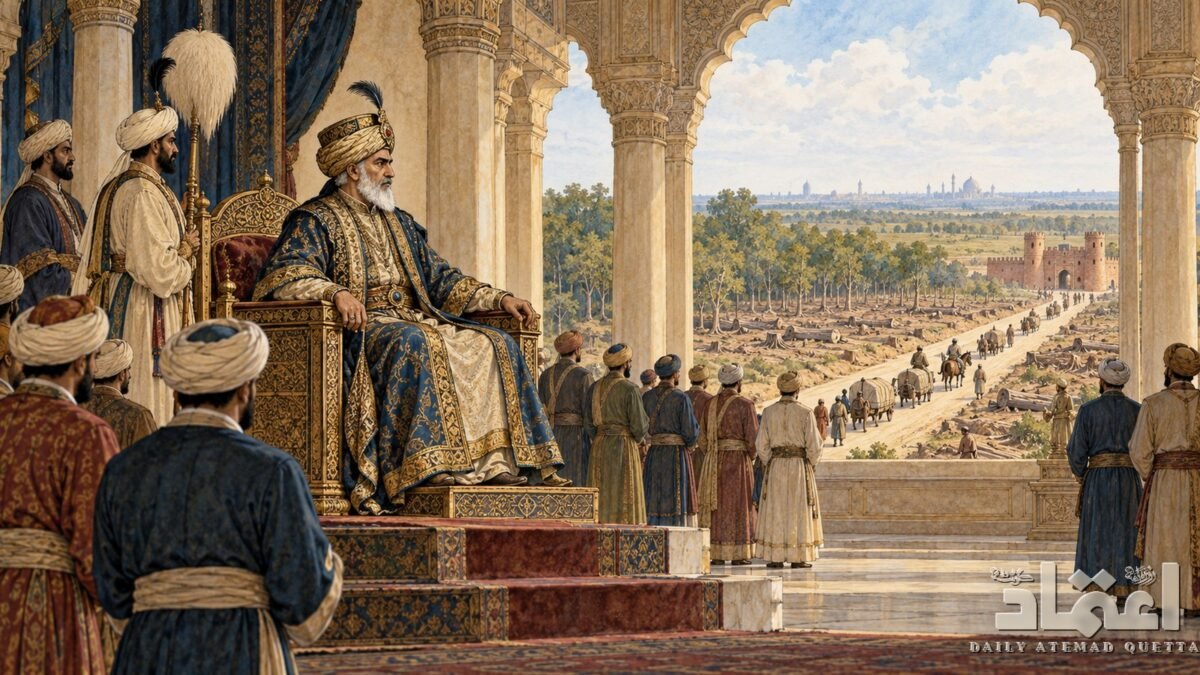
For about 40 years in the 13th-century Delhi Sultanate, one man remained at the centre of power: for the first 20 years as deputy to Sultan Nasir ud-Din Mahmud, and then, from 1266 to 1287, as sultan himself. He was Ghiyas ud-Din Balban (Ghiyas ud-Din Balban). According to Britannica, the Delhi Sultanate enjoyed nearly 40 years of stability during his time.
Early life
According to the British historian Stanley Lane-Poole, Balban was a Turk and came from the same region as Iltutmish. His family were tribal chiefs in Turkestan, and his father ruled a tribe of 10,000 tents. He was captured as a child and brought to India, where Sultan Iltutmish bought him. His early name is said to have been Baha ud-Din.
According to Lane-Poole, he was at first placed among the water-carriers (bhistis), but soon proved his ability, rose steadily and joined Iltutmish’s famous group of 40 slave nobles (the Chihilgani).
Rise to power
According to Lane-Poole, Balban was master of the royal hunt (Amir-i-Shikar) during the reign of Razia Sultana. He was later given the governorship of Hansi, where, in Lane-Poole’s words, he proved a reforming and just ruler. In 1243 he became Amir-i-Hajib (royal chamberlain). He was given the title “Ulugh Khan”, meaning “Great Khan”, for his efforts against Mongol attacks on the north-western frontier.
Twenty years as deputy
According to Britannica, by 1246 Balban, a relatively junior member of the “Forty”, had gained so much influence that administration under the new Sultan Nasir ud-Din Mahmud (1246-1266) passed into his hands, and he became the sultan’s deputy. According to Lane-Poole, Nasir ud-Din Mahmud was a gentle, scholarly man who lived very simply, while Balban ran the practical affairs of the sultanate.
According to Lane-Poole, in 1253 rivals at court had Balban removed from the court, but under pressure from the nobles he was recalled with full honours the following year, 1254. According to Lane-Poole, the two major tasks of this period were the organisation of the frontier provinces and tribes, which was entrusted to Balban’s cousin Sher Khan, and the suppression of internal revolts.
As sultan
Nasir ud-Din Mahmud died in 1266 and Balban became sultan himself. According to Lane-Poole, the style of government remained the same, but it now became harsher than before.
Safety of the roads
One of the notable achievements of Balban’s reign was making the roads safe. According to Lane-Poole, robbers at that time raided even the outskirts of Delhi, and not even the water-carriers of the city were safe. Balban had the forests around Delhi cleared, built forts in disturbed areas and stationed troops at posts along the roads. Woodcutters were sent to cut paths through the forests.
Lane-Poole quotes the historian of the period, Ziauddin Barani, as saying: “Sixty years have passed since then, but the roads are safe from robbers to this day.” Barani is the main source for this period.
Army and frontier
According to Lane-Poole, Balban’s greatest concern was the threat of Mongol invasions. He therefore gave his army a high standard of organisation and training, stayed close to the capital and avoided distant campaigns. According to Britannica, Delhi remained on the defensive against the Mongols throughout this period.
He also stopped the attempts of the great landholding nobles to make their estates hereditary. According to Lane-Poole, this reduced the old power of the Turkish nobles and strengthened the sultan’s authority.
Court etiquette
Balban laid great stress on the awe and dignity of the king. According to Lane-Poole, his court was splendid and strict about etiquette, and people came from far away to see its pomp. Even his personal servants never saw him without full official dress. He never laughed aloud at court and did not allow light conversation in his presence. It is generally said that he also introduced Persian-style court etiquette and the festival of Nowruz at court.
Learning and literature
One great name is linked with the literature of Balban’s time. According to Lane-Poole, the famous Persian poet Amir Khusrau was attached to the court under the patronage of Balban’s elder son, Prince Muhammad, whom Lane-Poole describes as a “cultured and refined” prince. Prince Muhammad was killed in 1285 in a battle with the Mongols near Dipalpur, and according to Lane-Poole the blow broke the old sultan.
Death
According to Lane-Poole, Balban died in 1287, after 40 years in power, half as minister and half as king. His date of death is generally given as 13 January 1287. His tomb is in the Mehrauli Archaeological Park in Delhi.
According to Lane-Poole, his second son, Bughra Khan, was governor of Bengal, and his descendants ruled Bengal for more than half a century, while Balban’s dynasty in Delhi did not last even three years after his death.
Legacy
Lane-Poole regards Balban as one of the most remarkable of the kings of Delhi: a water-carrying slave, master of the hunt, commander, minister and finally sultan. The safe roads, disciplined army and strong central government of his reign became the foundation for the Khalji sultans who followed.
Sources
- Stanley Lane-Poole, Mediaeval India under Mohammedan Rule (A.D. 712–1764), G. P. Putnam's Sons, New York, and T. Fisher Unwin, London, 1903 (The Story of the Nations), ch. IV. https://archive.org/details/cu31924024066668
- Encyclopaedia Britannica, "Ghiyāth al-Dīn Balban" and "India: the Delhi sultanate". https://www.britannica.com/biography/Ghiyath-al-Din-Balban
- Encyclopaedia Britannica, "India: The Khaljīs" (the succession after Balban). https://www.britannica.com/place/India/The-Khaljis
- Wikipedia, "Ghiyas ud din Balban" (pointer only: birth name, date of death, tomb at Mehrauli, Nowruz). https://en.wikipedia.org/wiki/Ghiyas_ud_din_Balban
 More from E-Magazine
More → Gianluigi Buffon: Italy's most capped goalkeeper
 Gordon Banks: the goalkeeper who saved Pele's header
 Gunpowder: how Chinese alchemists seeking medicine found "fire medicine"
 Gutenberg's printing press: lead type, oil-based ink and a wooden press
 Hasan al-Wazzan, Leo Africanus: the man who described Africa for Europe
 Hisham ibn Abd al-Malik: the caliph of Rusafa, desert palaces and an orderly treasury
 Ibn al-Haytham's Optics: how light, the eye and experiment explained sight
 Iker Casillas: Real Madrid and Spain's "San Iker" captain